What were the results of a thorough analysis of the aerodynamic characteristics of the 'Trionda,' the official ball of the FIFA World Cup 2026, by a Japanese research team?
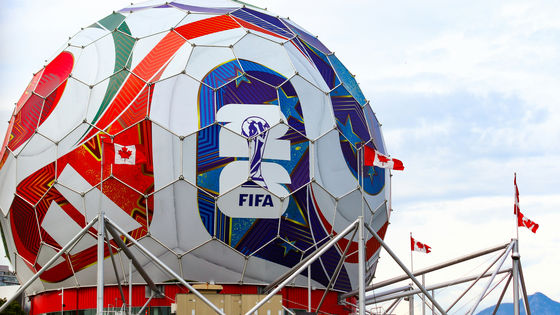
The FIFA World Cup, a quadrennial football spectacle, has several strict rules. The pitch size is strictly defined, offsides are indicated by flags, and referees must blow the whistle to signal the end of the match. However, the ball used in the matches changes from tournament to tournament, and for the FIFA World Cup 2026, Adidas' '
Trionda: Enhanced Surface Roughness Relative to Previous FIFA World Cup Match Balls
https://www.mdpi.com/2076-3417/16/6/2808
We tested the new World Cup ball – this is what you need to know about how it will fly, dip and swerve
https://theconversation.com/we-tested-the-new-world-cup-ball-this-is-what-you-need-to-know-about-how-it-will-fly-dip-and-swerve-280781
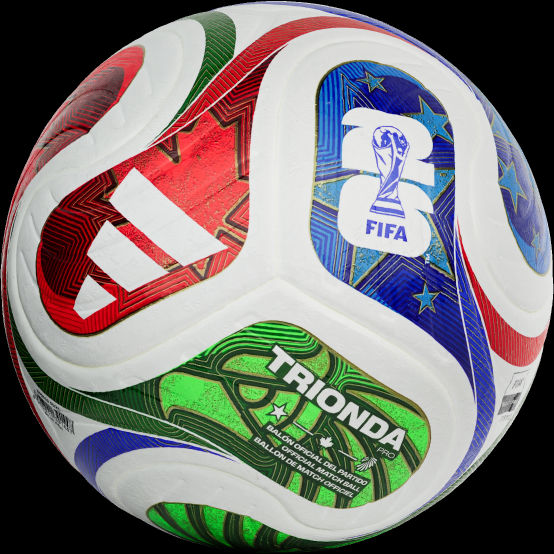
The Trionda is the official ball of the FIFA World Cup 2026, named after 'onda,' which means 'wave' in Spanish, and 'tri,' which means the number 3, signifying that it is the first tournament to be held in three countries: the United States, Canada, and Mexico.
The ball uses three colors: red, blue, and green, which represent the host countries Canada, the United States, and Mexico, respectively. In addition to the colors, each ball is also adorned with a motif representing a country: a maple leaf, a star, and an eagle.
The aerodynamic characteristics of the Trionda were investigated by John Eric Goff of the University of Puget Sound in Washington State, USA; Hong Seong-chan of the Department of Sports and Exercise Science at Seoul Women's University in South Korea; Liu Li-chung of the Graduate School of Human Sciences at the University of Tsukuba in Japan; and Takeshi Asai of the Graduate School of Sports Science at the Pacific University.
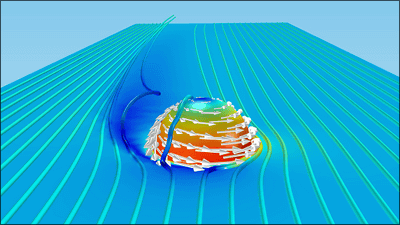
The research began with installing Trionda in a wind tunnel to measure drag, lateral force, lift, and other parameters. The following video shows the Trionda wind tunnel experiment. Using the various values measured in the experiment, the research team is conducting trajectory simulations to predict how the ball will move in an actual match. The research team is comparing Trionda to the ' Jabulani ,' the official ball of the 2010 FIFA World Cup, the ' Brazuca ,' the official ball of the 2014 FIFA World Cup, the ' Telstar 18 ,' the official ball of the 2018 FIFA World Cup, and the ' Al-Rifra ,' the official ball of the 2022 FIFA World Cup.
Trionda in Wind Tunnel - YouTube
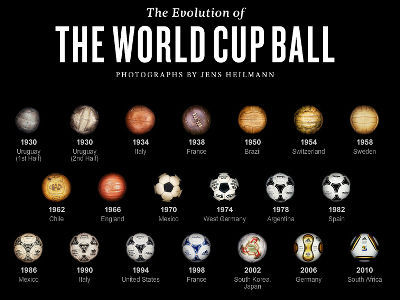
Goff points out that the official FIFA World Cup ball has evolved significantly over the decades. Two types of leather balls were used in the final of the 1930 FIFA World Cup, the first World Cup held in Uruguay in 1930. The official ball used in the first half was the 'Tiento' made in Argentina, and in the second half it was the 'T-Model' made in Uruguay. Both were multi-layered, hand-stitched balls that required air to be injected through an air bladder opening and then tied shut with a string. As a result, in humid conditions the leather would absorb moisture, making the ball heavier and harder to predict during play.
The Questra , the official ball of the 1994 FIFA World Cup held in the United States in 1994, has evolved into a ball based on foam material. Regarding this, Goff pointed out, 'The official ball is no longer simply a ball made of stitched leather, but has evolved into a ball with a surface designed based on aerodynamics.'
The Trionda is the first four-panel ball to be used as the official ball of the FIFA World Cup, and concerns have been raised that 'the ball might be too smooth because it has fewer panels.' The number of panels has a significant impact on gameplay, and in fact, the Jabulani, the official ball of the 2010 FIFA World Cup, was an eight-panel ball, which had fewer bumps and became a topic of discussion because it made it easier to produce knuckleball shots that were difficult to predict.
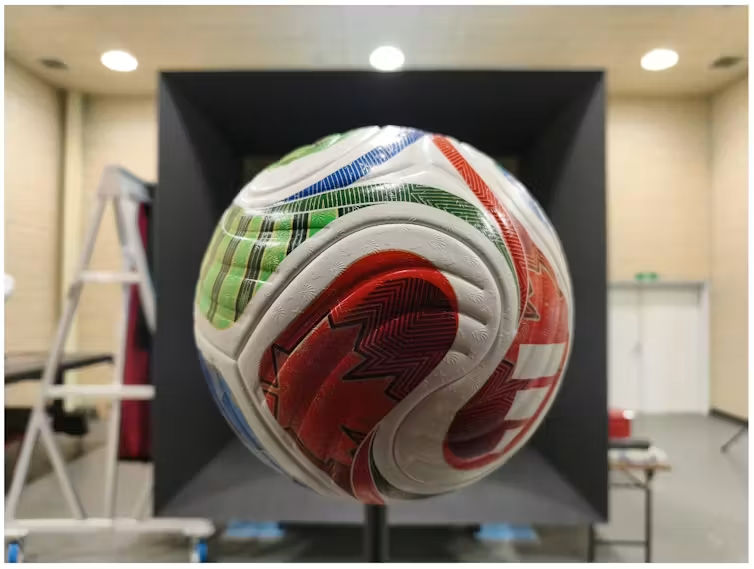
The Trionda's panels are joined together using heat and adhesive. Fewer panels mean shorter seams and a smoother ball surface, which is crucial because the thin air boundary layer that adheres to the ball determines the 'flow separation point,' 'size of the wake formed,' and 'the amount of drag the ball experiences.' However, the Trionda intentionally features deep seams, three prominent grooves on each panel, and a fine surface finish to prevent the surface from becoming too smooth.
In wind tunnel experiments conducted at the University of Tsukuba, the 'drag coefficient,' which represents the magnitude of air resistance experienced by each ball as it moves, was measured. This allows for a deeper understanding of the changes in surrounding airflow after a ball is kicked. Furthermore, researchers successfully identified the speed range (
The experiment revealed that the Trionda would experience a drag crisis at approximately 43 km/h. This is lower than the drag crisis of the comparison vessels, Brazuca, Telstar 18, and Al-Rifra (50-65 km/h), and, depending on the direction, is significantly lower than the drag crisis of the Jabulani (79-97 km/h).
The graph below shows the drag coefficients for official balls at different speeds across five tournaments.
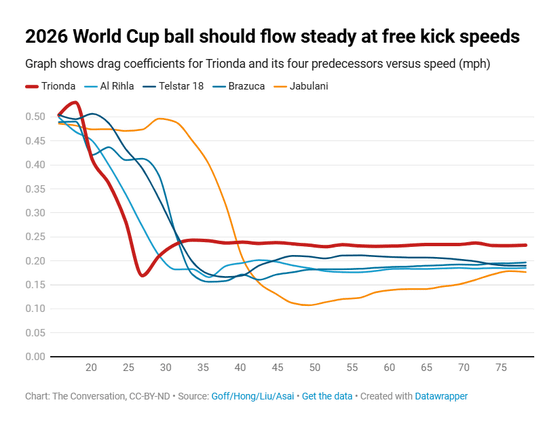
Even if a ball feels normal immediately after being kicked, its behavior can suddenly change dramatically during flight. One example of this is the Jabulani, a ball that, when kicked with almost no spin, would drop sharply after reaching a certain speed.
In contrast, the Trionda exhibits a more stable and consistent drag coefficient in the velocity range associated with corner kicks and free cooks. In other words, it's not a ball that flies in an unpredictable trajectory like the Jabulani.
However, while the Trionda's drag coefficient stabilizes at a certain speed, its value is slightly higher than that of the Brazuca, Telstar 18, and Al-Rifra. Goff explains that this suggests that the distance it can travel when kicked hard may be slightly shorter.
While the difference isn't that significant in simulations, Goff explained that 'players might notice that their long kicks land a few meters closer than they expect.'
Goff also explained that it's important to understand that this experiment tested only 'non-spinning balls.' In a typical soccer match, passes, clearances, and free kicks often involve some kind of spin. Goff also pointed out that factors such as temperature, humidity, and air pressure significantly affect the ball's trajectory.
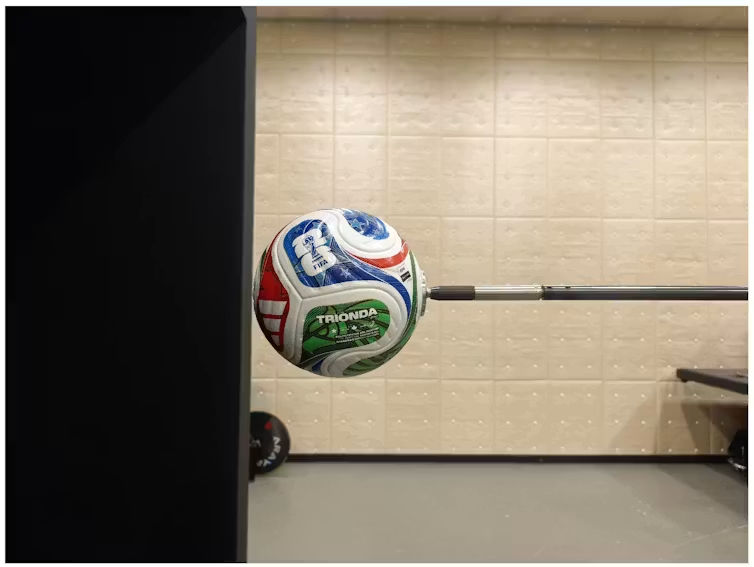
Furthermore, the Trionda's features go beyond its minimal panel count and surface treatment. The Trionda incorporates Connected Ball Technology to assist referees in their decisions. This allows the computer to recognize when the ball has been kicked, aiding in offside calls and other decisions.
In fact, Trionda's Connected Ball Technology played a crucial role in the fourth goal scored by Matthias Svanberg in the Sweden vs. Tunisia match at the 2026 FIFA World Cup, both teams being in Group F with Japan. At the time of the goal, Svanberg was in an offside position, but if Alexander Isak had touched the ball, he would no longer be offside. During the match, VAR was used to check whether Isak had touched the ball, but it was almost impossible to tell from the video. However, Connected Ball Technology confirmed that Isak had touched the ball, resulting in Svanberg's goal being allowed.
Do we now have 'snicko' in football?
— The Athletic | Football (@TheAthleticFC) June 15, 2026
Sweden beat Tunisia 5-1, but their fourth goal, scored by Mattias Svanberg, was initially ruled out for offside
Following a VAR review, the goal was given with Alexander Isak adjudged to have touched the ball on its way through to Svanberg.… pic.twitter.com/dElVkjr5BV
Related Posts: