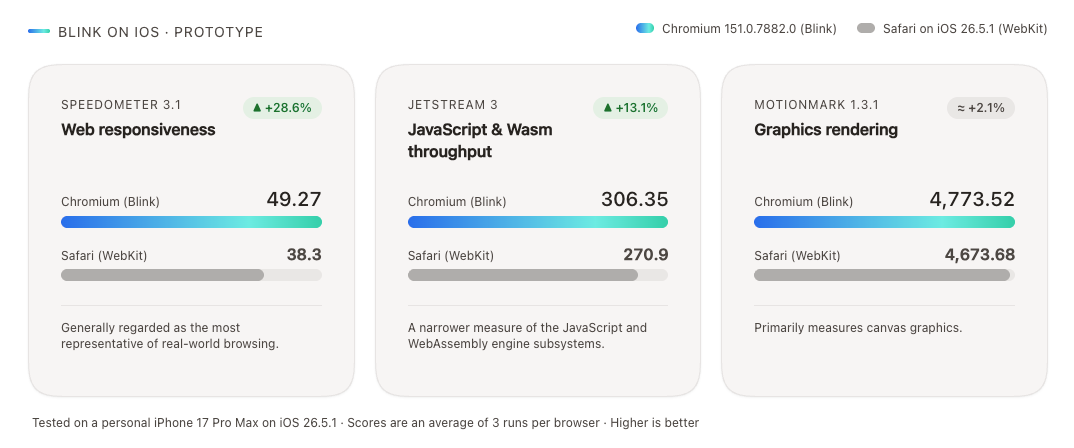
A Blink-powered prototype Chromium browser running on iOS delivers 30% better performance than Safari.
The Microsoft Edge Web Platform team has released benchmark results from running a prototype
Test Drive: Blink on iOS | LinkedIn
https://www.linkedin.com/pulse/test-drive-blink-ios-kyle-pflug-0nyxc/
Apple's WebKit performance tax leaves iOS browsers stuck in the slow lane, says Microsoft
https://www.theregister.com/software/2026/06/17/apples-webkit-performance-tax-leaves-ios-browsers-stuck-in-the-slow-lane-says-microsoft/5257384
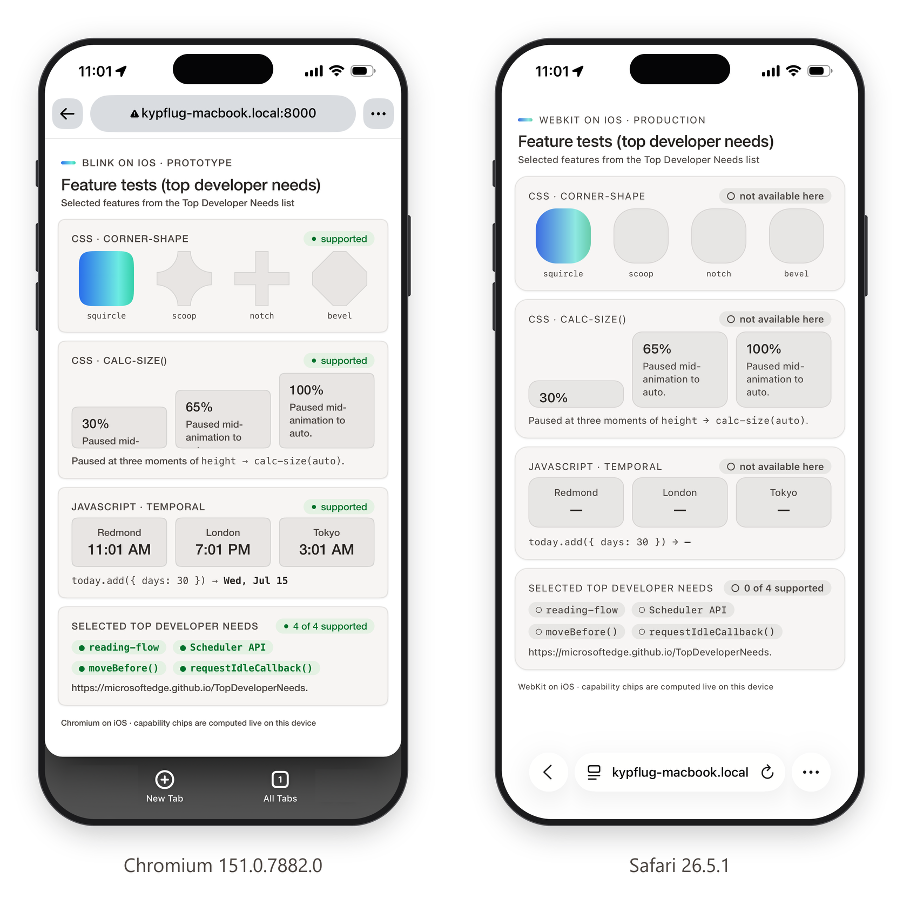
The results were published by Kyle Prueck, Group Product Manager for Microsoft Edge Web Platform. Prueck explained that he used Apple's BrowserEngineKit to create a research prototype that runs Blink, the open-source rendering engine used in Chromium, on iOS, and compared it to Safari on his own iPhone running iOS 26.5.1.
The biggest difference was observed in
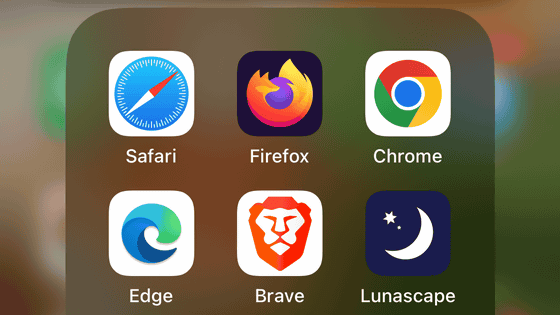
For many years, iOS browsers other than Safari have been required to use WebKit, and iPhone versions of Chrome and Firefox have also operated on a WebKit basis rather than using their own engines. Due to the EU's Digital Markets Act, Apple will be able to allow alternative browser engines through BrowserEngineKit starting in March 2024, but more than two years have passed and no major browsers with their own engines have emerged for iOS.
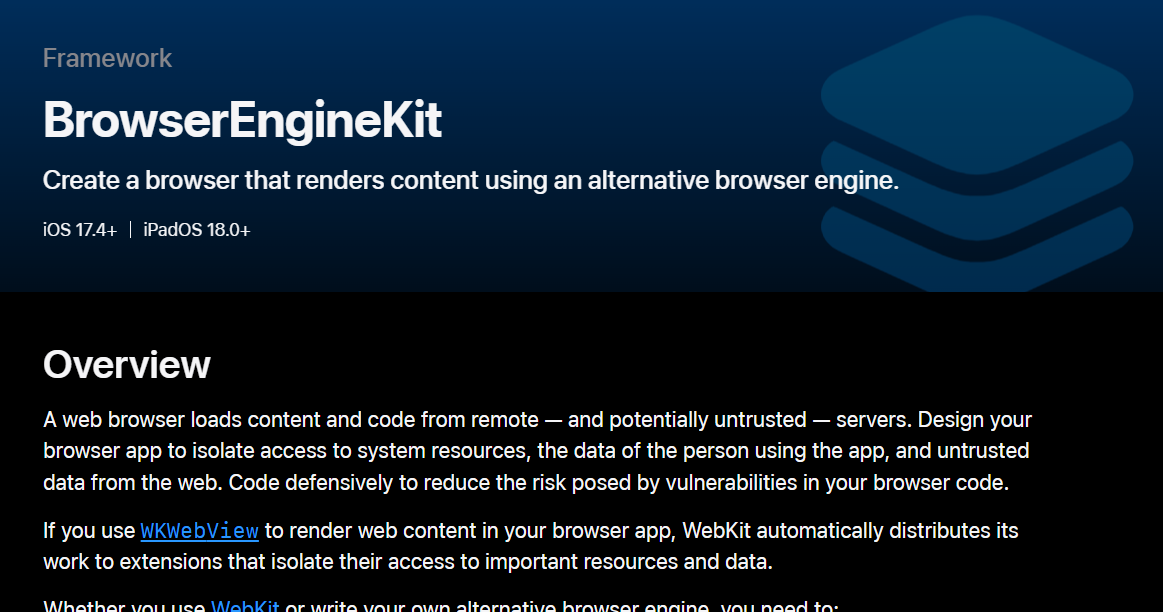
Similar to Microsoft's Blink-based prototype for Edge, Google and Mozilla have also prototyped Blink and Gecko-based browsers for iOS, but none have been released to the public. The reason for this is that Apple's BrowserEngineKit still has technical issues such as bugs, making the process of addressing them burdensome for browser development companies.
Furthermore, if Microsoft releases a Blink-based Edge for iOS, it will need to be offered as a separate app rather than replacing the existing WebKit-based Edge, meaning it will have to reclaim the user base it has already acquired for the iOS version of Edge.
On this point, Alex Moore, executive director of Open Web Advocacy, criticizes Apple, stating that 'Apple's 17-year de facto ban on competing browser engines has come at the expense of consumers and businesses worldwide.' Moore argues that despite calls from the EU and Japan to allow proprietary engines, Apple's established barriers continue to prevent browser vendors from porting their engines to iOS.
Moore further stated that the European Commission should initiate a process to specifically instruct Apple on which barriers to remove and how. Moore argued that if Apple can restrict the browser engine on iOS, it can limit the very capabilities that can be achieved on the mobile web, forcing businesses to remain dependent on native apps and App Store rules.
Related Posts:



in Software, Posted by log1i_yk