A research team from Japan and Spain has discovered a strange global pattern in the way people walk.
When you're strolling around a park or shopping mall without a specific destination, few people probably notice which direction they tend to walk. Experiments conducted by research teams in Japan and Spain have revealed that people worldwide tend to walk in a counter-clockwise direction.
Individual locomotor bias drives counterclockwise motion in pedestrian crowds | Nature Communications
When walking randomly, most people tend to turn counterclockwise—the reason for this is unknown, but this counterclockwise bias is observed even at the individual level.
https://www.tu-tokyo.ac.jp/press/pr2026-06-10-001
Counterclockwise bias | The University of Tokyo
https://www.u-tokyo.ac.jp/focus/en/press/z0508_00441.html
Scientists Discover a Strange Global Pattern in The Way Humans Walk : ScienceAlert
https://www.sciencealert.com/scientists-discover-a-strange-global-pattern-in-the-way-humans-walk
During the COVID-19 pandemic, public health organizations worldwide urged people to maintain social distancing as a means of preventing the spread of the virus. A distance of 2 meters between people is considered desirable to prevent viral transmission, and research was conducted in various countries on how to maintain social distancing.
Amidst this situation, a research team at the University of Navarra in Spain conducted an experiment in which multiple subjects were allowed to walk freely around a room while maintaining social distancing, in order to investigate 'how many people can be accommodated in one space before people can no longer maintain social distancing.'
Analysis of the captured data revealed that, on average, people walking around a room tend to rotate around a central point, and that this rotation is always counterclockwise. The research team at the University of Navarra contacted Japanese researchers to investigate whether this trend is due to cultural preferences.
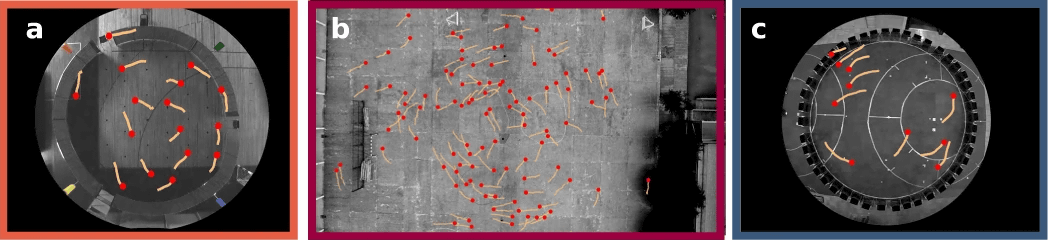
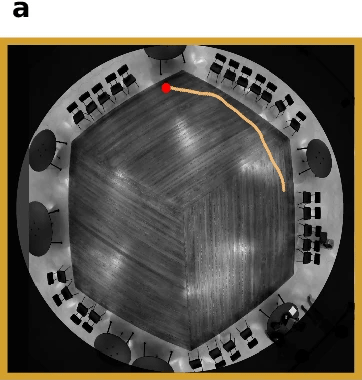
Claudio and his research team also conducted experiments in Japan to investigate people's walking patterns in various enclosed and open environments. The following a, b, and c are snapshots of various experimental scenarios, with the subject's latest position shown as a red dot and their walking trajectory over the past two seconds shown as an orange line. a is an experiment conducted in an enclosed environment in Spain, b is an experiment conducted in the playground of a middle school in Spain, and c is an experiment conducted in an enclosed environment in Japan. In all cases, it can be seen that people tend to walk counterclockwise rather than randomly.
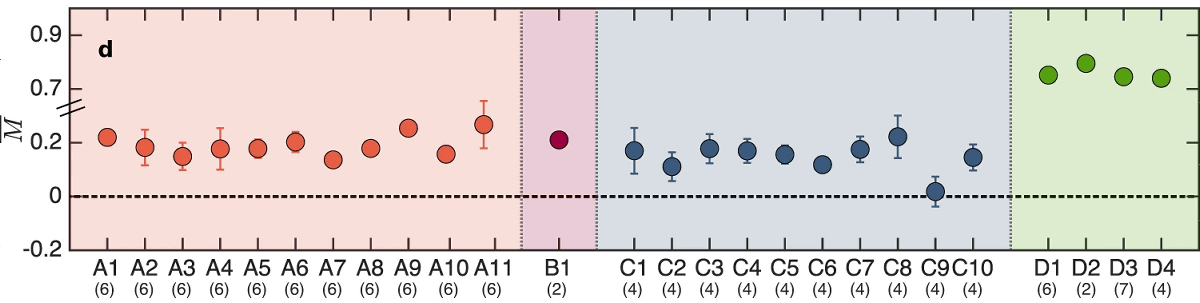
The following graph shows whether subjects tend to walk clockwise or counterclockwise. '0' indicates an equal balance of clockwise and counterclockwise walking, while values above '0' indicate a tendency to walk counterclockwise. a, b, and c correspond to the experiment described above, and d shows data from another experimental scenario. In all cases, it can be seen that subjects tend to walk counterclockwise.
Furthermore, in an experiment in which 209 subjects were instructed to walk freely alone in a space enclosed by chairs and tables, a tendency to walk counterclockwise was also observed, as shown below.
The research team also looked for trends by focusing on factors such as the subjects' dominant hand and foot, and gender, but found no changes due to these factors. Furthermore, there was no change in trends even when one of the subjects' eyes was covered, making it unlikely that the eyes were the cause. The only factor that influenced walking patterns was age, with younger people tending to walk counterclockwise, but it is important to note that the series of experiments did not include subjects in their mid-30s or older.
These research findings could potentially influence everything from building design to the planning of evacuation routes. In spaces where large numbers of people gather, such as airports, museums, train stations, shopping centers, and stadiums, even subtle biases in people's movement can have a significant impact on the overall situation. Therefore, utilizing these findings may allow for the design of more effective movement and evacuation routes.
Claudio stated, 'In nature, in most phenomena related to locomotion, there is no bias in the direction in which animals walk. The strong bias seen in humans suggests some kind of asymmetry at the biomechanical level. There are also interesting similarities with certain sports. Some running and driving competitions are always held on counter-clockwise courses for no explanation. But let's look into that another time.'
Related Posts:




in Free Member, Science, Posted by log1h_ik