The next update to Google Chrome will finally render popular ad blockers like uBlock Origin unusable.

Google is transitioning the Chrome extension framework from Manifest V2 to
Chrome update will soon disable adblockers for good | Cybernews
https://cybernews.com/security/chrome-update-disables-adblockers-manifest-v3/
Google Chrome update will fully close the door on ad blockers
https://9to5google.com/2026/06/15/google-chromes-next-update-will-mark-the-end-of-popular-ad-blockers/
While Manifest V3 can still block ads and trackers before they are displayed, the flexible judgment and modification for each communication using webRequestBlocking, which was used in Manifest V2, is limited, and it is now necessary to follow a rule-based system based on declarativeNetRequest. Advanced dynamic filtering that allows for fine-grained control based on context, such as 'which site is communicating with which site,' is no longer as flexible as it was in the Manifest V2 era.
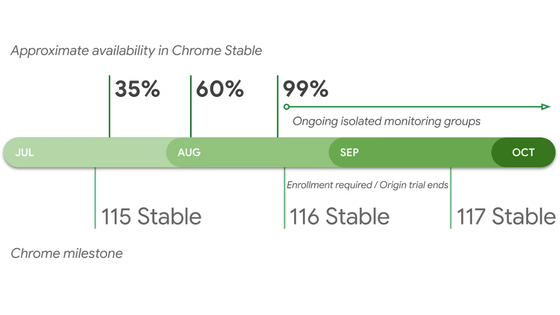
Google began gradually phasing out Manifest V2 around 2024, and disabled the Manifest V2 extension for all users on July 24, 2025.
Google begins phase-out of its extension specification 'Manifest V2' - GIGAZINE

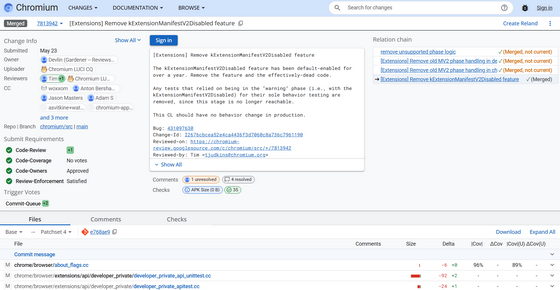
Furthermore, Chrome 150 is expected to remove the 'ExtensionManifestV2Disabled' flag. This flag remained as a de facto workaround for continuing to use Manifest V2-based ad blockers, but since Chrome no longer supports Manifest V2 extensions, it will be removed as unnecessary code.
While a limited method via DevTools will remain in Chrome 150 and later, it requires manually modifying page elements each time it's used, making it unsuitable for everyday use. Furthermore, Chrome 151 is expected to remove the remaining related flags such as 'ExtensionManifestV2Unsupported,' 'ExtensionManifestV2Availability,' and 'AllowLegacyMV2Extensions,' significantly narrowing the scope for continuing to use Manifest V2-based ad blockers in Chrome.
Google engineer Devlin Cronin explained in an issue regarding Chromium that 'maintaining Manifest V2 involves complexity, technical debt, and security risks.' In fact, 58 popular Chrome extensions have been found to contain malicious code after ownership changes, malware that installs backdoors, and secret tracking code.
On the other hand, ad blocking is not just a convenience feature, but also a security measure. The U.S. Cybersecurity and Infrastructure Security Agency (CISA) recommends using ad-blocking software (PDF file) as a means of reducing malicious ads and redirects to dangerous sites, improving page loading, and lowering the risk of data collection by third parties. However, CISA also warns of the dangers of ad blockers having too many privileges, stating that 'ad-blocking browser extensions operate with high privileges and can access all data traffic between the client and the network, allowing them to collect data and perform other potentially malicious activities.'
This transition is a measure to enhance Chrome's security, but it also narrows users' choices regarding ad display. For developers and users who want to avoid unwanted ads and content, migrating to Brave or Firefox is also an option.
Related Posts: