A landmark ruling has been issued, holding Google directly responsible for providing false information in its 'AI-generated summary' in Google Search results.
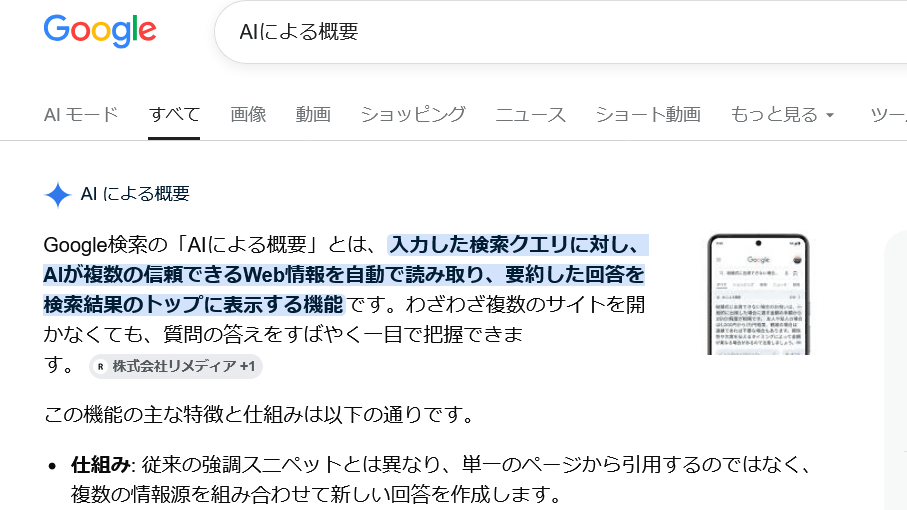
The 'AI-generated summary' displayed at the top of Google search results pages is highly convenient because it uses AI to summarize information, but its inaccuracy is sometimes a problem, as one study found it
Landmark German ruling declares Google's AI Overviews are Google's own words and makes it liable for false answers
https://the-decoder.com/landmark-german-ruling-declares-googles-ai-overviews-are-googles-own-words-and-makes-it-liable-for-false-answers/
Nobody needs AI to search the Internet, court says in ruling against Google - Ars Technica
https://arstechnica.com/tech-policy/2026/06/nobody-needs-ai-to-search-the-internet-court-says-in-ruling-against-google/
Two Munich-based publishers in Germany have sued Google in the Munich District Court, alleging that its AI-generated summaries for specific search queries falsely slandered the company, stating that 'the company is known for questionable business practices and is often considered a scam.' The publishers claim the AI confused the publishers with a fraudulent company, and they requested that the descriptions be removed from the AI summaries in early 2026, but the changes were not made.
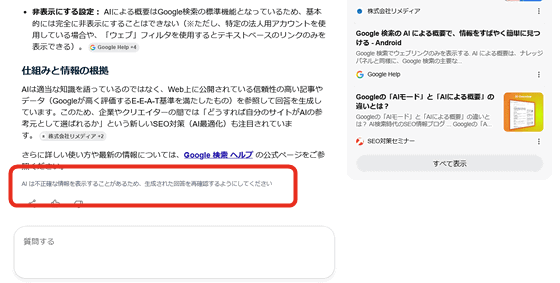
Google argued that it could not be held responsible for the AI-generated summary presenting false information, claiming that 'most users understand that AI output is not always accurate and needs to be verified.' Indeed, at the bottom of the AI-generated summary, there is a disclaimer stating, 'AI may display inaccurate information, so please double-check the generated answer.'
As a result of the trial, the court determined that the AI-generated summary was not merely a list of search results but 'Google's own content,' and that Google itself was the party responsible. The court pointed out that 'Google's AI-generated summaries function in a completely different way from conventional search results. The AI rewrites and judges search results 'based on its own language and structure.' In this case, the AI-generated summary included claims that were not even included in the search results, and constructed its own text, such as warning signs of potential fraud and advice for users, even though the linked sources contained no mention of any connection between the plaintiff and the suspicious company.'
In past rulings by the German Federal Supreme Court, it was argued that search engine operators were only liable as indirect infringers because they merely made third-party content searchable. The Munich District Court, however, ruled that this logic does not apply to AI-generated summaries, as AI-generated summaries combine content from multiple sites to create new descriptions, unlike regular search engines which only provide links. The court also pointed out that while traditional search results help users organize information, AI-generated summaries are merely an added feature and 'never absolutely necessary for using the internet.'
Google argued at the hearing that 'users can verify the accuracy of the AI-generated summary by checking the linked sources themselves.' The court rejected this argument, pointing to similarities with German press law, which holds publishers responsible for headlines and summaries that readers can understand on their own without reading the entire article. The court ruled that 'the AI-generated summary is 'self-understandable,' a self-contained statement containing independently understandable content, and does not refer to any other possible interpretations or unreliable content.'

The court also pointed out a lack of protection. If a page containing false information appears in traditional search results, the user can sue the third party operating that page to have the false content removed. However, AI-generated summaries can sometimes produce false information that appears to be based on sources that do not actually exist. If Google cannot be held responsible for this, victims will have no way to demand removal or correction from anyone, effectively losing their means of redress.
The court sided with the plaintiffs on most of the charges and issued a temporary injunction prohibiting the plaintiffs from spreading false claims against the publisher. Google will bear 80% of the litigation costs, with the two plaintiff companies each bearing 10%. While this lawsuit is specific to a particular case, it may be the first court to hold an AI company accountable for AI-related statements, and the court noted that 'this ruling could have international implications.'
A Google spokesperson told Ars Technica, 'We have made significant investments in the quality of our AI-generated summaries, striving to ensure that the vast majority of responses are accurate and designed to reflect the information available on the web. As the Munich District Court's decision is not yet final, we are carefully considering whether to appeal.'
Related Posts:






in AI, Web Service, Posted by log1e_dh