AMD has developed 'ORBIT-2,' a weather forecasting AI platform model, in collaboration with Oak Ridge National Laboratory.
AMD, in collaboration with
ORBIT-2 based Weather and Climate Downscaling and Downscaled Global Forecasts on AMD Instinct — ROCm Blogs
https://rocm.blogs.amd.com/artificial-intelligence/orbit2-inference/README.html
ORBIT-2: AMD and ORNL Advancing Earth System Intelligence at Exascale
https://www.amd.com/en/blogs/2025/earth-system-modeling-with-orbit-2.html
ORBIT-2 is an AI-based model designed to perform global ultra-high-resolution weather downscaling with an unprecedented 0.9km resolution. Developed by combining the Vision Transformer image recognition architecture with scalable algorithms, it is touted as a groundbreaking leap in Earth system modeling and high-performance computing.
ORBIT-2 is positioned as a model that shifts weather forecasting from a traditional simulation-based approach to an AI-based approach. It generalizes across regions and variables, providing physically consistent Earth system temperature and precipitation forecasts with ultra-high resolution of 0.9 km on a global scale.
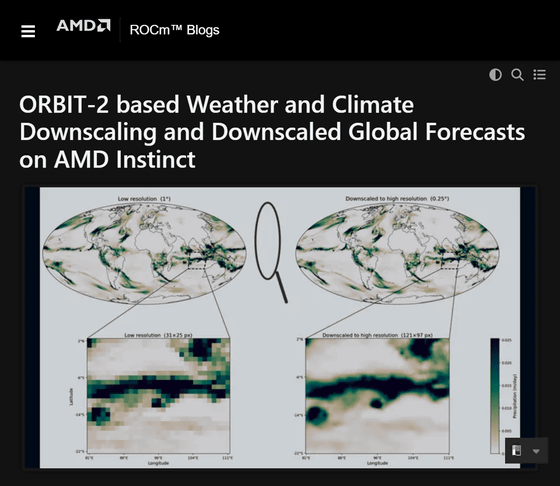
The image below shows the input image with a resolution of 28km on the right and the downscaled prediction with a resolution of 7km generated using ORBIT-2 on the left.

The following three points highlight the advantages of ORBIT-2:
Disaster countermeasures: Prediction of extreme weather events based on detailed spatial information.
Infrastructure Planning: Providing information for disaster-resilient design in areas prone to floods and heatwaves.
Situational awareness: High-precision, near real-time insights enable rapid response.
ORBIT-2's highly accurate predictive data can be deployed to edge devices, reducing inference time to milliseconds. This democratizes access to weather information, enabling researchers, policymakers, and industries worldwide to make informed decisions when faced with extreme weather events.
ORBIT-2 global precipitation downscaling animation (video courtesy of ORNL). - YouTube
As a groundbreaking achievement, ORBIT-2 has been shortlisted for the Gordon Bell Prize , the most prestigious award in the HPC community, and for Best Paper at Supercomputing 2025.
Widely recognized as the 'Nobel Prize of supercomputing,' the Gordon Bell Prize recognizes the most innovative and influential achievements in computational science, honoring breakthroughs that demonstrate outstanding performance, scalability, and scientific progress on the world's most powerful supercomputers. AMD claims that ORBIT-2's selection as a finalist for this prize highlights its role in shaping the future of exascale computing and AI-driven Earth system research.
Ralph Wittig, Corporate Fellow at AMD's Research & Development division, said, 'The ORBIT-2 project by AMD and Oak Ridge National Laboratory embodies the transformative potential of exascale AI to science. By combining AMD's cutting-edge GPU and CPU technologies with Oak Ridge National Laboratory's advanced scientific expertise, we have not only accelerated Earth system modeling but also redefined the possibilities of scientific discovery. Our partnership with AMD reflects AMD's commitment to pushing the boundaries of high-performance computing, addressing some of the world's most pressing challenges, and delivering scalable and energy-efficient AI solutions. ORBIT-2 is a significant milestone in our efforts to leverage AI for a better society.'
Related Posts: