Google has released information on its efforts to address water shortages at its data centers.

With the rapid proliferation of AI, power consumption and water usage in data centers have surged. Some
Google announces water stewardship commitments and initiatives
https://blog.google/company-news/outreach-and-initiatives/sustainability/new-water-stewardship-commitments/
AI has a water problem — Google thinks it has a fix | The Verge
https://www.theverge.com/policy/942296/google-water-commitments-data-centers
In a sustainability blog post published on June 2, 2026, Google stated, 'Water is an essential element in the development and operation of data centers. Because data centers generate heat from servers and chips that power the digital world, water is often used to reduce energy consumption for cooling. In many places, water cooling can reduce data center energy consumption by about 10% compared to air cooling. Overall water consumption in data centers is small; according to our 2024 Energy Use Report (PDF file) , the amount of water used by data centers in the United States is less than 1% of the amount of water Americans use to water their lawns in a year. However, we are committed to protecting local water resources in every aspect of our data center operations.' The company emphasized the importance of water in data centers and the protection of water resources.
Furthermore, Google has announced five initiatives for the 'responsible management' of water resources in the areas where its data centers are built and operated.
1: Supply more water than is consumed within the facility.
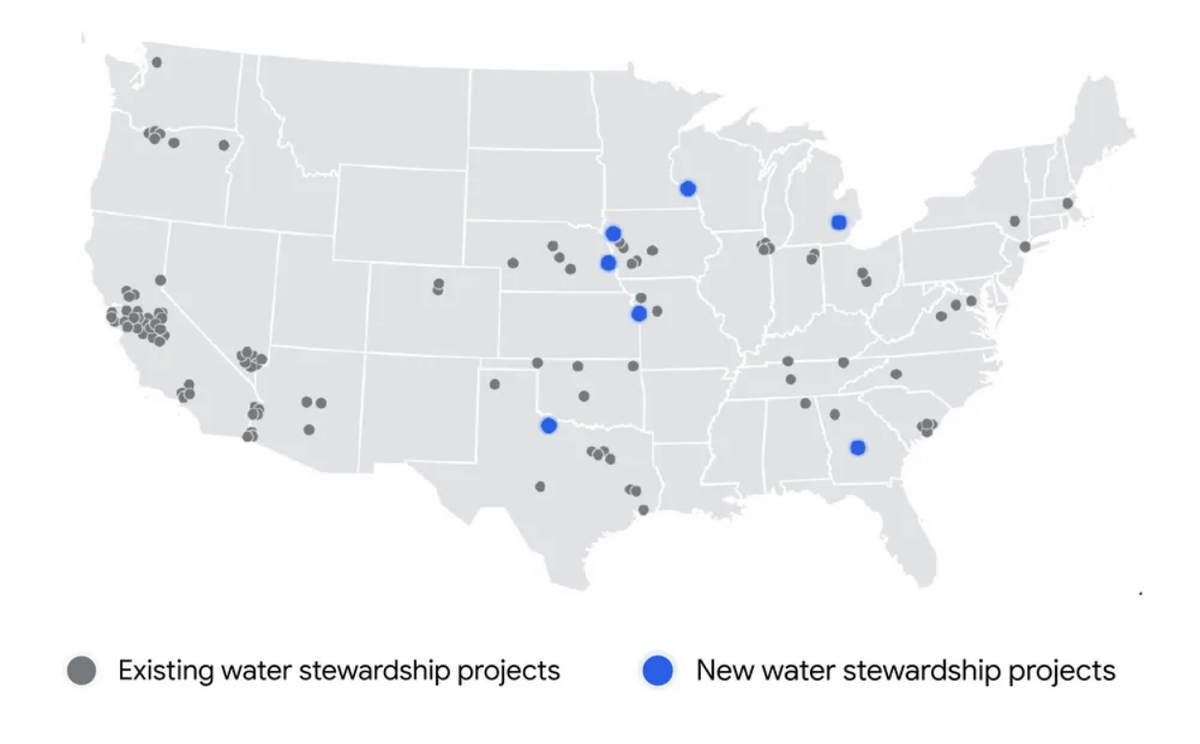
As of June 2026, Google has implemented 165 water resource management projects in 97 watersheds, and in 2025, it returned more than 30 billion liters of water, equivalent to the annual water usage of an average 70,000 households. By 2030, it is expected to supply more than 86 billion liters of water annually, which is more than double the annual consumption of Google's data centers. Furthermore, the water resource management projects are said to be helping to improve not only the quantity of water but also health issues throughout the watershed, such as water quality. In conjunction with this announcement, seven new state-level water resource management projects were announced: Georgia, Iowa, Michigan, Minnesota, Missouri, Nebraska, and Texas. On the map below, gray dots indicate existing projects, and blue dots indicate new projects.
2: Support the modernization of water and sewage infrastructure for local residents.
Google is working with water utility partners to help modernize public water infrastructure, which is often underfunded, so that local residents can have reliable and affordable water sources for the future. To date, Google has not only paid for the water it uses, but has also spent more than $500 million on developing water and wastewater and water reuse infrastructure in areas where it operates and builds data centers, and supporting water utility partners that supply water. Google says, 'We will continue to support local water utilities so that they can upgrade their infrastructure.'
3: Protect high-risk watersheds through preliminary surveys.
Water has a thermal conductivity approximately 4,000 times that of air, making water-cooled systems more energy-efficient than air-cooled systems. However, Google emphasizes that it doesn't always prioritize water-cooled systems. Instead, it uses a data-driven framework to evaluate the watershed in the area where a new data center is to be built, and only considers water cooling if the local water resources are healthy and resilient. In areas with high water resource loads, air cooling or recycled water is chosen.
4. Disclose annual water usage figures with transparency.
Google has stated that 'water usage should not be a black box,' and positions itself as 'the first major cloud provider to disclose its annual water usage.' The company will continue its efforts to make its annual water usage transparent to ensure transparency for the communities in which it invests and builds.
5. Actively promote the use of alternative water sources and recycled water.
To secure water resources, we are actively exploring the use of recycled water in cooperation with water utilities. As a practical example, in Douglas County, Georgia, Google has partnered with the county's water and sewage department to reuse treated wastewater as cooling water for its data centers.
Ben Townsend, Google's global head of infrastructure and sustainability, told The Verge in an interview, 'We are just one of dozens of players in this field. But we think it is very important to set guidelines that local communities can look to. So that if someone else says, 'I want to build a data center there,' the community can ask, 'There are five points to consider when putting the community and the watershed first. How many of these are you doing? If not, why not?''
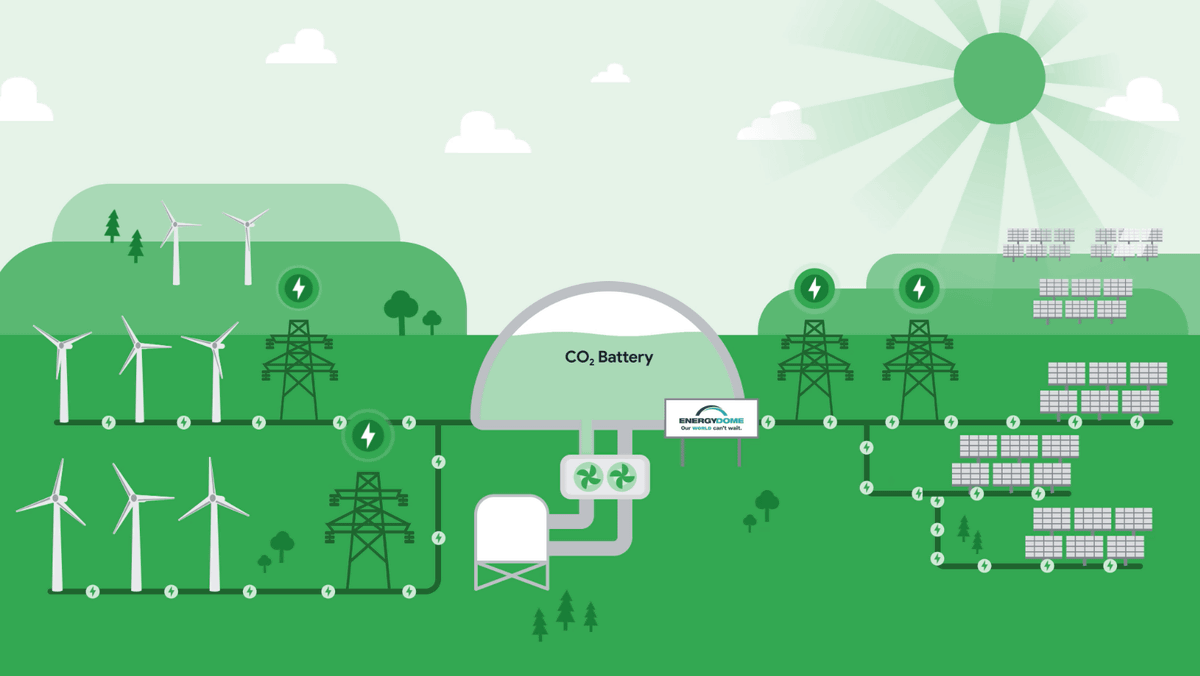
Google has been undertaking various initiatives to address energy consumption associated with the construction and operation of its data centers. In October 2024,

Furthermore, Google has
In other initiatives, Google, in a paper titled “Driving a New Era of Innovation in America,” highlighted the growing demand for specialized skills to build electrical infrastructure and announced its support for training new specialists. Funded by Google.org, the Electrical Workers Training Alliance (etA), established by the International Electrical Workers Union and the American Electrical Contractors Association, aims to increase the supply of electrical engineers by 70% in five years through a curriculum that incorporates AI tools.
Related Posts:


in Note, Posted by log1e_dh