A study suggests that shift work, such as night shifts, is associated with a decrease in brain volume.

Shift work, including night and early morning shifts, is a type of work that easily leads to sleep disturbances and fatigue. To investigate how shift work affects the brain, a research team led by neuroscientist Thomas Welton of Duke University of Singapore analyzed MRI data from over 14,000 people.
Shift work is associated with selective brain volume loss: a longitudinal study - ScienceDirect
https://www.sciencedirect.com/science/article/pii/S1053811925006226
Thousands of Brain Scans Reveal A Worrying Consequence of Night Shifts : Science Alert
https://www.sciencealert.com/thousands-of-brain-scans-reveal-a-worrying-consequence-of-night-shifts

Many people work outside of normal hours, such as nurses, doctors, and emergency responders who work around the clock. Shift work has been reported to be associated with sleep disturbances, cognitive decline, metabolic disorders, and an increased risk of neurodegenerative diseases, but its relationship to brain structure was not well understood.
Therefore, Welton and his research team used data from the UK Biobank, a large-scale biometric database in the UK, to analyze 14,198 adult workers without serious health problems. Of those analyzed, 12,076 were not on shift work and 2,122 were on shift work, with a median age of 47 years. The research team used self-reported data on participants' health, sleep, cognition, and employment, along with brain MRI, to compare 153 items related to brain structure, such as brain volume and nerve fiber condition.
The analysis revealed that shift workers tended to have smaller volumes of the right thalamus and left amygdala. The thalamus is a region of the brain that relays information and is involved in regulating sleep and wakefulness as well as memory recall. The amygdala is the region that regulates emotional responses such as fear and anxiety.
The research team suggests that the selective reduction in volume of the thalamus and amygdala observed in healthy shift workers may be an early sign that parts of the brain are becoming more susceptible to the effects of a disrupted circadian rhythm. These areas are involved in regulating sleep and wakefulness, emotions, and attention, and are also related to fatigue and mood disturbances associated with shift work. In the image below, the areas showing volume reduction are indicated in yellow, with darker yellow areas indicating a stronger tendency for smaller volume in shift workers.
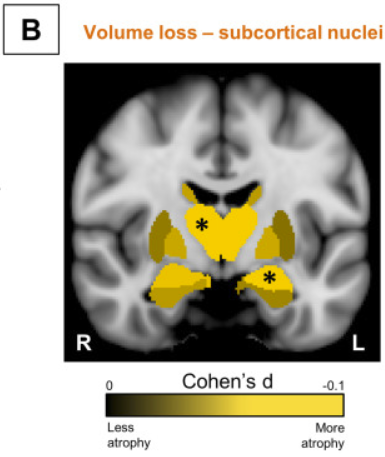
However, the science media outlet Science Alert points out that 'a decrease in volume in a part of the brain does not necessarily mean that the part is dead,' explaining that the brain is a flexible organ that rearranges neural circuits according to the situation, and that some kind of compensation may be occurring in the brains of shift workers to work through the night. Similarly, the research team states that 'people who do not experience brain changes may not be able to tolerate shift work and, as a result, may be gravitating towards non-shift jobs.'
Furthermore, the research team reported that their analysis of individuals who stopped shift work showed that the brain volume decline associated with shift work stopped within 2.4 years. Welton et al. stated that these results 'indicate that changes in brain structure associated with shift work are not fixed and can be prevented or reversed,' explaining that monitoring, counseling, and adjustments to work schedules can be considered to mitigate the brain volume decline among shift workers.
Related Posts:








in Science, Posted by log1b_ok