99% of executives believe that 'AI-related job cuts' will occur within the next two years.

Introduction - Mercer | Global Talent Trends 2026
https://info.marsh.com/global-talent-trends/2026/
Vast majority of executives expect AI layoffs soon, survey says | Mashable
https://mashable.com/tech/ai-layoffs-ceo-survey
Mercer's 'Global Talent Trends 2026' is a report based on a survey of approximately 12,000 executives, HR managers, investors, and employees.
This report offers a variety of insights.
For example, the report states that 'management and HR have differing perceptions of what will lead to improved performance in an era where humans and machines coexist.' The survey revealed that HR departments prioritize 'strengthening employee value propositions (EVPs) to attract top talent,' 'designing skills-centered talent development processes,' and 'implementing new HR technologies or optimizing existing platforms,' while executives prioritize strategies such as 'redesigning operations with AI and automation,' 'improving talent analytics capabilities,' and 'enhancing managers' ability to lead an integrated workforce (human and AI agents)' in order to improve return on investment.
Furthermore, 63% of executives believe that redesigning operations to incorporate AI and automation is the most effective talent development initiative. In contrast, only 32% of general employees believe that they can optimally combine human and machine capabilities.
Furthermore, 54% of executives cited talent shortages as the biggest factor influencing HR planning. 59% of HR leaders said that the difficulty in securing talent with critical digital skills will be the biggest talent challenge companies will face in 2026.

Furthermore, 99% of executives anticipate some degree of workforce reduction, including AI-related cuts, within the next two years. Additionally, 98% of executives stated they are planning organizational restructuring within the next two years. It also appears that executives place far more emphasis on 'how to integrate AI and automation into the organization' than regular employees.
In addition, it has become clear that declining employee happiness threatens productivity, and that many employees consider leaving the organization if they feel they have unequal access to AI tools and training.
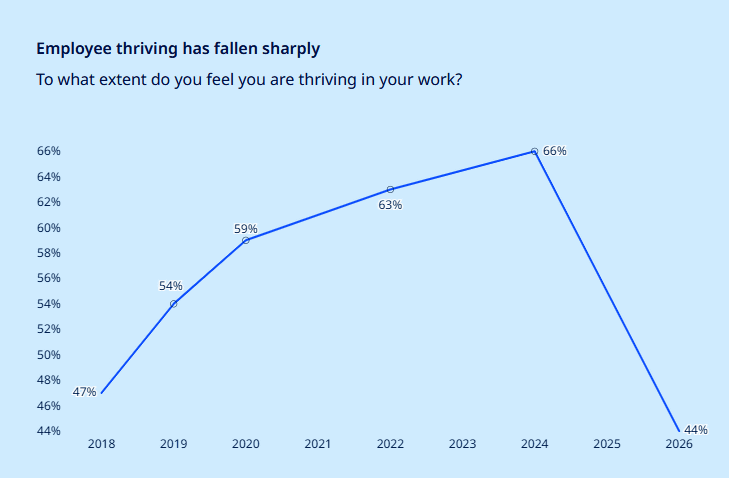
The following are the results of a survey on job satisfaction, which also reported a sharp decline in happiness levels by 2026. The 44% happiness figure for 2026 is the lowest score since this question began being asked in 2018.
Furthermore, few companies reported having integrated strategic HR functions within their organizations, and the majority of respondents expect HR and IT departments to merge in the near future. In fact, 56% of HR leaders anticipate this merger.
Furthermore, 57% of executives anticipate a turbulent decade ahead. New risks, such as misinformation and escalating geopolitical conflicts, are adding complexity to an already fragile and unstable environment. In this context, balancing long-term strategic planning with responding to short-term operational needs is crucial. In other words, business operations and transformation must proceed simultaneously. However, 81% of executives admitted that their leaders are struggling with this.
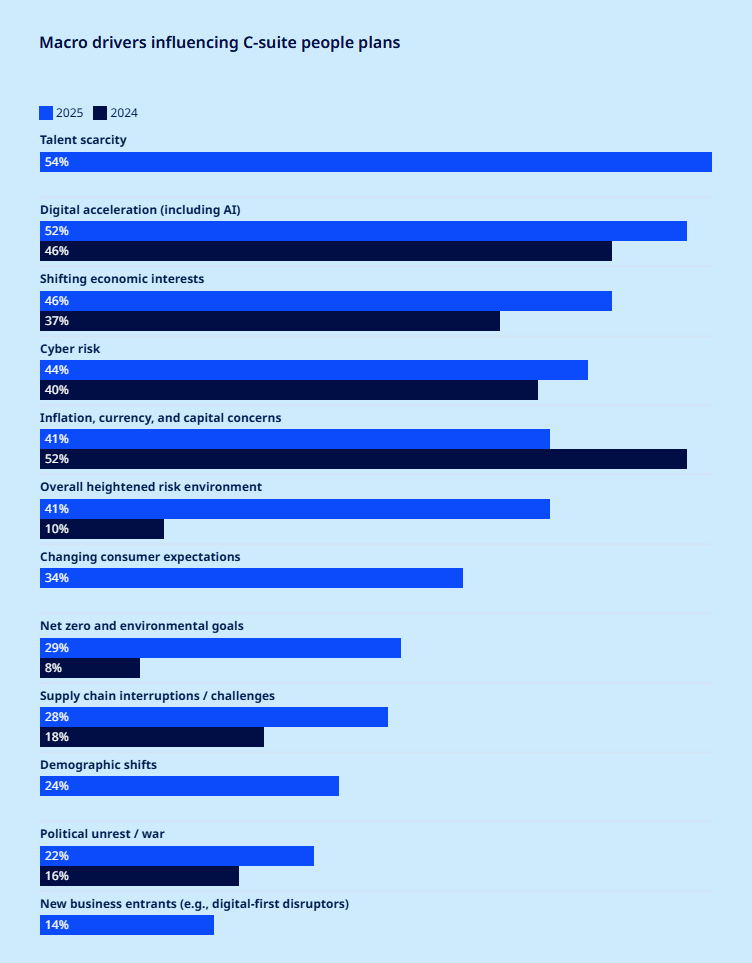
The following graph compares the macroeconomic factors that influence executive personnel plans in the 2024 survey with those in the current (2025) survey. In the 2024 survey, 'Inflation, currency, and capital concerns' (52%) was cited by many executives as a macroeconomic factor influencing personnel plans. However, the top three factors in the 2025 survey were 'Talent scarcity' (54%), 'Digital acceleration (including AI)' (52%), and 'Shifting economic interests' (46%).
Related Posts:








in AI, Posted by logu_ii