Is the incidence of colorectal cancer among young people really on the rise?
Is 'colorectal cancer' rising in 'young people'?
https://dynomight.net/crc-rates/
The DYNOMIGHT INTERNET WEBSITE points out that it has seen numerous articles in recent years reporting an increase in colorectal cancer among young people. The reasons given in these articles included the following:
- Overall deterioration of health
Modern people suffer from health problems such as obesity, lack of exercise, sleep deprivation, and diabetes, which lead to insulin resistance and chronic inflammation. As a result, epithelial cell proliferation is accelerated, and the dysfunction of the immune system may be increasing the incidence of early-stage cancer.
・Ultra-processed foods
Could it be that people are consuming more ultra-processed foods containing additives that break down the mucus in the large intestine, making it easier for bacteria to come into contact with the epithelial cells of the large intestine and cause inflammation? Or could it be that ultra-processed foods, being low in fiber and glycemic load, are more likely to cause insulin resistance and chronic inflammation, ultimately leading to an increase in colorectal cancer?
Poor quality meat
People are eating more ham and bacon, which contain nitrites , and this may be causing inflammation in the epithelial cells of the large intestine.
• Gut microbiota
Could it be that E. coli bacteria producing colibactin , a toxic substance believed to cause colon cancer, have colonized people's intestines? Or could it be that antibiotic use in childhood has reduced the number of protective bacteria in the gut, leading to an increase in harmful bacteria that cause inflammation or promote tumor growth?
Exposure to harmful substances in the environment
People are exposed to pollutants such as microplastics and pesticides, which may be causing problems such as the breakdown of the intestinal barrier and disruption of the gut microbiota.
• Mother's health
Could maternal health problems such as obesity and diabetes be negatively impacting the fetus's health, leading to lifelong metabolic disorders and inflammation?
Other factors
Other factors such as alcohol consumption, smoking, excessive use of painkillers, and nutritional deficiencies may be contributing to the increase in colorectal cancer.

Articles reporting an increase in colorectal cancer among young people sometimes cite the above points as reasons, but experts do not agree on these points. Furthermore, a detailed investigation by DYNOMIGHT INTERNET WEBSITE revealed that while it is true that deaths from colorectal cancer are increasing among young people, the individual reasons given are not well supported.
The DYNOMIGHT INTERNET WEBSITE points out that 'some of the causes cited, such as air pollution and tobacco, are actually decreasing in developed countries. Other explanations, such as E. coli producing colibactin, seem biologically plausible, but there is no evidence that they are increasing over time. Furthermore, other causes cited, such as microplastics and perpetual chemicals (PFAS), are mostly just speculation about the mechanisms at the time of writing. Obesity, lack of exercise, and chronic inflammation are all biologically plausible and likely increasing, but why do they cause colorectal cancer in young people?'
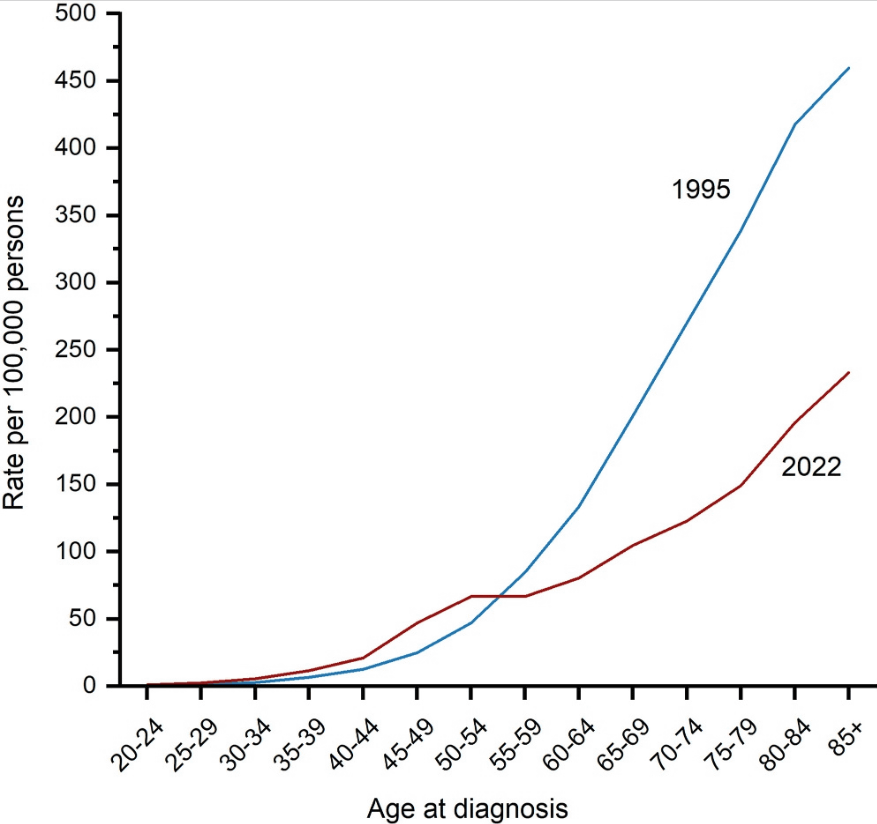
Therefore, the DYNOMIGHT INTERNET WEBSITE is conducting analysis based on data reported in various studies. The graph below shows the results of
Furthermore, the following graphs subdivide colorectal cancer into proximal colon cancer (green), distal colon cancer (blue), sigmoid colon cancer (purple), rectal cancer (red), and colorectal cancer (gray), and show the incidence rates by age group from top left: all ages, 20-49 years, 50-64 years, and 65 years and older.
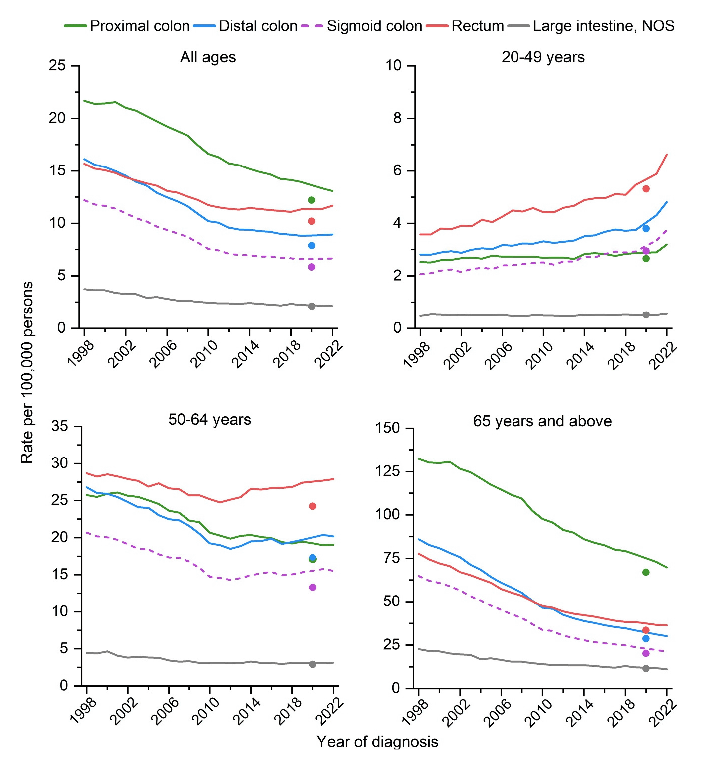
Looking at these graphs, you might think that 'the incidence of colorectal cancer among young people is increasing year by year, but the incidence decreases with age.' However, the DYNOMIGHT INTERNET WEBSITE points out that this is a misconception.
The graph below, created by the DYNOMIGHT INTERNET WEBSITE, uses data from
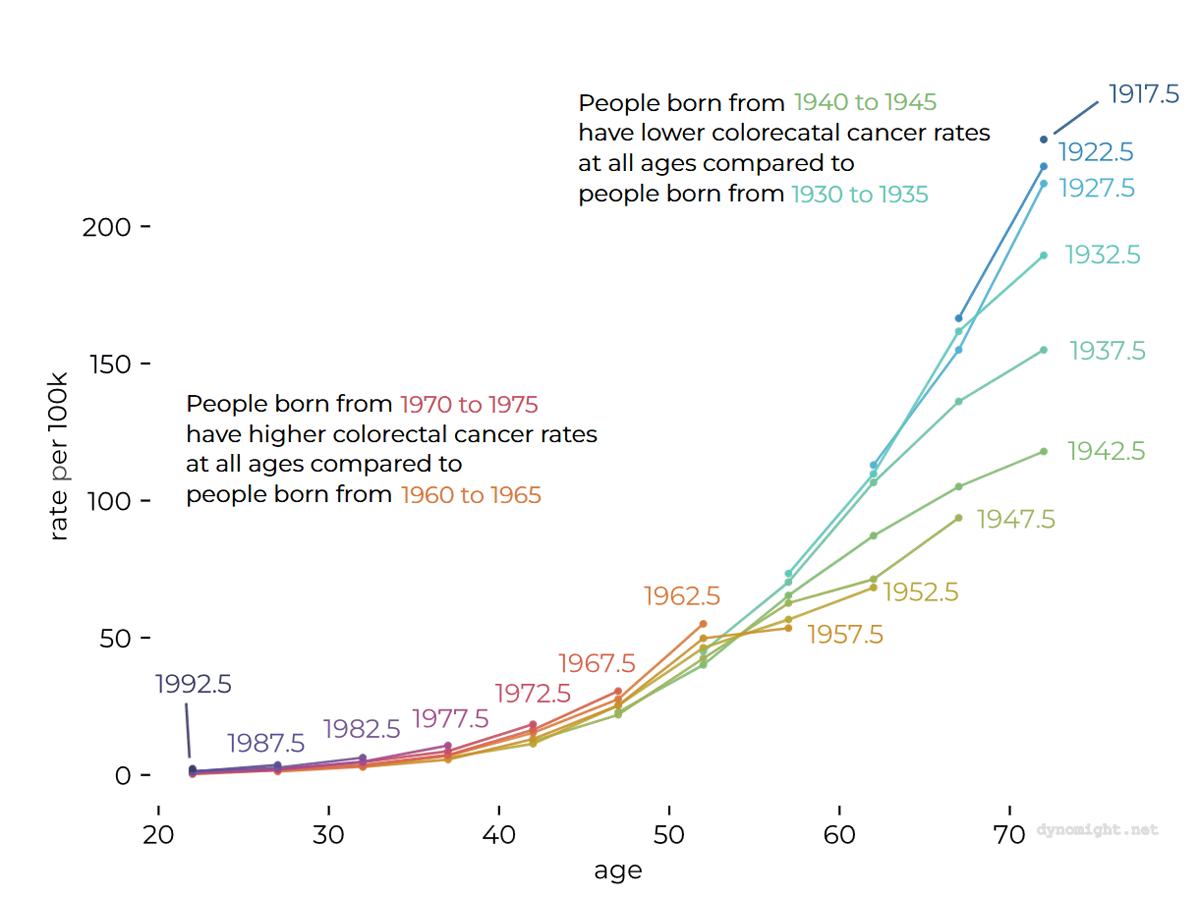
The DYNOMIGHT INTERNET WEBSITE warns, 'We can't be certain what will happen in the future. However, this trend is likely to continue. Indeed, today's younger generations are at a higher risk of colorectal cancer than previous generations were when they were young. That's bad news. Even worse news is that when you get older, you may also be at a higher risk of colorectal cancer than previous generations were when they were old.'
Another piece of bad news, as pointed out by the DYNOMIGHT INTERNET WEBSITE, is that colorectal cancer isn't the only cancer increasing among younger generations. The following graph, published in a 2019 study , shows the age-specific incidence rates for various cancers, including breast cancer and kidney cancer. The vertical axis represents the incidence rate on a logarithmic scale, and the horizontal axis represents the age group surveyed. Each line color and shape distinguishes different age groups, such as '25-29 years old,' '40-44 years old,' and '65-69 years old,' and it's clear that many cancers are increasing among younger generations.
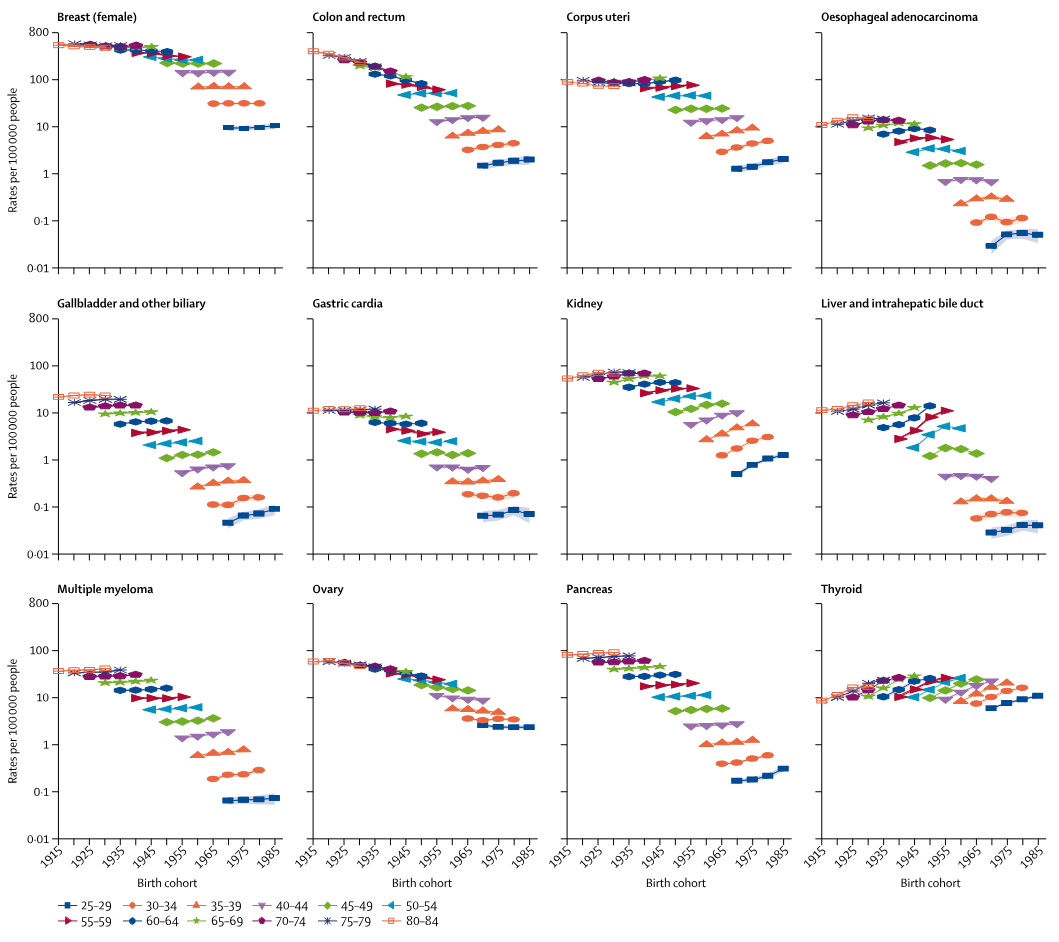
In other words, the recent increase in the incidence of colorectal cancer among younger generations is not limited to colorectal cancer; it is true for almost all cancers. Nevertheless, the reason why colorectal cancer is attracting attention is that it is a common and dangerous cancer, its incidence usually increases with age, it is treatable if detected early, and it can be detected through screening tests.
The DYNOMIGHT INTERNET WEBSITE acknowledges that by reporting on the increasing incidence of colorectal cancer among young people, it could potentially save lives by encouraging more people to undergo screening tests. However, it adds, 'If we want to unravel the mystery of the rising incidence of colorectal cancer, we need to keep in mind that colorectal cancer is not actually a unique disease at all.'
Related Posts:







in Science, Posted by log1h_ik