Human life expectancy has not yet reached its limit, but regional disparities may be worsening

While wealthy countries have seen their citizens' life expectancies increase over the past century and a half, some experts are wondering when this progress will plateau. In some Western countries, gains in life expectancy have already been negligible, and in some cases virtually nonexistent. A new analysis of data from 13 Western European countries by researchers at the French National Institute for Demographic Research suggests that human life expectancy has not yet reached its limit.
Potential and challenges for sustainable progress in human longevity | Nature Communications
Where are Europe's oldest people living? What geography tells us about a fragmenting continent
https://theconversation.com/where-are-europes-oldest-people-living-what-geography-tells-us-about-a-fragmenting-continent-274550
To examine the progress or stagnation of life expectancy in wealthy countries, the research team collected mortality and demographic data from the national statistical offices of 13 Western European countries (UK, Ireland, Portugal, Spain, France, Belgium, the Netherlands, Denmark, Germany, Switzerland, Italy, Austria, and Luxembourg), which together have a population of around 400 million.
The research team divided the 13 countries into 450 regions and recalculated the rate of increase in life expectancy at birth for each region between 1992 and 2019. Life expectancy at birth is an indicator that reflects mortality rates for all age groups, and by using advanced statistical methods, they were able to capture the underlying major trends without taking into account short-term fluctuations such as the heat wave in 2003 or the seasonal influenza that raged from 2014 to 2015.
The reason for using 2019 as the cutoff for the analysis is that it was too early to determine whether the COVID-19 pandemic was having a long-term impact on life expectancy at birth or whether it was only a limited impact between 2020 and 2022.

The analysis provided the researchers with unprecedented detail on regional life expectancy trajectories across Western Europe over the past 30 years, leading to three key findings:
◆1: Human life expectancy has not yet reached its limit
The first message that emerges from this study is that 'human life expectancy has not yet reached its limit.'
In the graph below, the vertical axis represents life expectancy at birth, and the horizontal axis represents years; the graph on the left is for men, and the graph on the right is for women. The black solid line shows the average for 450 regions, the blue solid line represents the average for the top 10% of regions with the longest life expectancy, and the red solid line represents the average for the bottom 10% with the shortest life expectancy. Looking at the blue solid line, we can see that in the regions with the longest life expectancy, life expectancy has continued to increase at a rate of approximately 2.5 months per year for men and approximately 1.5 months per year for women. This rate of increase in life expectancy was roughly equivalent to the rate of increase over the past few decades.
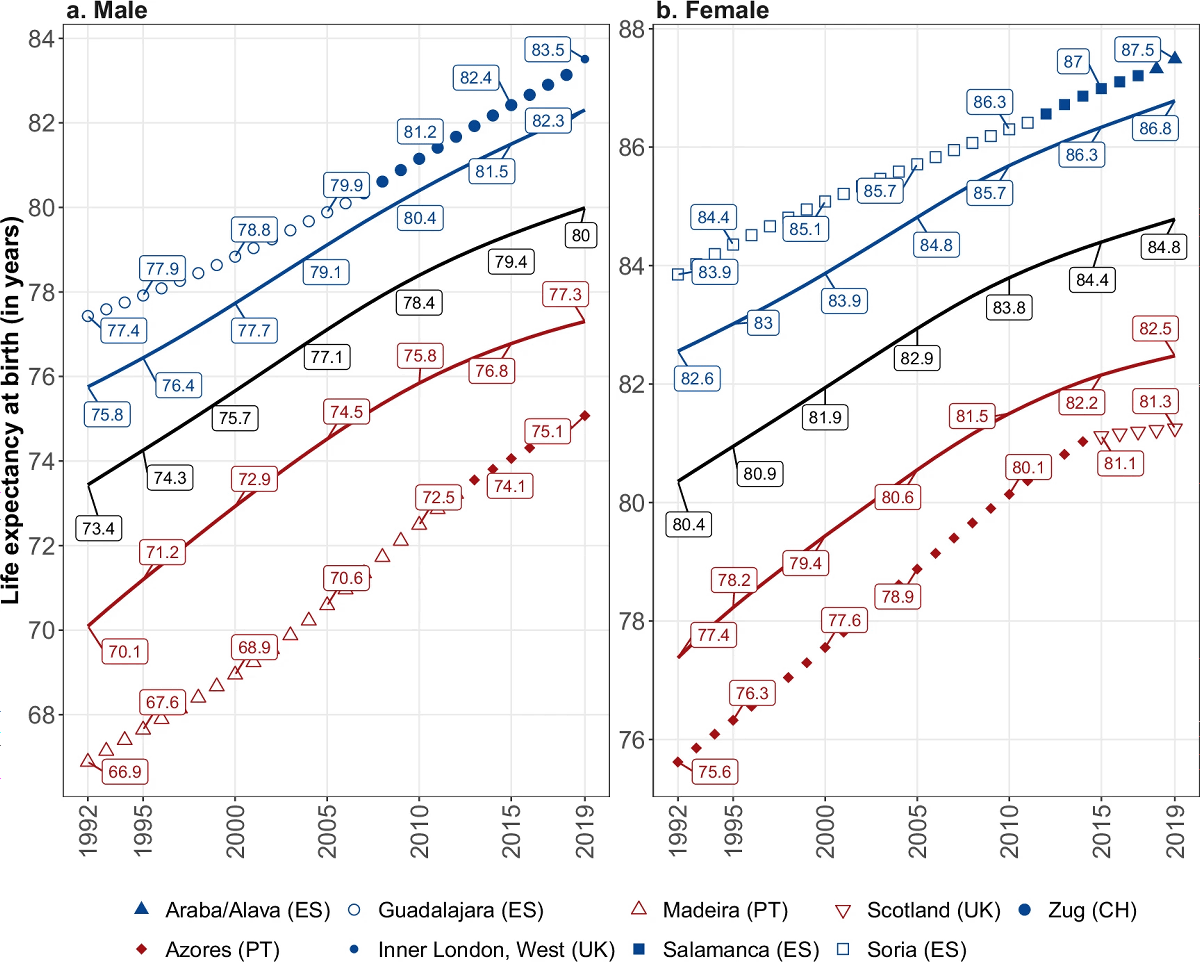
The researchers found that the regions with the highest life expectancy include northern Italy, Switzerland, some Spanish provinces, and the Paris area and other parts of France, where life expectancy at birth in 2019 was 83 years for men and 87 years for women.
'In other words, despite repeated concerns, there is currently no indication that life expectancy has hit a glass ceiling, and increases in life expectancy are still possible. This is a fundamental result that refutes the broad, alarmist claim that 'life expectancy gains have stagnated.''
◆2: Regional differences became more pronounced in the mid-2000s
The lowest 10% of regions with life expectancy at birth experienced significant increases in life expectancy between the 1990s and early 2000s, much larger than in any other region, resulting in a narrowing of regional differences in life expectancy across Europe.
However, around 2005, gains in life expectancy in the bottom 10% of regions slowed significantly and effectively stagnated. These regions include eastern Germany,
3. Mortality rates for people aged 55 to 74 play a crucial role
To understand the regional disparities in life expectancy, the research team analyzed the trends in mortality rates for each age group. The results showed that these regional disparities could not be explained by increases in infant mortality or mortality rates for people over 75 years old, but were primarily due to mortality rates around age 65 (55-74 years old).
In the 1990s, access to cardiovascular care and changes in risky behaviors led to a rapid decline in mortality rates around age 65, but since the 2000s, mortality risk has again been trending upward in some regions. The map below shows how mortality rates for people aged 55-74 in 450 Western European regions changed from 2018 to 2019, for men on the left and women on the right. Darker blue indicates a decline in mortality, while white indicates stagnation and lighter red indicates an increase. The map also shows stagnation or an increase in mortality in various regions of Germany, as well as an increase in mortality among women living in the Mediterranean region of France.
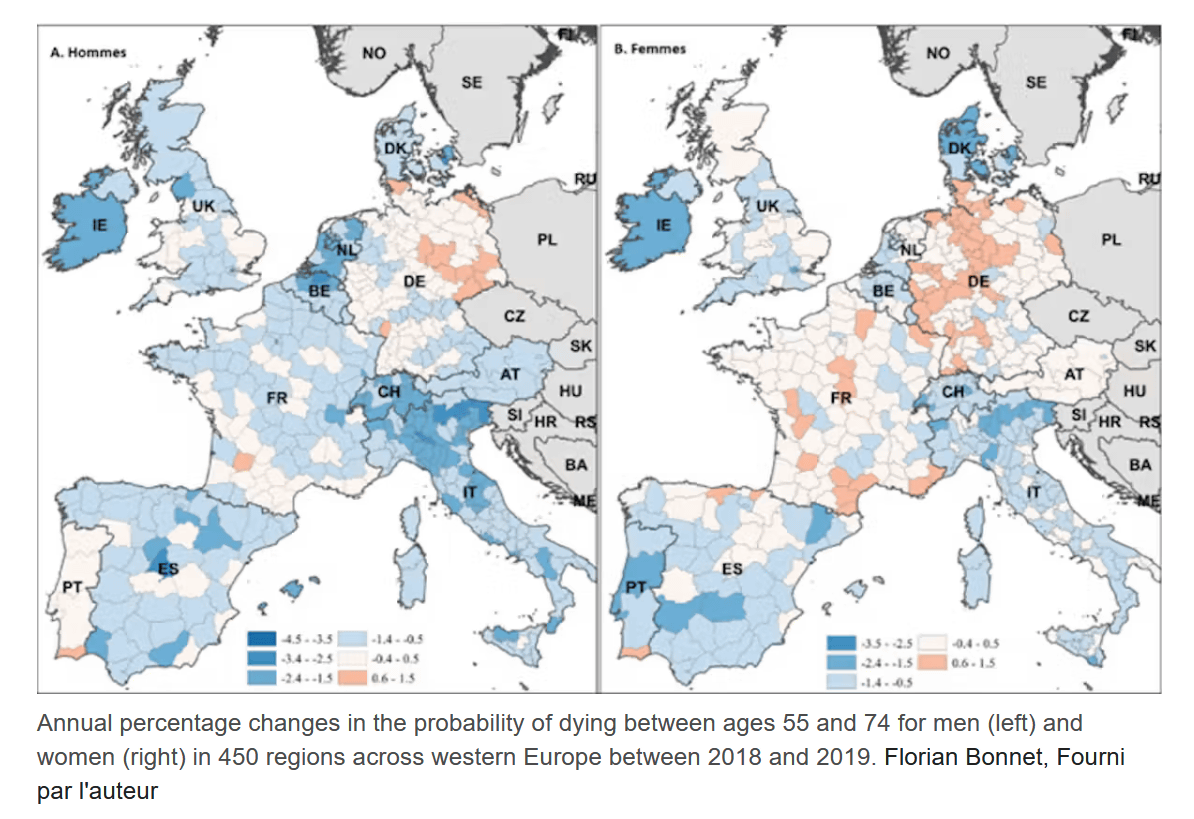
The research team pointed out that because there are many deaths around the age of 65, changes in mortality rates in this age group have a significant impact on overall life expectancy. While this study cannot pinpoint the cause of the disparity in mortality rates among people around the age of 65, recent research suggests the need to examine factors such as alcohol consumption, smoking, poor nutrition, and lack of exercise.
The 2008 economic crisis also exacerbated regional disparities across Europe, with some regions suffering long-term damage from the worsening health of their residents, but areas with a higher concentration of highly qualified jobs saw further increases in life expectancy, demonstrating that longevity depends not only on medical advances but also on socio-economic factors.

The research team points out that while there is still room for further increases in life expectancy, in some parts of Europe life expectancy has stagnated over the past 15 years due to rising mortality rates around age 65. 'Based on recent trends, it is quite possible that Europe will eventually become a two-tiered region, with a small number of regions continuing to push the boundaries of life expectancy and a majority where life expectancy gains are slowing,' they said.
Related Posts:








in Free Member, Science, Posted by log1h_ik