Why are most people right-handed?

Approximately 90% of humans are right-handed, but the reason for this remains unsolved as of the time of writing. A research team at Oxford University is analyzing 'why are most humans right-handed?'
Bipedalism and brain expansion explain human handedness | PLOS Biology
Why is almost everyone right-handed? The answer may lie in how we learned to walk | Oxford University
https://www.ox.ac.uk/news/2026-05-15-why-is-almost-everyone-right-handed-the-answer-may-lie-in-how-we-learned-to-walk
Approximately 90% of humans are right-handed, a percentage no other primate species exhibiting. While research into the brain, genes, and development related to handedness has been conducted for decades, the reason why humans are overwhelmingly right-handed remains a mystery.
A new study led by Oxford University and published in the peer-reviewed scientific journal PLOS Biology suggests that the reason why most humans are right-handed lies in two key features of human evolution: bipedalism and the dramatic expansion of the brain.
This research was conducted by Dr. Thomas A. Puschel and Rachel M. Hurwitz of the Department of Anthropology and Museum Ethnology at the University of Oxford, and Professor Chris Venditti of the University of Reading. The research team collected data from 2025 individuals of 41 species of monkeys and apes, and used a hierarchical Bayesian model that considers evolutionary relationships between species to test existing major hypotheses about why handedness evolved (tool use, diet, habitat, body weight, social organization, brain size, motor skills, etc.).
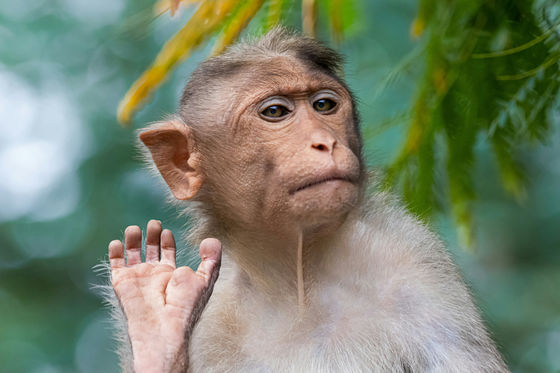
The analysis revealed that while humans clearly deviated from the pattern explaining other primates, this peculiarity disappeared when two factors were considered: 'brain size' and 'relative arm and leg length (standard anatomical indicators for bipedalism).' In other words, when upright walking and a large brain are taken into account, humans are no longer evolutionarily abnormal.
Furthermore, the research team also estimated the handedness of extinct human ancestors. From this estimation, it became clear that there is a gradual trend in handedness. It is estimated that early humans, such as
However, one notable exception has been reported: Homo floresiensis , a species with a small brain that lived in Indonesia. Homo floresiensis had a small brain and a body adapted to a combination of upright walking and tree climbing rather than complete bipedalism.
Based on these findings, the research team predicts a two-stage evolutionary process. The first is that 'bipedalism occurred, freeing the hands from the burden of movement and creating new selective pressure for delicate, asymmetrical hand movements.' The second is that 'as the brain grew and underwent growth and reorganization, right-brain dominance solidified into the almost universal pattern seen today.'

The research team explains that this study leaves several unanswered questions for future research, including the cumulative role of human culture in the stabilization of right-handedness, why left-handedness has persisted in the first place, and whether similar handedness patterns in the limbs observed in animals such as parrots and kangaroos suggest a deeper, more convergent narrative in the broader animal kingdom.
Related Posts:





in Science, Posted by logu_ii