How does DeepSeek plan to make money with its low-cost AI?
DeepSeek, a Chinese AI company, has released an open model with performance comparable to the cutting-edge AI of American companies, and at the time of writing,
DeepSeek's 10 trillion USD grand strategy / X
https://x.com/bookwormengr/status/2057909493250539891
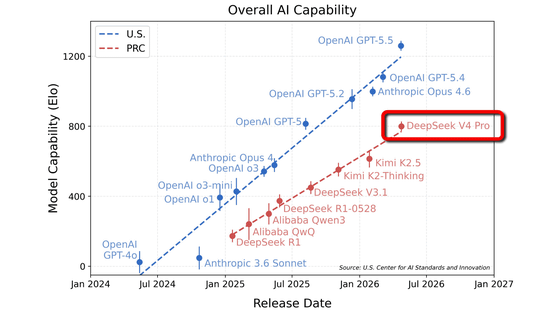
DeepSeek became famous in January 2025 when it released the ' DeepSeek-R1, ' a model with performance equivalent to the then-cutting-edge 'OpenAI o1,' for free. The ' DeepSeek-V4-Pro ,' which appeared in May 2026, was evaluated by the U.S. government agency, the Center for Artificial Intelligence Standardization and Innovation (CAISI), as having 'performance equivalent to GPT-5, and being eight months behind the most advanced models in the United States.'
'DeepSeek V4 Pro is about eight months behind major US AI models, but is currently the most high-performing Chinese-made AI model,' reports CAISI, the US government's AI risk management agency - GIGAZINE
DeepSeek-V4-Pro is available as a free model, and can also be used via DeepSeek's paid API. The API usage fee has been permanently discounted by 75% since its initial release, making it a highly cost-effective model.
A 75% permanent discount on the high-performance Chinese AI 'DeepSeek-V4-Pro' is being offered, and attention is also being drawn to 'Reasonix,' a coding agent specifically designed for DeepSeek - GIGAZINE

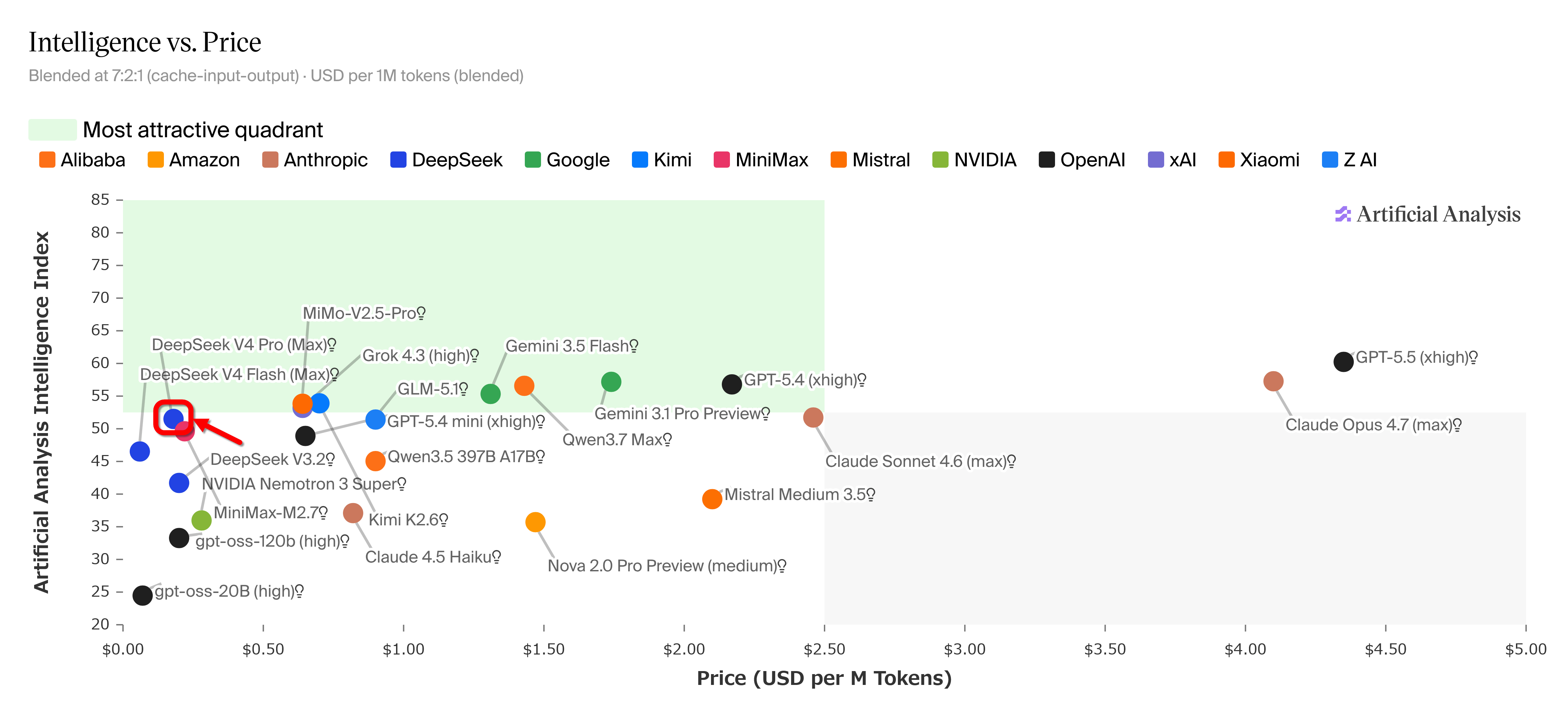
The following graph, published by the third-party organization Artificial Analysis, shows the 'Price-Performance Ratio of AI,' with the horizontal axis representing price and the vertical axis representing performance. It can be seen that DeepSeek-V4-Pro is significantly cheaper than models with comparable performance.
As mentioned above, DeepSeek makes its cutting-edge models publicly available as open models and sets its API fees very low. Chinese companies such as Alibaba and Z.ai also tend to make their cutting-edge models publicly available, similar to DeepSeek, but unlike DeepSeek, they are building agent systems and showing signs of moving towards monetization. In other words, despite not showing any significant moves toward monetization, DeepSeek is valued enough to be able to negotiate a fundraising round of approximately 1.6 trillion yen.
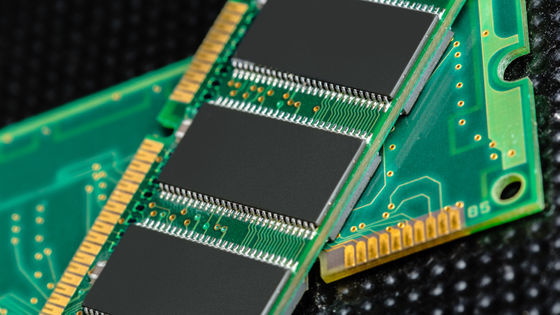
GDP cites 'overwhelmingly high efficiency' as the reason for DeepSeek's high rating. Large-scale language models incorporate a mechanism called a 'KV cache' that allows computation results to be reused later, and DeepSeek's KV cache is designed to be extremely efficient. When processing input of 1 million tokens, the memory usage is 60GB for GLM-5 and 89GB for Qwen3-235B-A22B, while DeepSeek-V4 uses only 5.48GB. With the demand for AI, the price of memory continues to rise, resulting in a situation where '63% of the cost of an AI chip is memory, and memory is more expensive than the GPU.' In this situation, the high efficiency of DeepSeek's AI models allows for profitability while keeping costs down.
63% of AI chip costs are in memory; we're entering an era where memory is more expensive than the GPU - GIGAZINE
Furthermore, by efficiently utilizing the cache with a superior KV cache, even relatively low-performance AI chips can reduce the time it takes to produce output. The graph below shows the token position on the horizontal axis and the computational effort required to process one token on the vertical axis, demonstrating that DeepSeek-V4-Pro can complete the computation with 1/3.7th the computational effort of the previous generation model, and DeepSeek-V4-Flash can complete the computation with 1/9.8th the computational effort of the previous generation model.
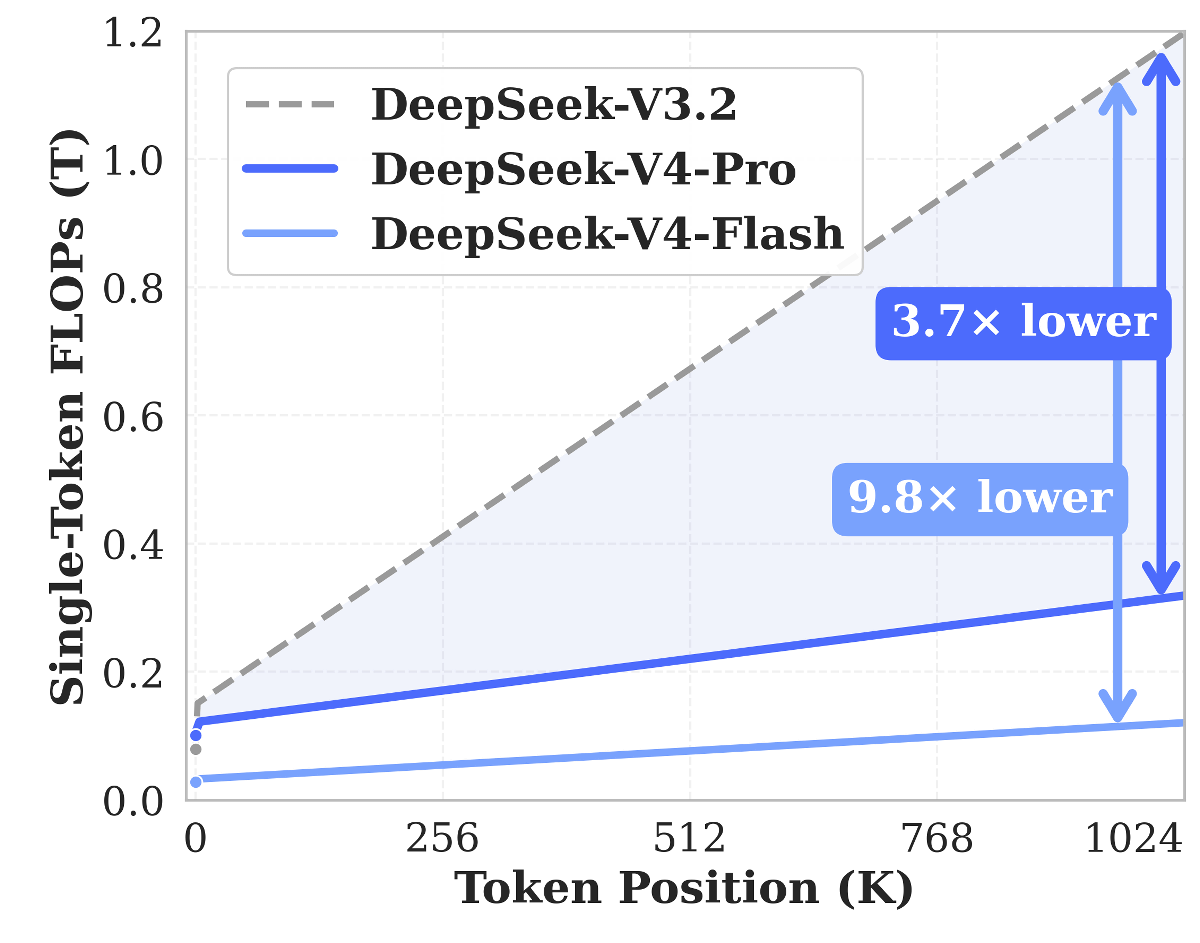
While access to high-performance AI chips from NVIDIA is severely restricted in China, DeepSeek can perform inferences at speeds close to those of American-made AI models, even with lower-performance AI chips.
GDP speculates that DeepSeek's large-scale fundraising is not aimed at short-term AI development, but rather at a long-term goal of 'renewing the hardware ecosystem.' According to GDP, DeepSeek is likely to reinvest the funds into Chinese memory manufacturers and AI chip manufacturers, aiming to build an ecosystem that allows for cost-effective training and service deployment of AI models. If a cost-effective AI ecosystem is built by Chinese companies, it could become a strong option for AI development companies worldwide.
Related Posts:



in AI, Posted by log1o_hf