OpenAI has successfully disproven a mathematical conjecture that had remained unsolved for nearly 80 years, a discovery that has surprised even human mathematicians, who say 'AI has gone beyond being just an assistant.'
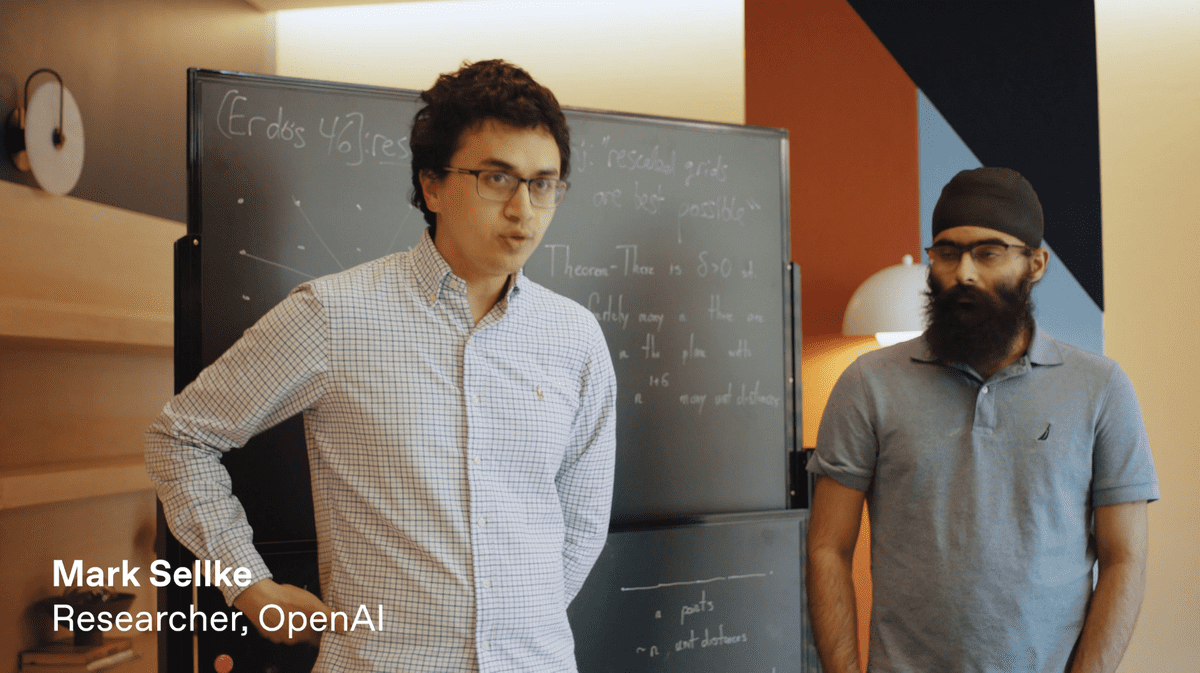
On May 20, 2026, OpenAI announced that its internal AI model had disproven a long-held prediction regarding the 'unit distance problem,' a central unsolved problem in discrete geometry. The unit distance problem asks, 'Given n points on a plane, what is the maximum number of pairs of points that are exactly 1 apart?'
An OpenAI model has disproved a central conjecture in discrete geometry | OpenAI
Examples of mathematical research using OpenAI models have been reported before, and ChatGPT 5.5 Pro, released on April 23, 2026, made headlines for completing doctoral-level research in just one hour. This time, they have succeeded in conducting even higher-level research by using OpenAI's internal models.
ChatGPT 5.5 Pro performs doctoral-level mathematical research in one hour, mathematicians point out that 'the minimum standard for human research is changing' - GIGAZINE
The 'unit distance problem' that the AI tackled this time was posed by mathematician Paul Erdős in 1946, and OpenAI describes it as 'one of the best-known and easiest-to-explain problems in combinatorial geometry.' The unit distance problem has a very short problem statement, but it is said to be extremely difficult to solve.
In the simplest form of the unit distance problem, consider arranging n points in a straight line; there are n-1 unit distance pairs between adjacent points. Furthermore, if we place the points on a square grid, such as the intersections of graph paper, the number of unit distance pairs is approximately 2n. Moreover, known configurations that adjust the square grid by scaling it can achieve an increase slightly faster than n.
The image below shows a conventional configuration using a rescaled square grid. The black dots represent points on the plane, and the lines represent pairs of points at a distance of 1. It can be seen that a very large number of unit-distance pairs can be created even with a configuration based on a square grid.
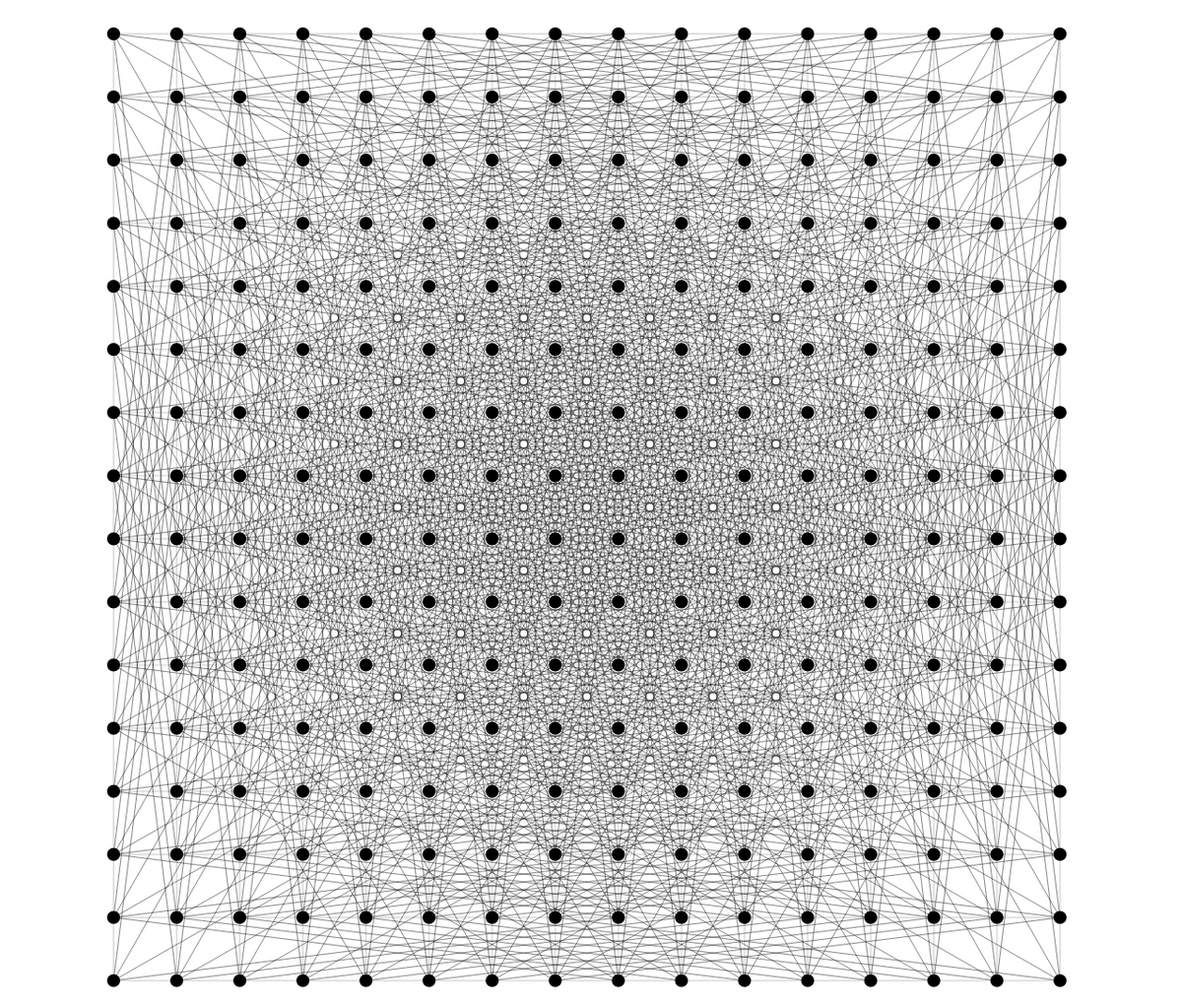
In conventional square lattice system constructions, it was known that the number of unit distance pairs is at least n to the power of (1 + C/loglog(n)). C is a fixed positive constant independent of the magnitude of n, and is used to represent the strength of the correction term obtained from the number-theoretic construction. Since loglog(n) increases very slowly as n gets larger, the exponential part C/loglog(n) gradually approaches 0. In other words, the construction of the square lattice system increases slightly faster than n, but not 'strong enough to exceed n at a fixed rate.'
Therefore, for many years mathematicians have predicted that
OpenAI's internal AI model demonstrated that it can construct point configurations with at least n^(1+δ) unit distance pairs for an infinite number of n. This configuration example surpasses the conventional upper bound conjecture that the maximum number of unit distance pairs is limited to approximately n^(1+0(1)), thus disproving the conjecture. δ is a fixed value greater than 0, representing an improvement that does not disappear even as n increases.
According to OpenAI, the proof initially generated by the AI model did not specify a concrete value for δ, but improvements by Princeton mathematician Will Sowin have shown that δ can be taken as 0.014. Until now, the lower bound of the unit distance problem had remained virtually unchanged since Erdős's 1946 construction, and this discovery marks the first update to the lower bound in 80 years. The upper bound, however, remains essentially unchanged from the O(n^4/3) result obtained by Spencer, Semeredi, and Trotter in 1984.
This discovery was derived from a general-purpose inference model that OpenAI was testing internally. This model is designed to handle general problems and is not a mathematics-specific AI. OpenAI explains the discovery as follows: 'As part of an effort to investigate whether advanced general-purpose inference models can contribute to cutting-edge research, we were evaluating a set of Erdős problems when we generated a proof that disproves an unsolved conjecture for the unit distance problem.' The proof has been verified by an external group of mathematicians, and an accompanying paper explaining the background and significance has also been written.
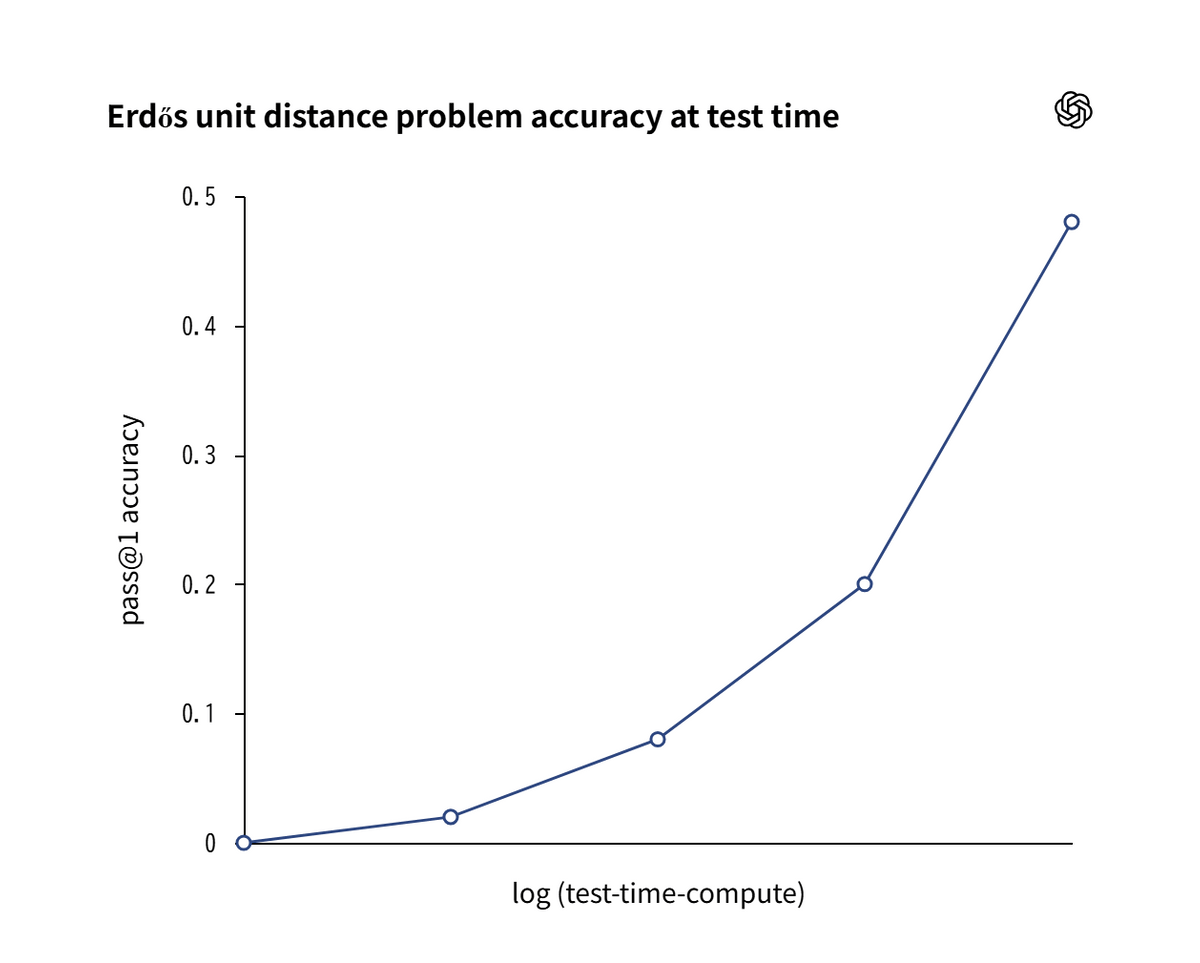
The image below shows the accuracy rate of an AI model during testing of a unit distance problem. The horizontal axis represents the logarithm of the computational complexity used during testing, and the vertical axis represents the percentage of times the correct answer was reached in a single attempt. It can be seen that the accuracy rate increases as the computational complexity during testing increases.
The proof employs advanced tools of algebraic number theory for a seemingly elementary geometric problem. OpenAI explains that Erdős's traditional lower bound construction can be understood using 'Gaussian integers' expressed in the form a + bi, where i is the imaginary unit.
The new proof utilizes an algebraic number field more complex than Gaussian integers, drawing out richer symmetries that allow for a greater number of unit length differences. Furthermore, it uses specialized theories for investigating the structure and existence of algebraic number fields, such as the infinite class field tower and Gorod Shafarevitch theory, to demonstrate that the number fields required for the proof actually exist. OpenAI states that it was surprising that a concept known in algebraic number theory could have an impact on geometry problems on the Euclidean plane.
Reactions have also come from mathematicians outside the university. Princeton University combinatorial mathematician Noga Aron described the unit distance problem as one of Erdős's favorite problems and called OpenAI's solution using its internal AI model an outstanding achievement that settles a long-standing unsolved problem. Fields Medal laureate Tim Gowers also lauded it as a milestone in AI mathematics in an accompanying paper. Number theorist Arle Shankar stated that current AI models demonstrate that they are capable of going beyond being mere assistants to human mathematicians and generating and executing original ideas.
OpenAI also explained that 'mathematics is a clear testbed for measuring AI's reasoning ability because mathematical problems require precise formulation, verifiable proofs, and logically coherent arguments from beginning to end.' OpenAI described this achievement as an example of AI not merely providing an answer, but connecting ideas from disparate fields to generate mathematical discoveries.
OpenAI states that 'AI with stronger mathematical reasoning capabilities could be a powerful partner for researchers.' The ability to consistently handle complex arguments, connect disparate fields of knowledge, and present promising pathways that experts may not have prioritized is relevant not only to mathematics but also to biology, physics, materials science, engineering, and medicine. On the other hand, OpenAI also emphasizes the importance of human judgment, stating that while AI can assist with exploration, suggestions, and verification, the role of selecting important problems, interpreting results, and deciding what questions to pursue next remains with humans.
Related Posts: