OpenAI's GPT-5.2 successfully creates a new physics equation
OpenAI has announced that it has used GPT-5.2 to derive new theoretical physics formulas. The research, which also includes the Institute for Advanced Study at Princeton and Harvard University, has succeeded in simplifying and generalizing complex formulas previously derived by humans. The research team plans to publish their findings in a paper, and a pre-peer-reviewed paper has already been published.
GPT-5.2 derives a new result in theoretical physics | OpenAI
The research team worked on deriving a formula for the amplitude of gluons, a type of elementary particle. The conventional wisdom for gluons was that 'in an interaction involving n gluons, if only one has negative helicity and the remaining n-1 have positive helicity, the amplitude will be zero.' However, some researchers argue that the amplitude will never be zero, and have continued to work on creating a formula for calculating the amplitude.
Human researchers have previously derived formulas for n = 3, n = 4, n = 5, and n = 6, but the problem is that the formulas become rapidly more complex as the number of n increases.
The formulas derived by humans are as follows. Equation (29) is the formula for calculating the amplitude when 'n = 3' and appears to be simple. However, the formulas for 'n = 4' (Equation (30)) and 'n = 5' (Equation (31)) become more complex.
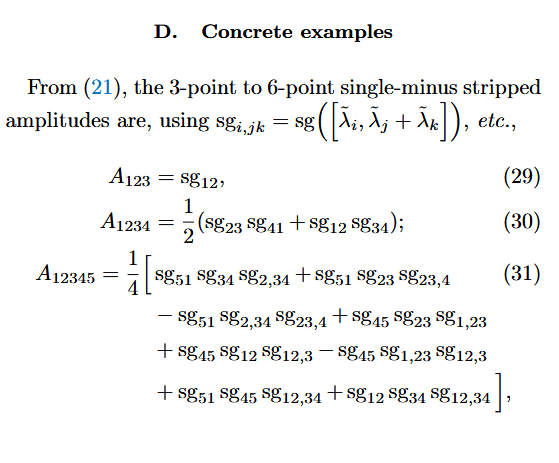
And the formula for 'n=6' is below. It's become very complicated.
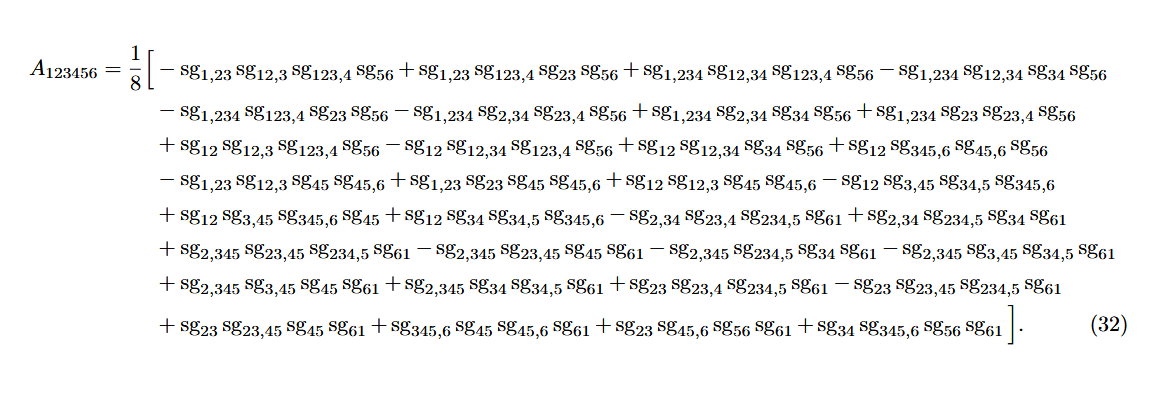
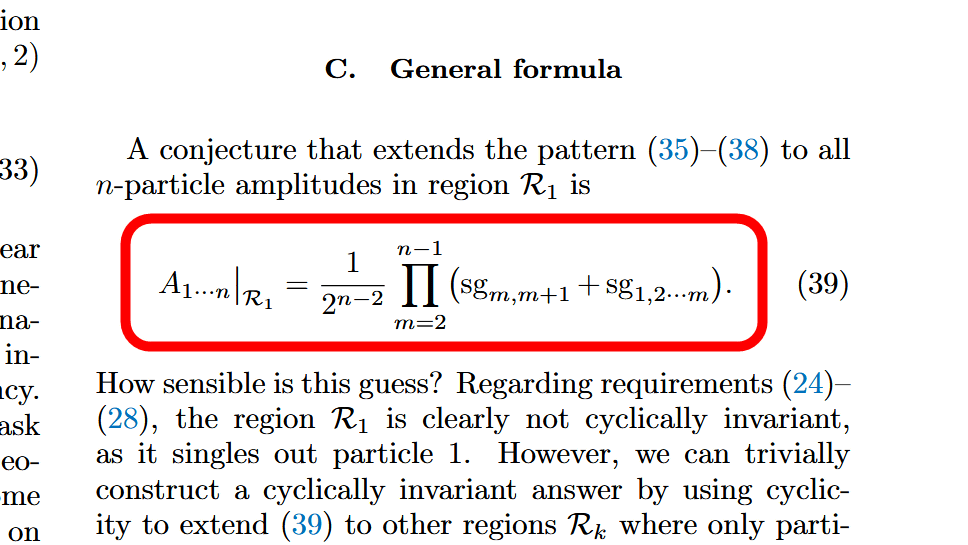
In this study, GPT-5.2 Pro was tasked with simplifying human-derived formulas. As a result, it successfully simplified the formulas for 'n=3,' 'n=4,' 'n=5,' and 'n=6' as follows:
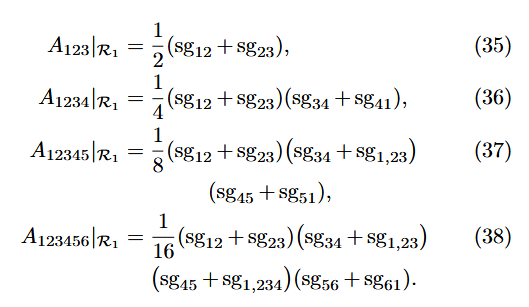
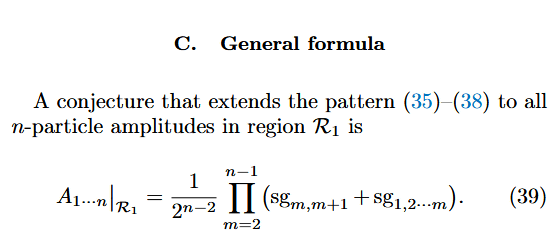
Based on the underlying mathematical patterns in the above formula, GPT-5.2 Pro also derived a simple formula for any number of particles. After 12 hours of inference using the 'internal scaffolding version of GPT-5.2,' the proof of the formula was also successfully created.
Professor Nima Arkani-Hamed, a theoretical physicist at the Institute for Advanced Study in Princeton, said of the results of this research, 'I've been interested in this problem ever since I first encountered it about 15 years ago. For this reason, I'm excited to see the surprisingly simple formula presented in this paper.' 'For me, the task of 'finding simple formulas' is tedious, and I've long wondered whether it could be automated by computers. This seems to be starting to happen in many fields. I think the examples in this paper are particularly well suited to leveraging the power of modern AI tools. I hope that in the near future, AI will develop into a 'general-purpose tool for recognizing simple mathematical patterns.''
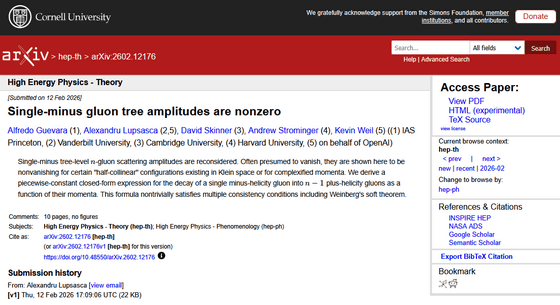
A paper describing the research results has been published on the preprint server arXiv. At the time of writing, the paper is in the process of being submitted, and OpenAI is seeking feedback from the community.
[2602.12176] Single-minus gluon tree amplitudes are nonzero
https://arxiv.org/abs/2602.12176
Related Posts: