Why does Anthropic, the AI company that develops Claude, exchange ideas with philosophers and religious organizations?
Anthropic, the developer of the AI tool Claude, is committed to human-first AI development, prioritizing safety and reliability. This article explains why Anthropic focuses on activities that might seem unrelated to AI, such as dialogues with philosophers and religious groups.
Widening the conversation on frontier AI \ Anthropic
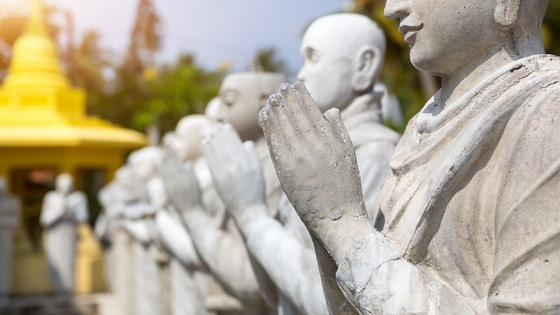
Over the past few months, Anthropic has organized dialogues with various organizations working on issues related to AI. In late March 2026, they hosted a two-day summit at Anthropic headquarters, inviting Christian clergy and scholars.
Anthropic holds summit with Christian leaders and philosophers: Can AI 'Claude' become a 'child of God'? - GIGAZINE

Anthropic points out that building safe and useful AI models requires advanced technical work regarding integrity, decipherability, and security measures. Furthermore, they believe that AI is already being used by many people, not just a select few experts, and that the issues AI raises should be considered from diverse perspectives.
Anthropic, which champions a human-centered philosophy, is not simply developing advanced AI, but is also considering 'what it means to thrive in a future where powerful AI exists' and 'what it means for an AI that interacts with many people to be 'good',' and is carefully considering a 'constitution' that defines Claude's guiding principles and values.
Philosophers, clergy, lawyers, writers, psychologists, and civil rights activists have conducted extensive research on the ethics and morals of AI. Anthropic explains why he engages in dialogue with philosophers, stating, 'It is important that we learn from these individuals, their communities, and their organizations.'
AI models are trained using vast amounts of text, and developers choose which patterns to reinforce or ignore, and what personality traits they want the AI model to acquire. This raises questions such as, 'What constitutes a 'good personality' for an AI model?', 'What characteristics and behaviors should it exhibit in specific situations?', and 'How can we instill a personality that is resistant to human manipulation and can withstand pressure?'
Anthropic's dialogue with experts from various fields is still in its early stages, but sessions with scholars studying neuroscience and personality development have already provided insights into the importance of 'others' in moral development. Mentors and supporters serve as 'safe others' that individuals can turn to when they are forced to act against their own values, and this helps them to protect their moral beliefs.
Anthropic wondered if this idea could also be useful for AI models, and conducted an experiment in which they gave Claude a tool that he could call up midway through a task to briefly remind him of his ethical commitments. As a result, Claude was able to call up this tool before taking significant actions and was often able to recognize his own conflicts of interest.
Over the next few months, Anthropic plans to collaborate with a wider range of groups, including legal scholars, psychologists, writers, and civil society organizations. Anthropic stated, 'Many of these dialogues will go beyond the realm of moral formation and expand into broader issues such as how AI will transform work, institutions, and power distribution.'
Anthropic isn't unilaterally focusing on religion; religious figures are also closely watching AI developments. Pope Leo XIV is expected to address 'Human Protection in the Age of AI' in an encyclical scheduled for release on May 25th. Christopher Oler, co-founder of Anthropic and a specialist in AI safety research, is also scheduled to speak at the encyclical release event.
Pope Leo XIV to address 'protecting humanity in the age of AI' in his first encyclical; Anthropic co-founder to attend event - GIGAZINE
Related Posts:



in AI, Posted by log1h_ik