What is the reason why Poland, where meat and sugar were rationed until the 1980s, is now among the top 20 economic powers in the world?
Poland is a model for economic growth | AP News
https://apnews.com/article/poland-economy-growth-g20-gdp-26fe06e120398410f8d773ba5661e7aa
Just a generation ago, Poland was a communist state where essential goods such as sugar and meat were rationed, and citizens' wages were only one-tenth of those in West Germany. However, in 1989, free elections were held, and the country transitioned from communism to democracy. As a result, Poland's economy grew dramatically, and it developed into the world's 20th largest economy with an annual output exceeding $1 trillion (approximately 1.57 trillion yen).
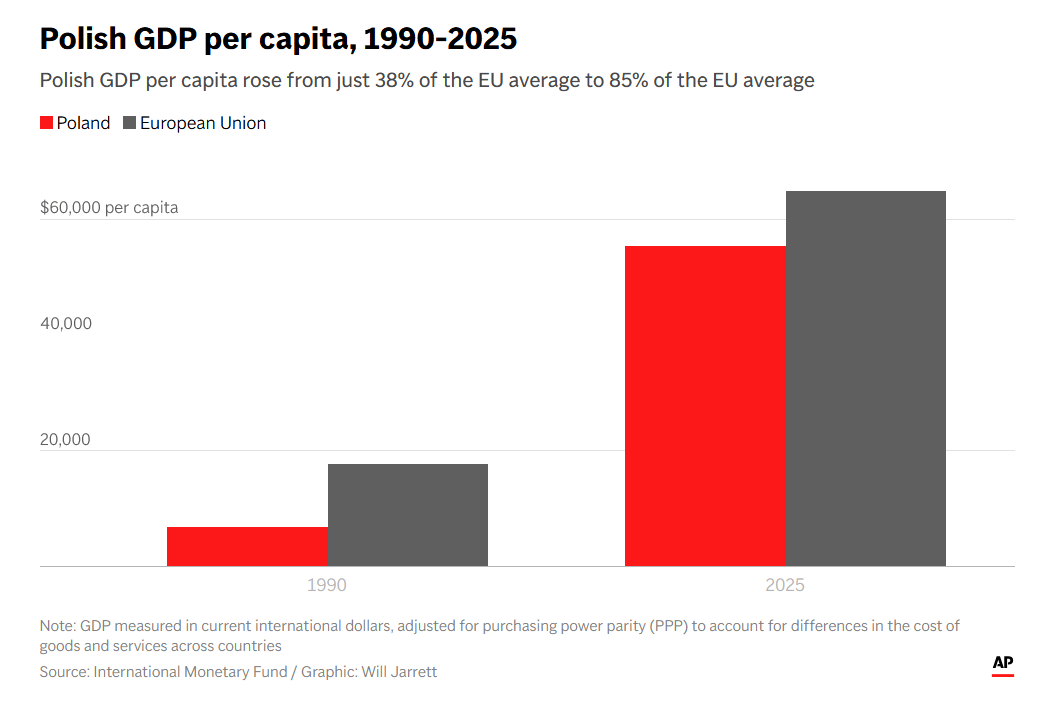
The graph below shows GDP per capita on the vertical axis, with red representing Poland and gray representing the EU average, and the left side representing 1990 and the right side representing 2025. In 1990, Poland's GDP per capita was only $6,730 (approximately 1.06 million yen), just 38% of the EU average, but by 2025 it had reached $55,340 (approximately 8.7 million yen), 85% of the EU average. Note that the GDP has been converted to modern dollars and adjusted for purchasing power parity (PPP) , which takes into account the differences in the cost of goods and services between countries.
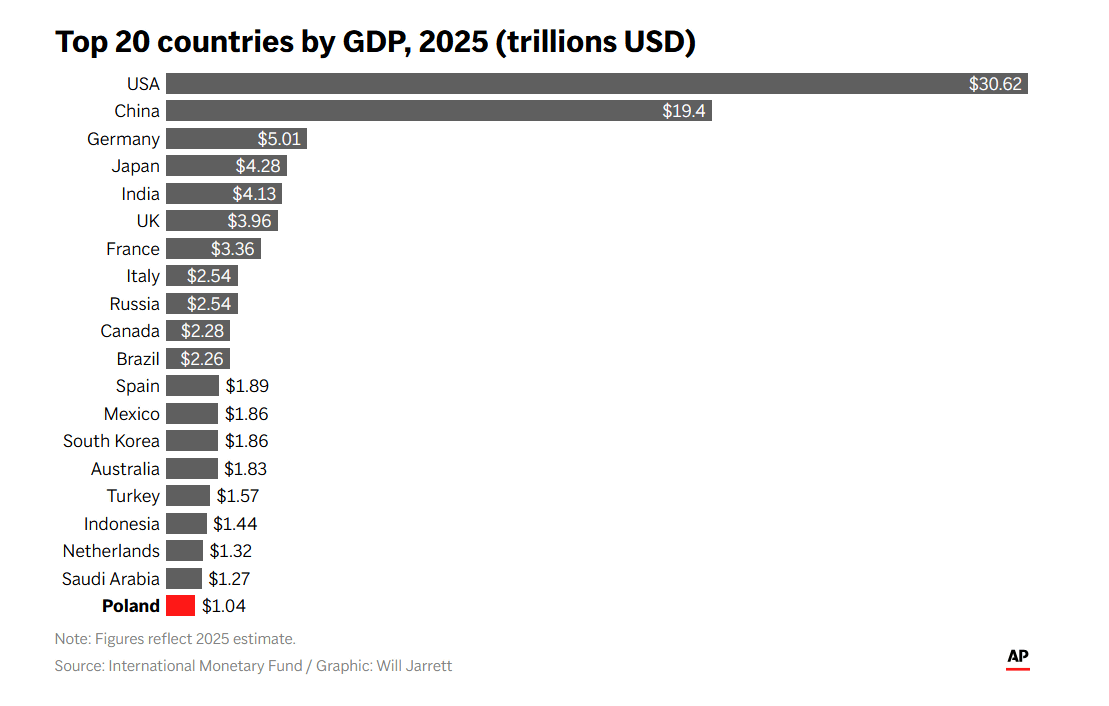
The top 20 countries by GDP in 2025 are as follows: The United States is in first place with $30.62 trillion (approximately 4,830 trillion yen), China is in second place with $19.4 trillion (approximately 3,060 trillion yen), Germany is in third place with $5.1 trillion (approximately 800 trillion yen), and Japan is in fourth place with $4.28 trillion (approximately 670 trillion yen). Poland is ranked 20th with $1.4 trillion (approximately 221 trillion yen).
The Polish economy has grown at an average annual rate of 3.8% since joining the EU in 2004, which is significantly higher than the EU average of 1.8%. Professor Marcin Pyńckowski of Kozminski University in Poland explains that several factors have helped Poland escape poverty, one of which is the rapid development of a 'strong institutional framework for business.'
After transitioning to a democratic state, Poland established independent courts, an antitrust agency to ensure fair competition, and strong regulations to prevent struggling banks from halting lending. As a result, it was able to achieve economic development without the corruption and economic takeovers by a few politicians that plagued other former communist countries.
Furthermore, the EU had provided Poland with hundreds of billions of yen in aid even before its accession, and the fact that Poles, regardless of their political stance, shared EU membership as a long-term goal also contributed to its economic development. Professor Pyonckowski stated, 'Poles knew where they were headed. Poland adopted some of the institutions, rules, and even cultural norms that Western countries had built up over 500 years.'
Although the communist regime was oppressive, it laid the groundwork for economic development by removing social barriers related to education and providing educational opportunities to factory and farm workers. After the transition to a democratic state, Poland experienced a higher education boom, and at the time of writing, half of the young people had obtained a university degree, which has led to Poland possessing the attractive characteristics of 'low labor costs and high educational standards' that draw investors.
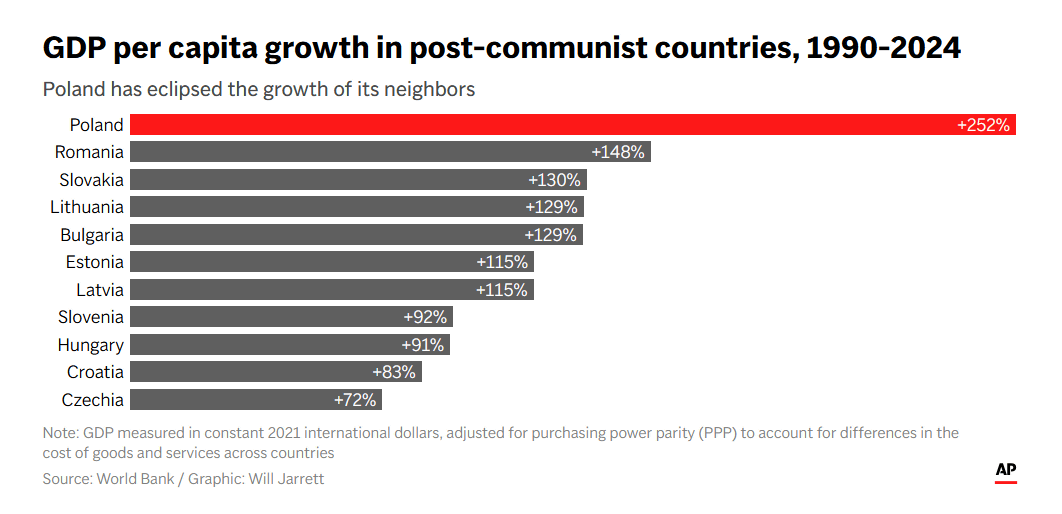
The graph below shows the GDP per capita growth rate of former communist countries from 1990 to 2024, revealing that Poland achieved a growth rate of 252%, significantly higher than the other countries.
The Associated Press claims that the success of Solaris , a Polish car manufacturer founded in 1996, symbolizes Polish entrepreneurship. Solaris's founder, Krzysztof Olszewski, originally ran a car repair shop that repaired Polish cars using parts imported from West Germany under the communist regime. Although most companies in Poland were nationalized, small private repair shops were granted operating licenses, creating a kind of enclave where private entrepreneurs gathered.
After Poland transitioned to a democratic state, Olszewski established a subsidiary of a German bus company in 1996 and began manufacturing buses for the Polish market. When Poland joined the EU in 2004, access to the European market opened up, and in 2011, when very few companies in Europe were experimenting with electric bus technology, he made the high-risk, high-reward decision to start manufacturing electric buses. This was partly due to the smaller risk of failure compared to large Western companies, and as a result, Solaris has become a major company with a 15% share of the electric bus market.
While the Polish economy may appear promising, it still faces challenges such as average wages remaining below the EU average, a thriving small and medium-sized enterprise sector, and a lack of global brands. Like many developed countries, it also faces the problem of a declining birthrate and an aging population. However, millions of Ukrainian migrants who fled the 2022 Russian invasion are reportedly becoming a vital workforce in this aging society.
Related Posts:





in Note, Posted by log1h_ik