A policy promoting AI was withdrawn after it was discovered that it had been generated by AI.

In South Africa, a draft policy aimed at establishing rules and promoting the widespread use of AI was published and open for public comment. However, it was discovered that the draft contained fictitious information sources that appeared to have been generated by AI, and the draft was subsequently withdrawn.
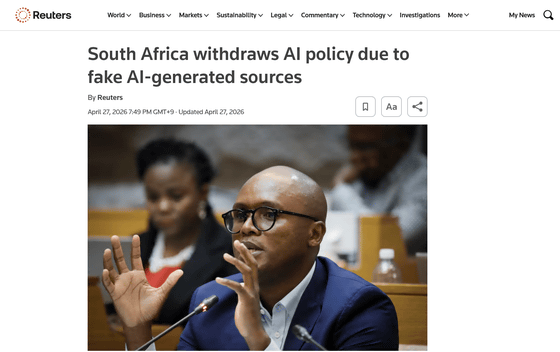
South Africa withdraws AI policy due to fake AI-generated sources | Reuters
https://www.reuters.com/world/africa/south-africa-withdraws-ai-policy-due-fake-ai-generated-sources-2026-04-27/
South Africa withdraws AI policy filled with AI hallucinations | Mashable
https://mashable.com/article/south-africa-withdraws-ai-policy-for-being-ai-generated
On April 10, 2026, South Africa's Ministry of Communications and Digital Technology released a 'National AI Policy Proposal' seeking public opinion on comprehensive proposals for establishing rules for AI implementation and promoting its widespread adoption. This policy aims to position South Africa as a continental leader in AI technological innovation and to address the ethical, social, and economic challenges associated with AI.
The draft outlined plans for the establishment of new bodies such as a 'National AI Commission,' an 'AI Ethics Commission,' and an 'AI Regulatory Authority.' These bodies would be responsible for coordinating policies, overseeing compliance with ethical standards, and providing redress and compensation mechanisms for AI-related harm. Furthermore, incentive programs such as tax breaks, grants, and subsidies targeting local startups and small and medium-sized enterprises were also being considered to promote collaboration with the private sector.
Other key policy considerations include investing in robust and cost-effective supercomputing infrastructure to support AI research and development. Strategic investments in digital infrastructure, including collaboration with international cloud providers and regional supercomputing centers, were also deemed necessary.
However, on April 26, 2026, South Africa's Minister of Communications and Digital Technology, Soli Maratzi, announced on X that 'the draft national AI policy will be withdrawn.'
Statement on the integrity of the Draft National Artificial Intelligence Policy
— SollyMalatsi (@SollyMalatsi) April 26, 2026
Following revelations that the Draft National Artificial Intelligence Policy published for public comment contains various fictitious sources in its reference list, we initiated internal questions…
According to Maratzi, an internal investigation revealed that the draft's bibliography included fictitious sources that appeared to have been generated by AI. Maratzi stated, 'This failure is not merely a technical issue; it undermines the integrity and credibility of the policy. The South African people deserve something better. The Ministry of Communications and Digital Technology has failed to meet the standards expected of an agency that plays a leading role in South Africa's digital policy environment.'
Maratzi also pointed out that those responsible for drafting and quality assurance of the policy would be held accountable, and added, 'This unacceptable failure demonstrates why vigilant human oversight of the use of AI is extremely important. This is a lesson we must take seriously. I want to assure the public that we are taking this issue seriously in accordance with its gravity,' thus reiterating the importance of AI policy.
Related Posts:






in AI, Posted by log1e_dh