The location of the edge of the Milky Way galaxy's 'star-forming disk' has been identified.

The edge of the Milky Way's star-forming disc: Evidence from a 'U-shaped' stellar age profile | Astronomy & Astrophysics (A&A)
https://www.aanda.org/articles/aa/full_html/2026/04/aa58144-25/aa58144-25.html
The Edge of the Milky Way's Star-Forming Disc Revealed in new research co-authored by UM Professor - Newspoint
https://www.um.edu.mt/newspoint/learn/2026/theedgeofthemilkywaysstar-formingdiscrevealedinnewresearchco-authoredbyumprofessor.html
Astronomers Find the Edge of the Milky Way - Sky & Telescope
https://skyandtelescope.org/astronomy-news/astronomers-find-the-edge-of-the-milky-way/
In general, in disk-shaped galaxies like the Milky Way, stars form from the inside out. Therefore, the further you go from the outer edge of the observed galaxy, the younger the stars are, but the exact edge of the Milky Way galaxy has not been defined.
In this study, a research team from the University of Malta and other institutions combined high-precision measurements from China's LAMOST spectroscopic telescope, APOGEE (which conducts wide-area surveys of the Milky Way galaxy), and the Gaia satellite launched by the European Space Agency (ESA) to analyze more than 100,000 massive stars orbiting the main disk of the Milky Way galaxy.
As expected, the results showed that the average age of stars in the Milky Way galaxy decreases with increasing distance from the galactic center. However, at a distance of approximately 35,000 to 40,000 light-years from the center, this trend reverses, revealing a 'U-shaped' distribution where the age of stars increases with increasing distance from the center.
In the image below, the graph in the upper right shows the age of a star on the vertical axis and the distance from the galactic center on the horizontal axis. It can be seen that the age of a star reverses beyond 12 kpc (12,000 parsecs , approximately 39 light-years). The diagram below it shows the boundary at 12 kpc from the center of the Milky Way galaxy.
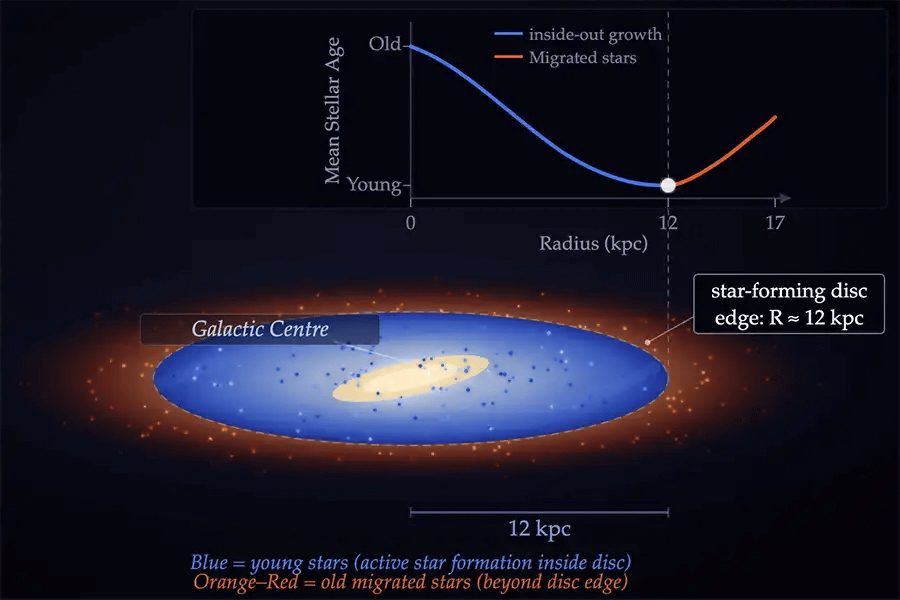
The research team's analysis revealed that the boundary of the 'Milky Way's star-forming disk' is located 35,000 to 40,000 light-years from the galaxy's center. New stars are forming from the center up to this boundary, but beyond this boundary, new star formation decreases sharply, meaning that only old stars remain outside the boundary.
Stars located on the outer edges of a star-forming disk are thought to have migrated from the galactic center through a process called 'radial migration.' In radial migration, stars ride the spiral waves that orbit the galaxy, gradually moving outward from their birthplace. This process takes a very long time, which is why stars located further out are older.
Dr. Carl Fiteni , the lead author of the paper and currently affiliated with the University of Insubria in Italy, stated, 'The scale of the Milky Way galaxy's star-forming disk has long been an unsolved problem in galactic archaeology. By mapping how the age of stars changes across the entire disk, we have obtained a clear and quantitative answer.'
Similar U-shaped age distributions have been reproduced in simulated disk galaxies, and have also been inferred from observational data of galaxies other than the Milky Way. In other words, the Milky Way is not a unique entity, and it is highly likely that it follows a pattern common to disk-shaped galaxies.
Related Posts:





in Science, Posted by log1h_ik