OpenAI releases 'ChatGPT for Clinicians,' an AI for clinical settings, which has achieved better benchmark scores than human doctors.
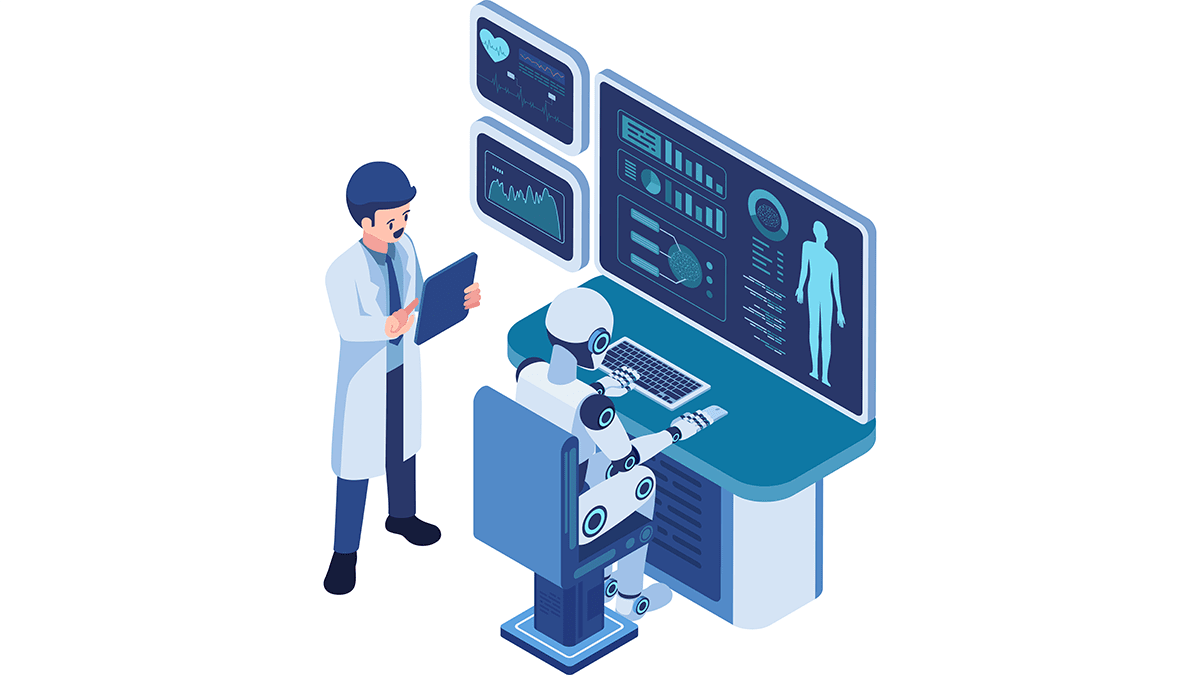
OpenAI has announced a new tool called ' ChatGPT for Clinicians ,' specifically designed to support clinical practice. It will be offered free of charge to verified doctors, nurses, pharmacists, and other healthcare professionals in the United States.
Making ChatGPT better for opposition | OpenAI
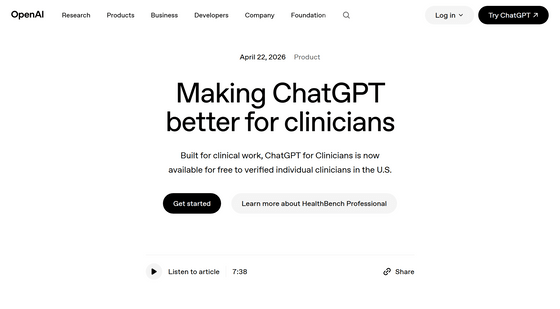
ChatGPT for Clinicians is a new version of ChatGPT designed to support clinicians in their clinical tasks, such as documentation and medical research, so that they can focus on providing high-quality patient care.
American clinicians are being asked to see more patients while keeping up with increasing administrative demands and rapidly expanding medical research, and are already leveraging AI tools like ChatGPT. According to a 2026 survey by the American Medical Association, 72% of physicians will be using AI in their practice. This represents a 24% increase from 48% in the 2025 survey.
Furthermore, according to OpenAI, clinicians outside the United States are also using ChatGPT for purposes such as patient consultation, document creation, and medical research. Globally, the use of ChatGPT by clinicians has doubled in the past year.
In light of these circumstances, OpenAI has decided to provide free access to ChatGPT for Clinicians in clinical settings as 'the next step in supporting our mission that AGI will benefit all of humanity.'
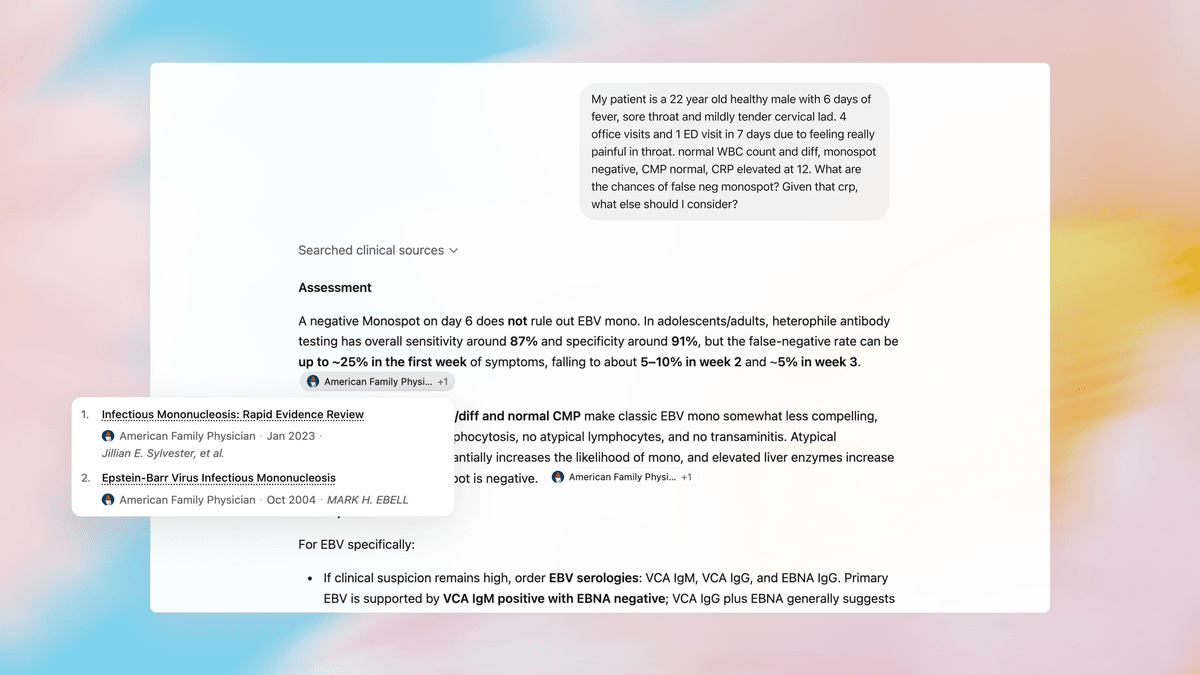
ChatGPT for Clinicians includes the following elements:
• Advanced AI models to address complex clinical questions
They say that the latest, most advanced models are available for free use in medical settings.
• Skills for repeatable clinical workflows
By converting common workflows into reusable skills, ChatGPT can perform tasks such as writing referral letters, obtaining pre-approvals, and giving patient instructions using the same procedure every time.
• Reliable clinical search
Answers are based on evidence from millions of trusted, peer-reviewed medical sources. Responses are provided in real time and with citations, allowing for faster and more confident case review.
• A thorough investigation across all medical journals.
By setting trusted sources in ChatGPT and entrusting it with medical literature reviews or guiding it to conduct research as needed, it's possible to create comprehensive, well-cited reports in minutes.
Continuing medical education credits (CMEs) derived from actual clinical questions.
If you investigate a clinical question using ChatGPT, the review of the relevant evidence will automatically be recognized as continuing medical education credit.
Optional support for compliance with the Health Information Privacy Act (HIPAA).
If needed, HIPAA compliance support is available through a Business Associate agreement.
Account security and privacy
The content of conversations is not used to train the model, and the security of highly confidential work is ensured through protection features such as multi-factor authentication.
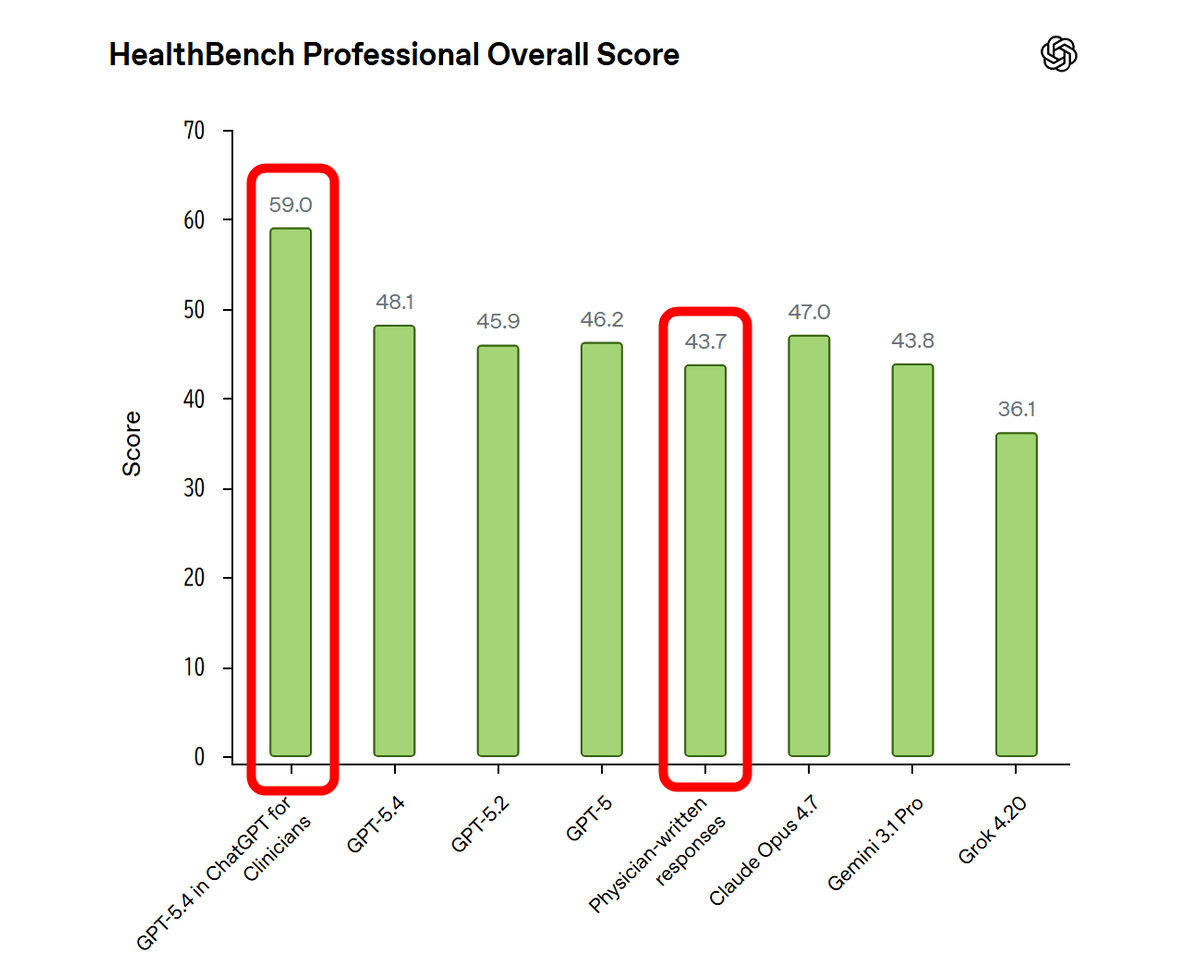
OpenAI has also announced the introduction of a new benchmark called ' HealthBench Professional ' to improve the safety and accuracy of ChatGPT responses. HealthBench Professional is an open benchmark targeting actual clinician chat tasks across three use cases: medical consultation, document creation, and medical research.
The following chart compares HealthBench Professional scores across various models. It shows that 'GPT-5.4 in ChatGPT for Clinicians,' built on ChatGPT-5.4, not only stands out but also achieves a higher score than 'Physician-written responses.'
While this release is currently limited to the United States, OpenAI states that it plans to expand its services internationally in the future.
Related Posts:





in AI, Posted by log1d_ts