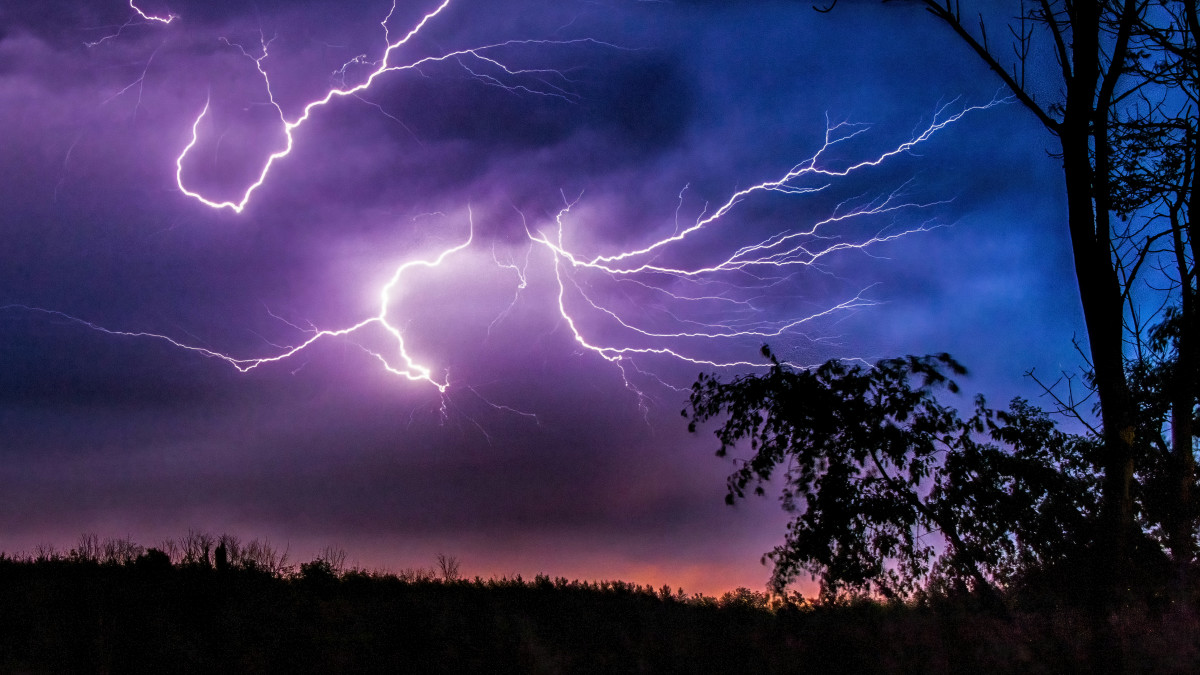
Corona discharge, where the tips of leaves glow during a storm, has been observed in nature for the first time.
For many years, scientists have hypothesized that a weak electrical discharge called
Corona Discharges Glow on Trees Under Thunderstorms - McFarland - 2026 - Geophysical Research Letters - Wiley Online Library
https://agupubs.onlinelibrary.wiley.com/doi/10.1029/2025GL119591
Treetops glowing during storms captured on film for first time | Penn State University
https://www.psu.edu/news/earth-and-mineral-sciences/story/treetops-glowing-during-storms-captured-film-first-time
Corona discharge is a type of electrical discharge that occurs during storms. When clouds accumulate strong negative charges , they attract positive charges on the Earth's surface, causing these positive charges to rise from the surface through trees to their highest points. This creates a strong electric field in the fine, hair-like parts at the tips of leaves, resulting in a weak luminescence in both visible and ultraviolet light.
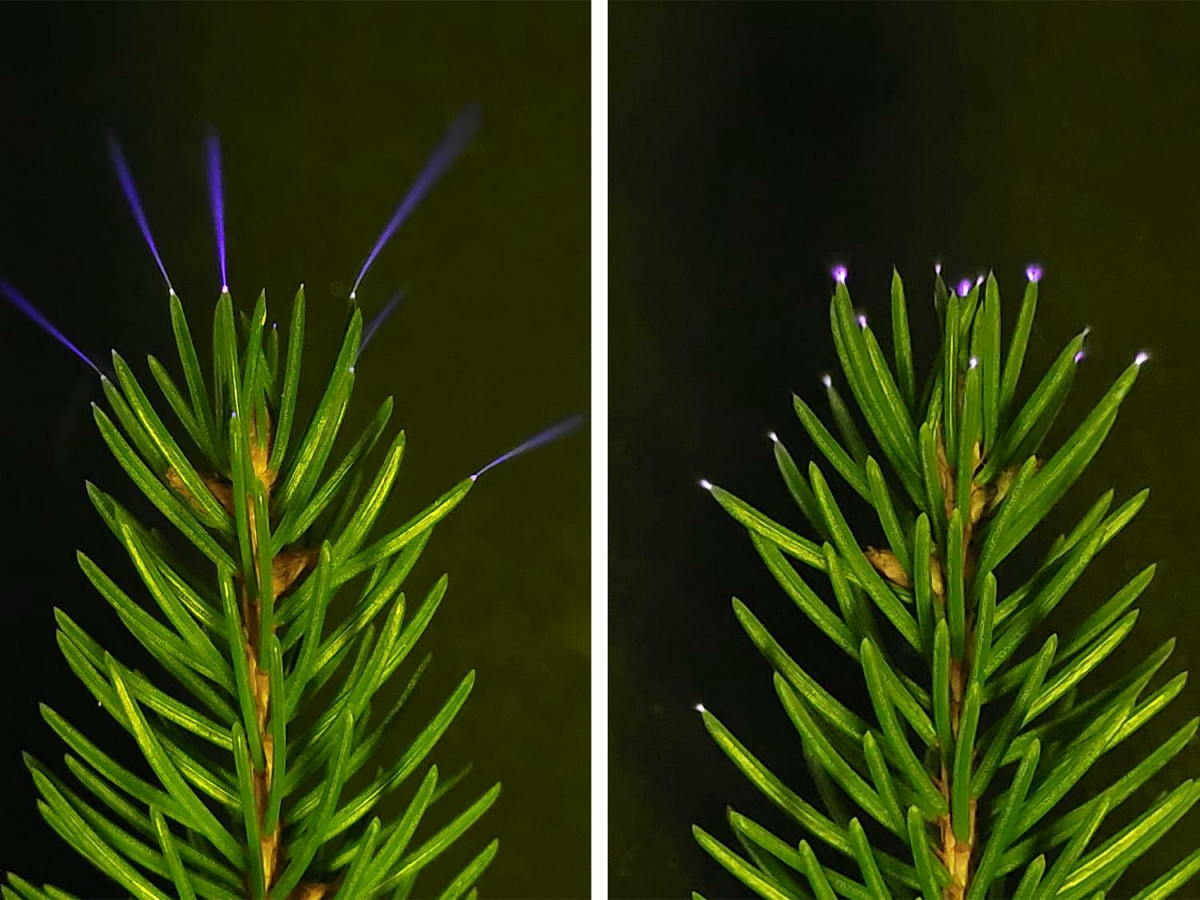
Previous studies had confirmed corona discharge in plants in the laboratory, but no scientifically observed cases in nature had been reported. The following photograph, taken in the laboratory, shows corona discharge occurring in spruce leaves.
In this study, Patrick McFarland, a meteorologist and atmospheric scientist at Pennsylvania State University, and his research team attached a special retractable weather observation device to a 2013
The observation device developed by the research team consists of an ultraviolet camera connected to a telescope, equipped with a device to measure electricity in the atmosphere, and uses a mercury lamp to calibrate ultraviolet radiation. As a result, ultraviolet wavelength bands such as those of the sun are completely blocked, and only lightning and fire can be observed as ultraviolet sources, in addition to corona discharges.
The research team drove south from Pennsylvania in the northeastern United States through Sienna, chasing the storm in Florida, a state in the southeast known for its frequent thunderstorms.
However, they weren't getting the results they wanted, so they headed north on Interstate 95 to return to Pennsylvania. Along the way, they encountered a perfect storm in North Carolina . They quickly pulled over, pointed their observation equipment at sweetgum trees and pine trees 30 meters away, and conducted observations in the thunderstorm.
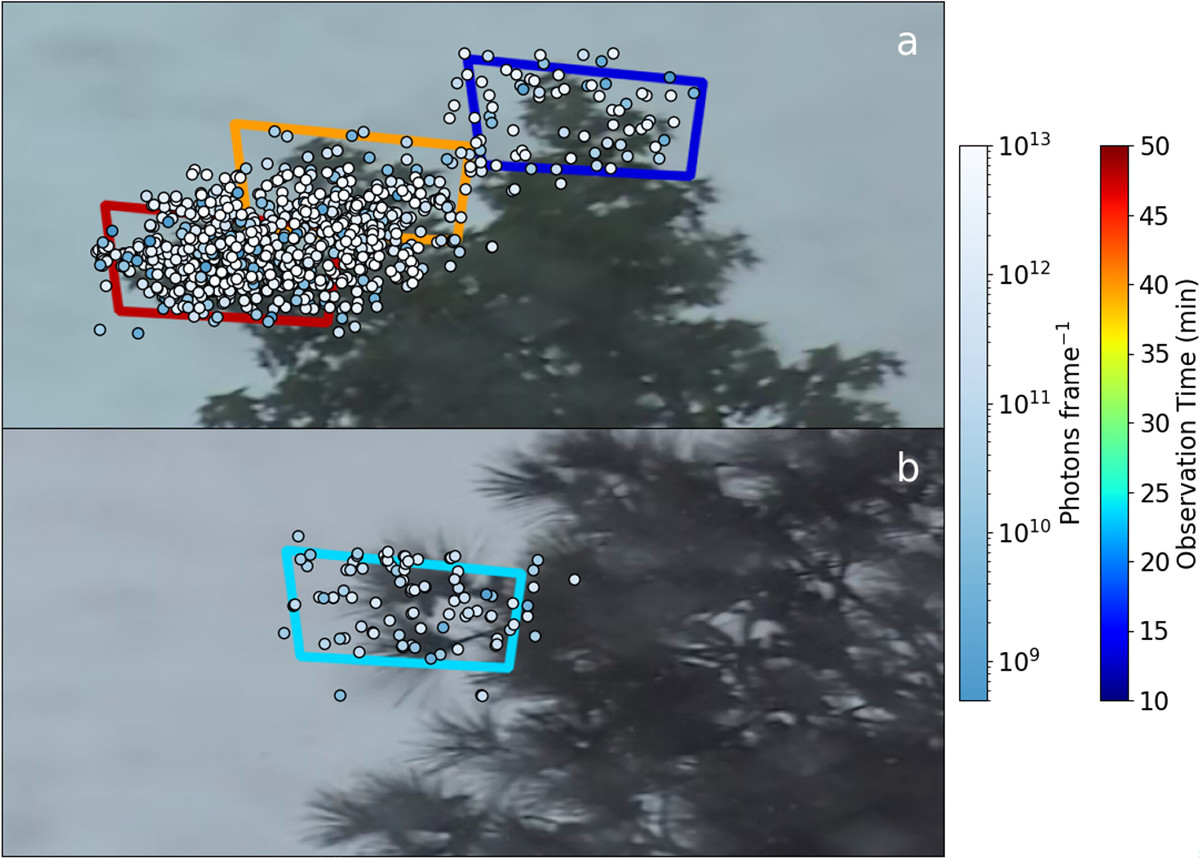
During a thunderstorm that lasted nearly two hours, the research team continued their observations and confirmed 859 corona discharges in sweetgum trees and 93 in loblolly pine trees. The image below maps the locations where corona discharges occurred on the sweetgum trees that were observed.
McFarland said, 'This shows that discovery science is still going strong. Scientists have theoretically speculated about the existence of corona discharges for over half a century, but this study has proven it. They are barely visible to the naked eye, but our observation equipment captures shimmering bands of corona discharges as thunderstorms pass overhead.'
Furthermore, when water vapor is decomposed by corona discharge from trees, oxidizing agents such as hydroxyl radicals are generated. Since hydroxyl radicals react with greenhouse gases such as methane, it is possible that corona discharge from plants indirectly helps purify the atmosphere.
The 'corona discharge' that causes the tips of branches and leaves to glow blue when lightning strikes may be affecting air quality - GIGAZINE
Related Posts: