Anthropic has published research findings on AI, including 'the greater the job using AI, the greater the sense of crisis' and 'the higher the income, the greater the benefits from AI.'

Anthropic, the company that develops the AI model 'Claude' series, conducted a survey of 81,000 users of Claude and has published the results.
What 81,000 people told us about the economics of AI \ Anthropic
The survey reportedly included various questions about 'people's outlook and concerns regarding the advancement of AI.' Claude was also used to infer respondents' attributes and emotions, and to quantify concerns about unemployment.
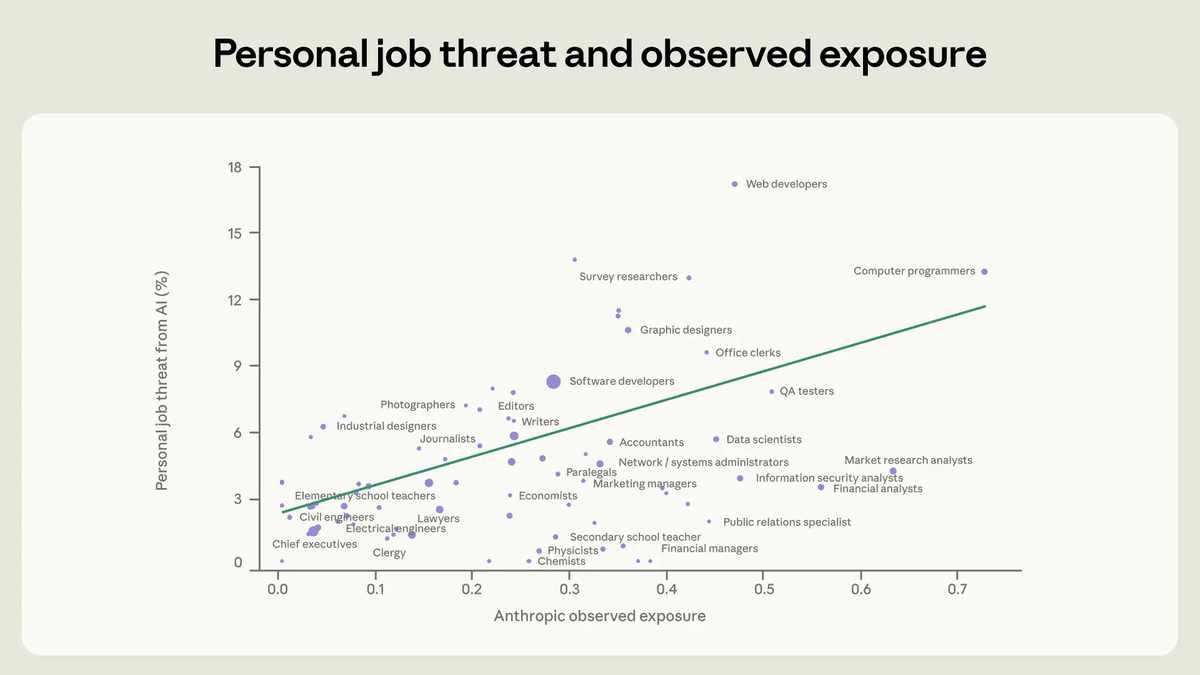
Through its research, Anthropic created and measured an index called 'exposure level.' Exposure level indicates which parts of the work Claude is used in; in other words, occupations with a high exposure level are those in which AI is used extensively in the work.
The following graph shows the percentage of people who answered 'AI is replacing my role, or is likely to replace it in the near future' on the Y-axis, and the degree of exposure on the X-axis, categorized by occupation. It can be seen that the higher the percentage of people who use AI in their work, the greater their concern about their jobs being taken over by AI.
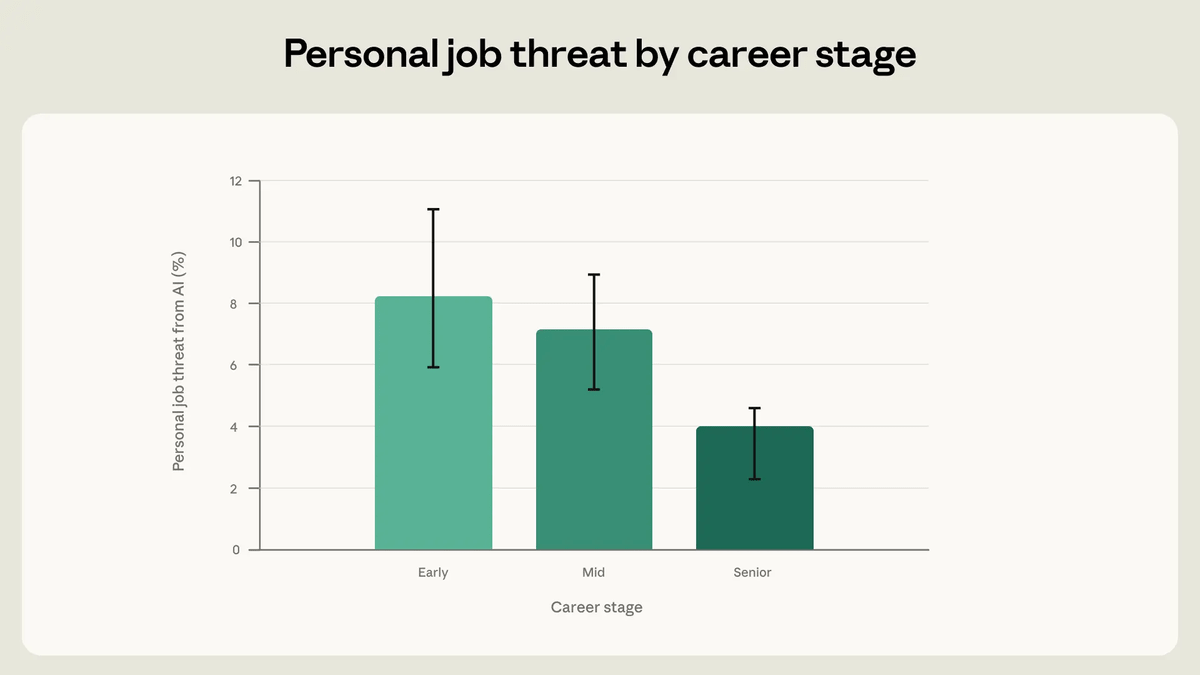
Furthermore, the responses, categorized by career stage, are as follows: The group at the far left, in the early stages of their careers, has a higher level of concern about job loss.
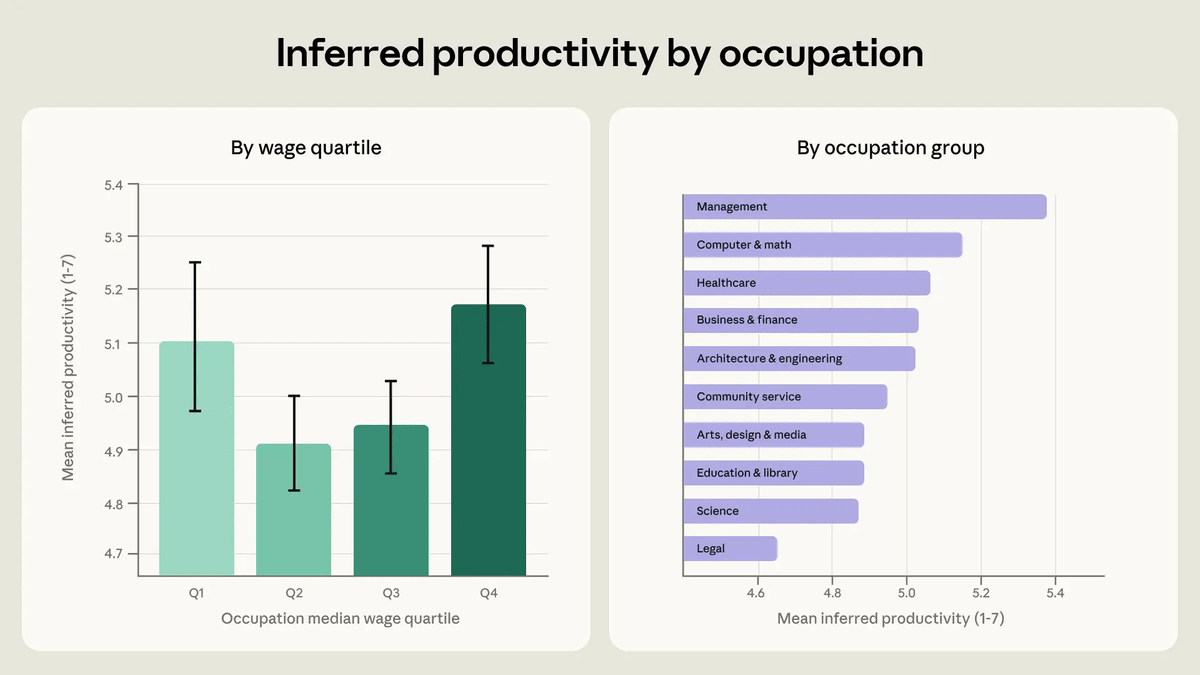
The following are the results of a survey on how much people are benefiting from AI. Written responses were converted to scores from 1 to 7. The average score for all respondents was 5.1, which corresponds to a score of 'productivity has greatly improved.' It also became clear that people in higher-paying professions, such as executives and software developers, are benefiting more from increased productivity.
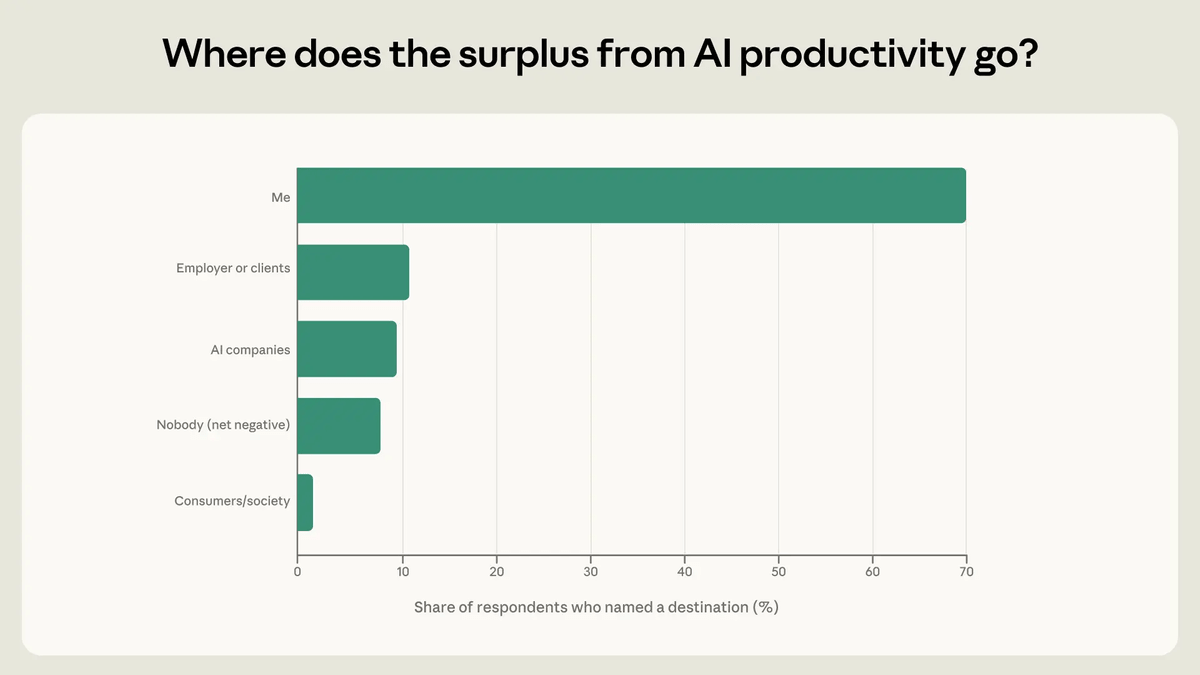
When asked, 'Who do you think is benefiting from the advent of AI?', the overwhelming majority answered 'myself.' Additionally, 10% said they were benefiting from their employers or clients demanding more work.
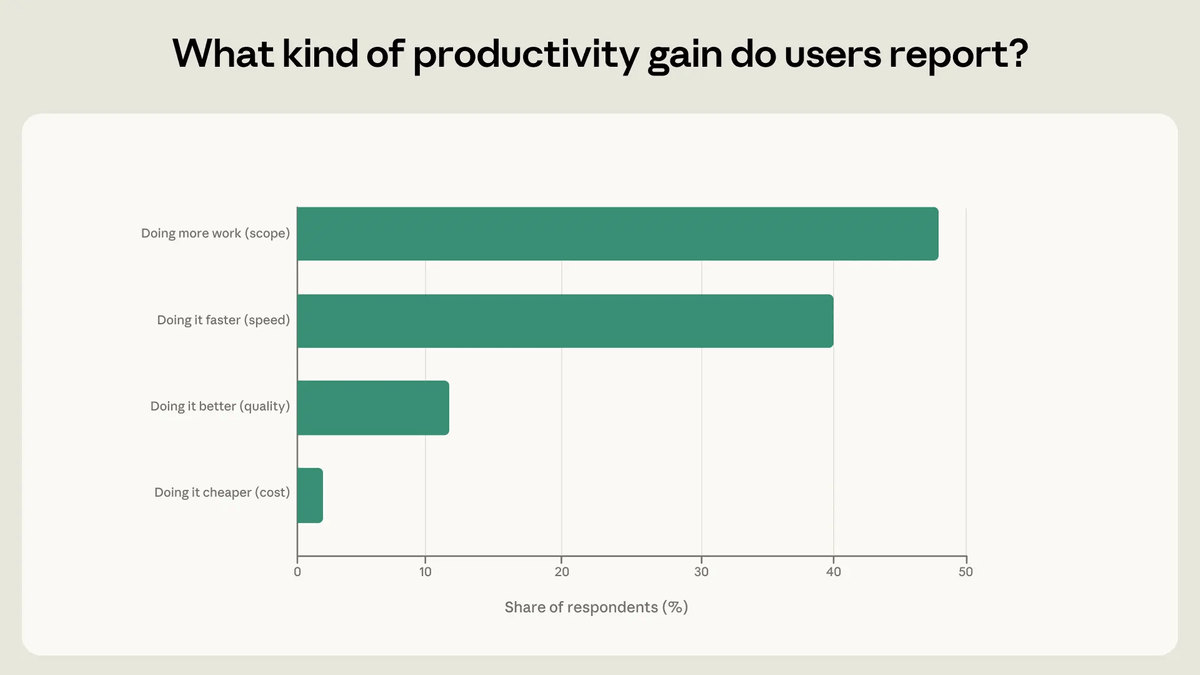
Anthropic also investigated the content of 'productivity improvement.' When they categorized respondents' descriptions of productivity improvement into four aspects—'expanded scope of work,' 'increased speed,' 'improved quality,' and 'reduced costs'—the most common response was 'expanded scope of work,' such as 'I was able to write code outside my area of expertise,' followed by 'increased speed,' such as 'financial tasks that used to take two hours can now be completed in 15 minutes.' Together, these two accounted for nearly 90% of the responses.
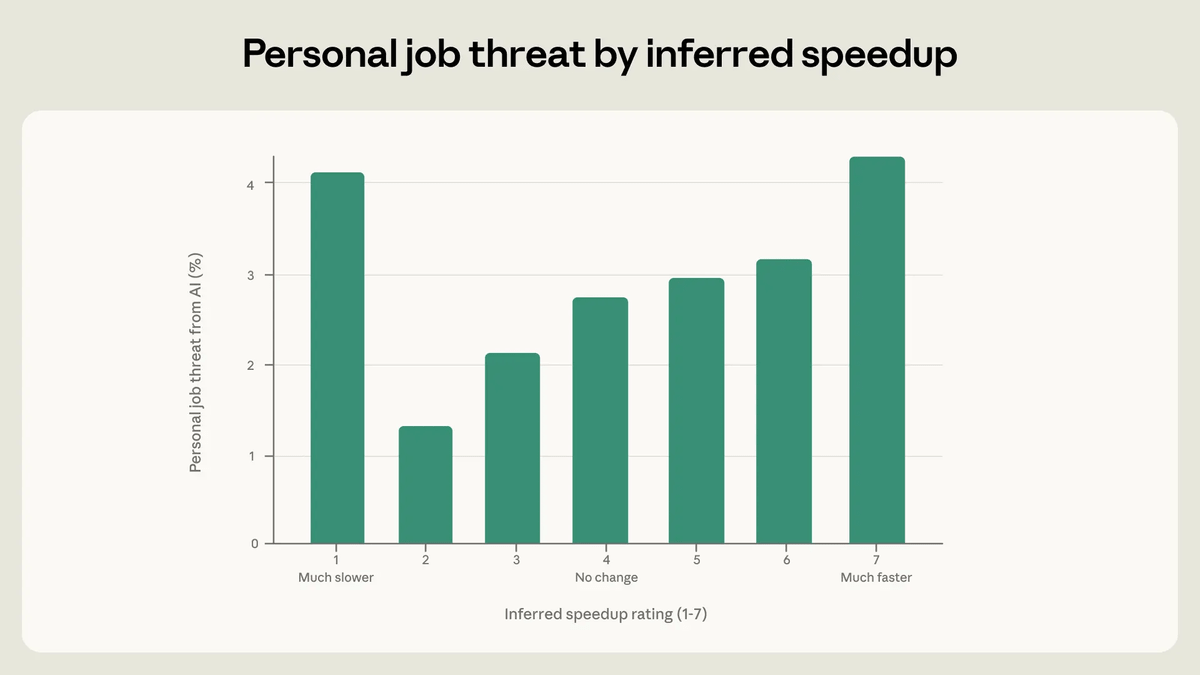
A study investigating the relationship between the fear of losing one's job to AI and the increased work speed due to AI revealed that the sense of crisis was higher in both extreme groups: those whose work speed decreased and those whose work speed increased significantly. In creative fields, although AI's inflexibility slowed down the process, the sense of crisis regarding job loss remained high.
Anthropic also noted that the survey targeted 'people who have a personal Claude account and wished to respond,' and cautioned that 'they may be more likely to perceive the benefits as being directed towards themselves.'
Related Posts:








in AI, Posted by log1d_ts