The little-known large-scale 'mountain climbing rescue' scam in Nepal has defrauded insurance companies worldwide of millions of dollars.
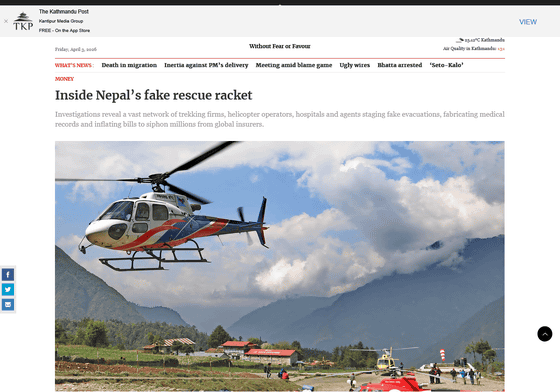
Nepalese media have reported that a large-scale 'fake rescue scam' is spreading, involving trekking companies, helicopter operators, hospitals, and agencies. This scam involves staging fake mountain rescues to defraud insurance companies worldwide of hundreds of millions of dollars.
Inside Nepal's fake rescue racket
The scam involves calling a helicopter under the guise of a medical emergency, admitting tourists to a hospital, and then defrauding insurance companies of large sums of money by filing insurance claims that are far removed from the actual events. What makes this scam so clever is that it is difficult for foreign insurance companies, such as those based in Australia or the UK, to thoroughly investigate an incident that supposedly occurred in a remote valley at an altitude of 3,000 meters in the Himalayas.
The Kathmandu Post , Nepal's leading daily newspaper, first reported on the fraudulent mountain rescue scams taking place in Nepal in 2018. Following the report, the government established a fact-finding commission, produced a 700-page report, and announced reforms.
However, when the Central Bureau of Investigation (CIB) of the Nepalese police reopened the investigation in 2025, it was discovered that the fraudulent activities had not stopped due to past media coverage and government investigations, but had actually expanded.
A CIB investigation identified two main methods used by fraud groups to fabricate mountain rescues. First, after completing a grueling trek, such as reaching Everest Base Camp, where it can take up to two weeks to return home, guides feign illness and claim a helicopter will arrive, creating a medical emergency. This creates opportunities for fraud by exploiting tourists who, having reached their destination, are unwilling to walk back.
The second method involves the fact that at altitudes above 3000m, mild symptoms of altitude sickness, such as numbness in the hands and feet and headaches, often occur due to decreased blood oxygen saturation. While most of these symptoms resolve with rest, hydration, or a slow descent, guides and hotel staff often tell climbers that they are in danger of death and will not survive unless they evacuate immediately. When a rescue request is made, even though multiple passengers are actually on one helicopter, individual insurance companies are billed for the full amount, as if each passenger had their own helicopter.
According to a CIB investigation, there were cases where Diamox (acetazolamide), a drug used to prevent altitude sickness, was administered in combination with excessive fluid intake to induce symptoms that justified a request for rescue. Furthermore, there have been confirmed instances where baking powder was mixed into food with the intention of causing illness among tourists.
The investigation identified 4,782 foreign patients who received treatment at hospitals suspected of being involved in the fraud between 2022 and 2025, and confirmed that 171 of these cases involved fraudulent rescue operations. It was also revealed that hospitals suspected of being involved in the fraud received up to $15.87 million (approximately 2.5 billion yen).
Dr. Gilwan Raj Thirmina of Sridee Hospital, who is alleged to have received more than $1.22 million (approximately 200 million yen) for his involvement in the fraud, admitted his involvement in the fraud during questioning, saying, 'My hospital has also paid commissions from its profits to trekking companies and rescue companies to promote its business.'
In 2018, the government's business investigation committee recommended that all helicopter companies, hospitals, travel agencies, and insurance companies be required to submit details of rescue flights and medical treatments to the Tourism Search and Rescue Committee, the Tourism Police, and the Ministry of Tourism, while also excluding intermediaries and stipulating that travel agencies would be legally responsible to customers during their trips. However, since fraud continued, the Kathmandu Post noted that 'this new investigation highlights systemic failures in Nepal.'
CIB Director Manoj Kumar stated, 'This fraud has survived without being eradicated because enforcement has been lax. If no action is taken against the crime, it will continue to spread.' On March 12, 2026, the CIB indicted 32 people, including employees of a helicopter operator and doctors and managers at hospitals, on charges of crimes against the state and organized crime related to rescue fraud.
Related Posts:






in Note, Posted by log1e_dh