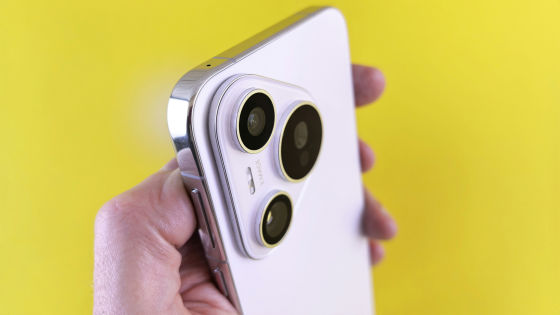
The smartphone brought on 'Artemis II' was a specially modified 'iPhone 17 Pro Max,' marking the first time NASA has allowed astronauts to use a smartphone on a lunar exploration mission.
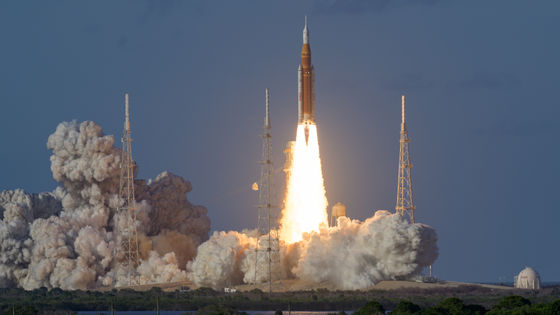
NASA announced that it successfully launched a crewed spacecraft on April 1, 2026, for the Artemis II mission , the second phase of the Artemis program aimed at landing humans on the moon, with the goal of performing a lunar flyby . The Orion spacecraft, carrying four astronauts, is the first crewed spaceflight to officially allow the use of smartphones, and a specially modified iPhone 17 Pro Max was brought aboard the spacecraft.
NASA's Artemis II Astronauts Took iPhones Into Space - The New York Times
https://www.nytimes.com/2026/04/03/technology/iphones-artemis-nasa.html
NASA had to 'reload' Microsoft Outlook after Artemis II glitch | The Verge
https://www.theverge.com/science/906988/nasa-artemis-ii-microsoft-outlook-issue-fixed
NASA Administrator Jared Isaacman announced in an X post on February 4, 2026 (local time) that Artemis program astronauts will be allowed to bring smartphones into space. One of the goals of the Artemis II mission is to take various photographs from the spacecraft, so using smartphones will make it easier to take pictures from space.
NASA allows astronauts on the Artemis lunar exploration mission to bring smartphones into space - GIGAZINE
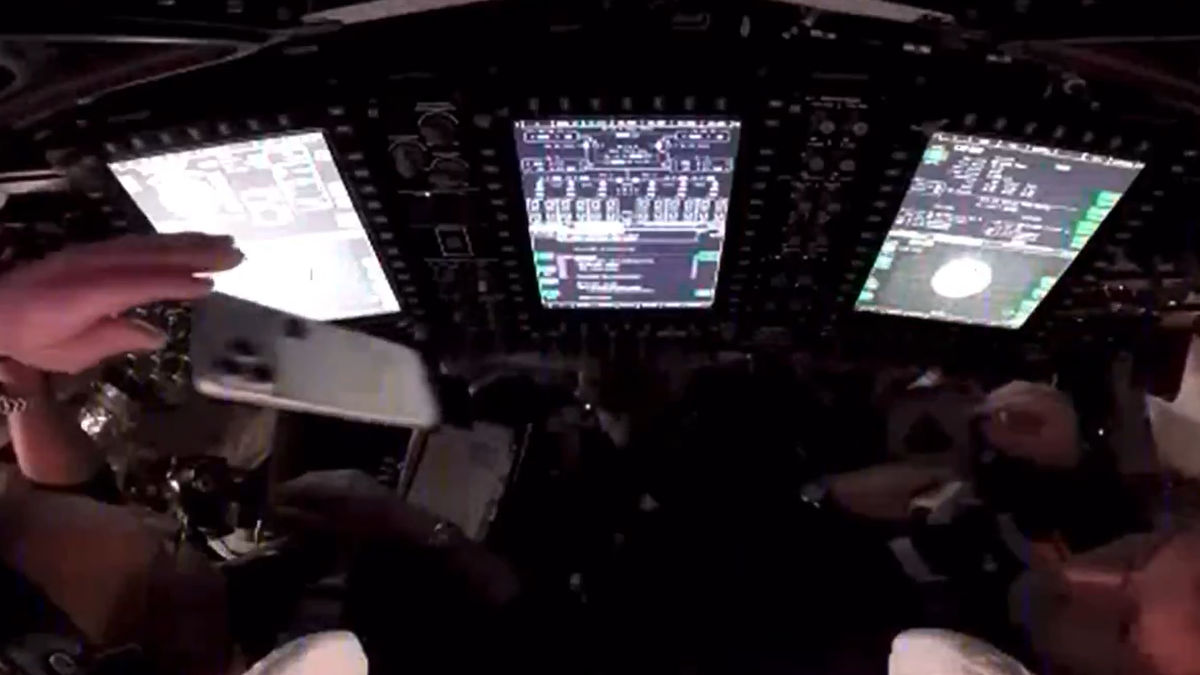
Approximately four hours after the start of the Artemis II mission, a camera positioned overlooking the cockpit captured footage of astronauts tossing iPhones to each other, which became a hot topic.
The Artemis crew tossing around their iPhones, floating in zero gravity 😂 https://t.co/8Xzjm5Njgz pic.twitter.com/mjghv2fz1I
— Owen Sparks (@OwenSparks) April 2, 2026
According to reports, an iPhone 17 Pro Max was brought aboard the Orion spacecraft. However, the iPhone 17 Pro Max was specially modified for the purpose of taking photos and videos, and was not capable of connecting to the internet or Bluetooth, playing games, or running other apps. In addition to the iPhone 17 Pro Max, two Nikon D5s and four GoPro Hero 11s were used to take photos and videos.
Tobias Niederwieser, an assistant professor at BioServe Space Technologies , a research institute at the University of Colorado Boulder, who worked on the Artemis I mission's payload, points out that 'the process of approving bringing specific hardware onto a spacecraft is quite complex and time-consuming.' According to Niederwieser, this process typically involves four steps: 'introducing the equipment to the safety panel,' 'identifying the equipment's potential hazards, from moving parts to materials that could shatter like glass,' 'developing a plan to address those hazards,' and 'verifying that the plan is effective.'
Apple told the media that it was not involved in the approval process for iPhones on the Artemis II mission. They also stated that this mission marks the first time an iPhone has been deemed suitable for long-term use in orbit and beyond. While iPhones have been brought onto spacecraft for photography and experimentation on private missions, this is the first time NASA has allowed astronauts to bring a smartphone on board.
It was also shared in the livestream that Commander Reed Wiseman reported to control center, 'We have two Microsoft Outlook instances, but neither is working.' Artemis Flight Director Judd Freeling stated that it wasn't a major problem, saying, 'This isn't unusual. It happens all the time on the space station. As you know, Outlook can have configuration issues, especially when it's not directly connected to the network. So, simply reloading his files in Outlook fixed the problem,' but it illustrates the difficulties of operating consumer software in a space environment.
The recent use of an iPhone 17 Pro Max inside a spacecraft is noteworthy not only for facilitating the smooth capture and sharing of photos and videos, allowing for the delivery of more scenery, but also as a first step in using commercially available devices within spacecraft. It is hoped that future missions will see the further advancement of the use of more flexible and readily available devices.
The photos taken from the Orion spacecraft are available on NASA's website. Some of the published photo data retains Exif information, and it has been determined that the global photograph of Earth used as the top image in the following article was taken with a Nikon D5.
Photos of Earth taken from the Orion spacecraft en route to the moon - GIGAZINE
Related Posts:

in Hardware, Posted by log1e_dh