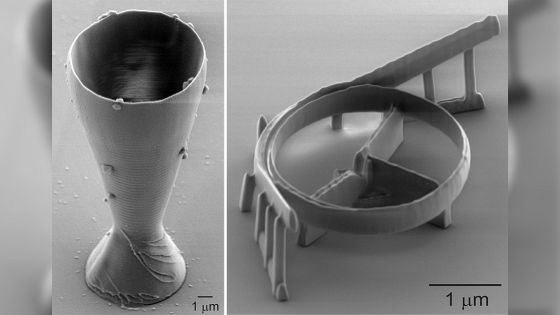
We have succeeded in 3D printing a robot the size of a single cell organism, smaller than a human hair.
A research team at
Alive or not? Tiny 3D printed robots that swim and navigate just like animals - Leiden University
https://www.universiteitleiden.nl/en/news/2026/03/alive-or-not-tiny-3d-printed-robots-without-a-brain-that-swim-and-navigate-just-like-animals
Researchers 3D print robot the size of a single-cell organism — devices move and navigate even without a 'brain,' uses their shape and the environment to get going | Tom's Hardware
https://www.tomshardware.com/3d-printing/researchers-3d-print-robot-the-size-of-a-single-cell-organism-devices-move-and-navigate-even-without-a-brain-uses-their-shape-and-the-environment-to-get-going
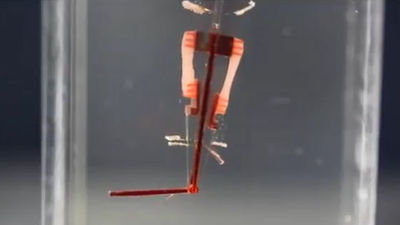
A research team at Leiden University has successfully 3D printed a robot the size of a single cell organism. Measuring just 0.5 to 5 micrometers, it can move at a speed of 7 micrometers per second. Considering that a human hair is approximately 70 to 100 micrometers thick, you can see just how tiny the robot developed by the research team is. According to the research team, the robot was 3D printed at the very limit of what was technically possible at the time of writing. The robot is made of synthetic resin and was printed using a Nanoscribe 3D printer.

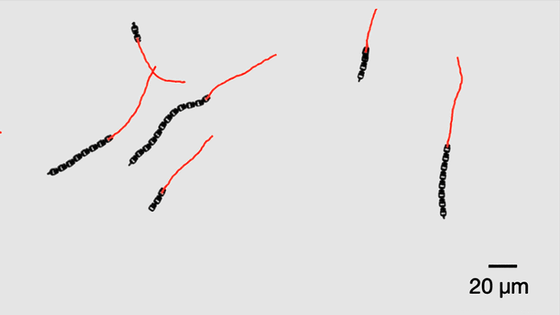
The defining characteristic of this robot is that it operates without the need for sensors, software, or external control. Professor Daniela Kraft, who led the robot development team, explained the development process: 'Animals like earthworms and snakes constantly change their body shape when moving, which allows them to navigate their surroundings effectively. Similarly, some large robots utilize flexibility to perform their functions. However, microrobots have only been either small and rigid or large and flexible. So, we thought it might be possible to create a small and flexible microrobot.'
You can see the robot developed by the research team moving around in the following video.
Microrobots - by Professor Daniela Kraft and postdoc Mengshi Wei - Universiteit Leiden - YouTube
The robot has a chain-like structure, similar to a bicycle chain, and when an electric field is applied, the chain moves, allowing it to move as if it were alive. Mency Wei, a member of the research team, explained, 'When the robot slows down or stops, it starts wagging its tail as if it wants to escape. This is because the rear parts are still trying to move, and it is thanks to their flexibility that it can move.'
Professor Kraft explains, 'We discovered that there is continuous feedback between the robot's shape and movement. The shape influences how it moves, and the movement changes the shape. As a result, this microrobot senses how the environment changes its body and reacts to it, making it appear almost alive. In other words, tiny electronics are not needed to integrate smart functions.'
The ability of these microrobots to autonomously navigate complex environments holds great potential for applications in biomedical fields such as targeted drug delivery, minimally invasive medical procedures, and diagnostics. However, the mechanisms behind such dynamic and functional behavior are not fully understood, so further research is needed before they can be applied to the medical field.
Related Posts: