Who was Lieutenant Thomas Selfridge, who died in the world's first fatal airplane crash?

On December 17, 1903, brothers Wilbur and Orville Wright successfully achieved the world's first manned powered flight. The U.S. Army was considering purchasing the Wright Flyer developed by the Wright brothers, and a demonstration was held at a base, but a crash occurred during the demonstration. Lieutenant Thomas Selfridge, who was on board, was killed.
Thomas Selfridge: The First Airplane Fatality | Amusing Planet
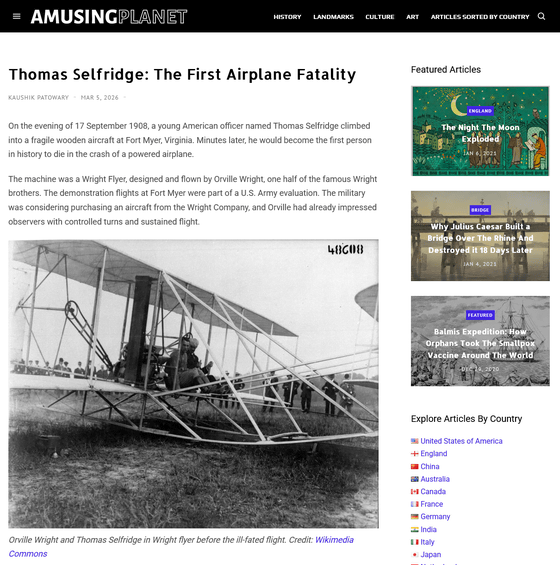
Aviation History: First Lt. Thomas Selfridge died during aerial mishap in Wright Military Flyer, but there's more to his legacy > Joint Base San Antonio > News
Thomas Selfridge was born in 1882 in San Francisco, California. His grandfather was Thomas Oliver Selfridge, a naval admiral during the Mexican-American War and the American Civil War in the mid-19th century. His uncle, Thomas Oliver Selfridge Jr., was also a naval admiral.
Unlike his grandfather and others, Selfridge graduated from West Point Military Academy in 1903. He ranked 31st out of 96 students, while Douglas MacArthur, a name well-known in Japan, was the top student of the class.
After graduation, Selfridge was commissioned as a lieutenant in the artillery and participated in relief efforts following the 1906 San Francisco earthquake.
Apparently, he had an early interest in aeronautics, and in 1907 he was assigned to the 'Air Division Signal Corps' established by the U.S. Army, where he received training in flying airships. He also served as the government representative and secretary-general of the Aeronautical Experimental Association (AEA), founded by Alexander Graham Bell, the scientist and inventor of the telephone. Lieutenant Selfridge was apparently very enthusiastic, and Bell, who was planning a flight demonstration, reportedly asked President Theodore Roosevelt to appoint Lieutenant Selfridge as the official supervisor.
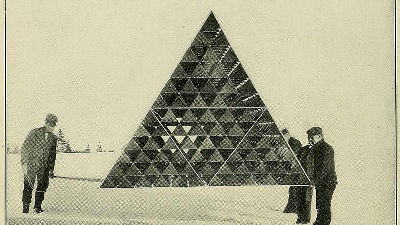
At the AEA, Lieutenant Selfridge flew a Bell-designed tetrahedron kite called Signet for seven minutes at an altitude of 50 meters.
The tetrahedron kite, an unusual kite that Graham Bell, the inventor of the telephone, researched, looked like this in person - GIGAZINE
The AEA also designed aircraft, and although Lieutenant Selfridge handed over the first aircraft, 'Aerodream No. 1' (nicknamed 'Red Wing'), to AEA member Frederick Baldwin , on May 17, 1908, Lieutenant Selfridge flew the second aircraft, 'Aerodream No. 2 (White Wing),' at an altitude of 3 meters and a height of 85 meters. Since Baldwin was Canadian, this means that Lieutenant Selfridge was 'the first American military officer to fly a modern aircraft on his own.'
On September 17, 1908, Orville Wright was scheduled to give a flight demonstration of the Wright Flyer to Army personnel. There are two theories regarding who was on board the Wright Flyer at that time: one says that Lieutenant Selfridge volunteered, and the other says that he was urged to do so by a fellow officer.
In any case, the Wright Flyer attempted the demonstration with the two on board, taking off and rising to an altitude of at least 30 meters. After circling three times, the wooden propeller broke midway through the fourth circle, causing it to shake, and the wires broke the propeller, resulting in a steep descent. Although it glided for a short distance, it crashed nose-first into the ground, throwing the two men off the plane.
In an era before protective helmets existed, Orville suffered serious injuries, including broken ribs, leg bones, and hip joints. Lieutenant Selfridge suffered a fractured skull and, despite surgery, never regained consciousness before dying.
The Wright brothers subsequently modified the aircraft to address structural weaknesses and propeller reliability issues, and in 1909, the Army signed a contract with the Wright Company to purchase the aircraft. The propeller from the wrecked aircraft was recovered and can be seen at the National Museum of the United States Air Force at Wright-Patterson Air Force Base in Ohio.
Related Posts: