A study analyzing 668 dreams reveals a link between stress and sleep.

Many people have likely experienced getting into bed to sleep, only to find themselves unable to fall asleep because unpleasant past events or anxieties about the future keep popping into their heads. Research by Swiss psychologists has shown that sleep quality differs depending on whether you are already experiencing stress or anticipating future stress.
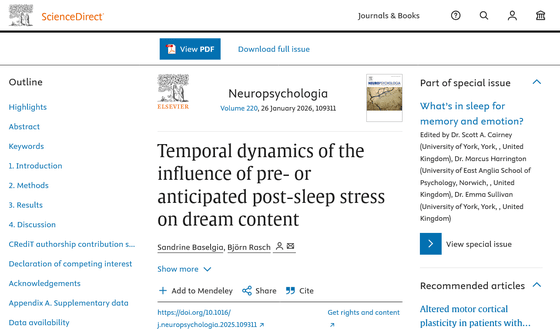
Temporal dynamics of the influence of pre- or anticipated post-sleep stress on dream content - ScienceDirect
Why Worrying About Tomorrow Can Disrupt Your Sleep Tonight | Psychology Today
https://www.psychologytoday.com/us/blog/memory-tour-guide/202603/why-worrying-about-tomorrow-can-disrupt-your-sleep-tonight
Sandrine Bazelzias and Bjorn Lasch, psychology researchers at the University of Fribourg in Switzerland, investigated the relationship between stressors and dreams, believing that anticipated stress before or after sleep can influence the content of dreams and disrupt sleep. In psychology, memories related to such planned future events are called ' prospective memories .'
Similar studies have been conducted in the past. For example, a study published in 2014 by a French research team reported that approximately 60% of students experienced poor sleep quality due to nightmares about the exams immediately before medical school entrance exams. In addition, a paper published in 2023 by Jonas Beck and colleagues at the University of Fribourg found that indicators of high-quality sleep decreased when brain activity during sleep was anticipated, based on their findings.
Building on previous research, the research team of Bazelzia and Rush investigated the effects of pre-sleep stress and predicted post-sleep stress. Participants were divided into a 'pre-sleep group' and a 'post-sleep group.' The pre-sleep group was asked to perform either a stress task or a relaxation task before sleep, while the post-sleep group was informed before sleep that they would be given either a stress task or a relaxation task the following morning. Both groups were awakened up to eight times during the early and late stages of sleep, and their polysomnographic data, which included questions about cognitive activity and assessments of sleep, was recorded.
Fifty-five participants took part in the experiment, and they reported having dreams 772 times, or 94.61% of the total. Of these, 668 dreams whose content was remembered were recorded in the database. While there was no difference between the two groups in the reflection of threat and stress-related elements in dreams, the post-sleep group, which was informed of the task for the following morning, showed effects such as 'dream content becoming more stressful as wake-up time approached' and 'dreams becoming longer.'

Researchers have concluded that when a stressful task is anticipated after sleep, brain activity increases, primarily in the latter half of sleep, in preparation for the expected stress. On the other hand, in a pre-sleep group that performed either a stressful or relaxation task before sleep, the level of stress in dreams did not differ significantly depending on the type of task, suggesting that 'completing a stressful task needs to provide a greater sense of relief than performing a relaxation task.'
A limitation of this study is that artificial stress tasks may have a different impact on sleep than actual experiences of past trauma or future anxieties that disrupt sleep. Furthermore, since dream collection involved waking participants up to nine times a night to report their dreams, repeated awakenings may have been an additional stressor. Therefore, future research is expected to investigate the impact of a wider range of stressors on dreams.
Related Posts:








in Free Member, Science, Posted by log1e_dh