The mystery of prime numbers may be hidden inside black holes.
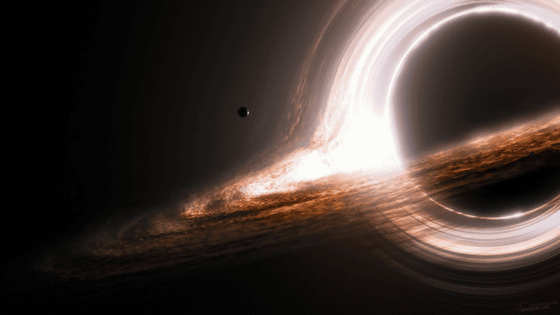
Recent research suggests that formulas based on prime numbers may be able to describe the behavior inside black holes, and that prime numbers and the Riemann zeta function, which mathematicians have long studied, may be able to help unravel the mysteries of quantum gravity and singularities, according to the science media outlet Live Science.
Exotic prime numbers could be hiding inside black holes | Live Science
Prime numbers are natural numbers that are divisible only by themselves and 1. An important unsolved problem concerning prime numbers is the Riemann Hypothesis , proposed by Bernhard Riemann in 1859, and is one of the Millennium Prize Problems with a $1 million (approximately 159 million yen) prize for solving it.
What exactly is the Riemann Hypothesis, a difficult problem with a $1 million reward that, if proven, holds the key to solving the mystery of prime numbers? - GIGAZINE

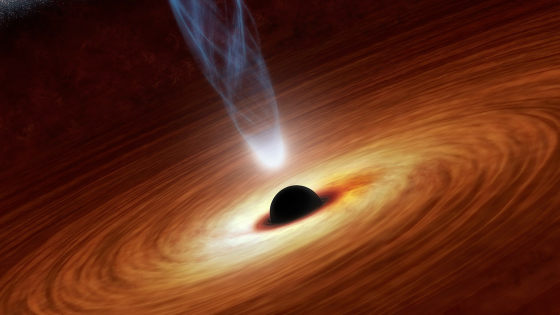
At the center of a black hole lies a singularity , where, according to general relativity, gravity becomes infinite. It is believed that the usual understanding of space and time ceases to hold true at this point, but in the 1960s, it became known that a kind of chaotic behavior appears just outside the singularity.
In recent years, this chaos has attracted attention for its striking resemblance to another type of chaos discovered in the study of prime numbers. This is because it has emerged that the complex disturbances occurring deep within black holes and the fluctuations appearing in prime numbers and zeta functions may share the same mathematical framework.
by
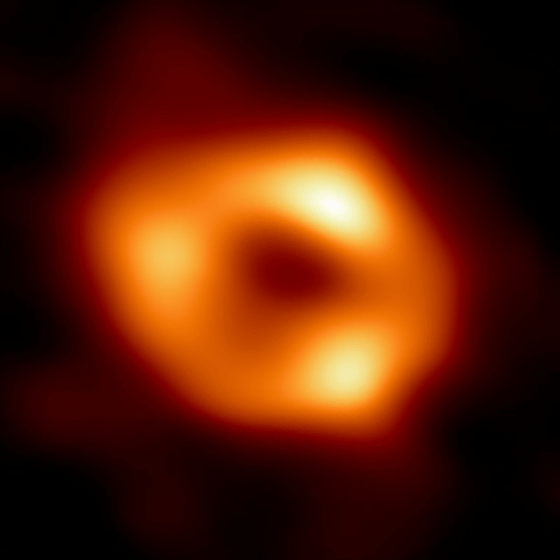
In 1990, French physicist Bernard Julia conceived of hypothetical particles whose energy levels are the logarithms of prime numbers, and named them 'primons.' Furthermore, Julia argued that when considering a collection of such particles, known as a ' primon gas ,' its partition function coincides with the Riemann zeta function. However, at the time, this was considered more of a theoretical concept than a discussion of actual particles.
However, Jan Fyodorov of King's College London, Geiss Heerley of Ohio State University, and John Keating of Oxford University argued that by examining the subtle discrepancies and irregularities in the arrangement of points where the Riemann zeta function is zero, rather than simply listing them, a self-similar complex structure emerges that is not merely random disorder. This conjecture wasproven in 2025.
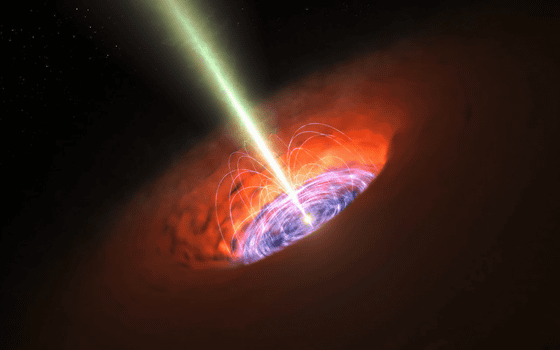
In February 2025, Sean Hartnoll and graduate student Min Yang of Cambridge University brought this primon theory into the interior of a black hole and argued that in the chaos near the singularity, a ' conformal symmetry ' appears where the same pattern is repeated beyond expansion and contraction, revealing a property where the same structure is repeated at different scales. From this conformal symmetry, they derived that the spectra of quantum systems near the singularity are arranged according to prime numbers.
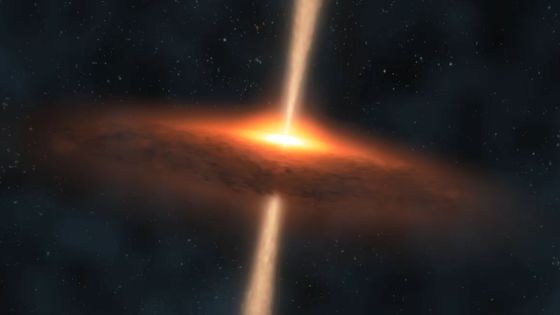
by European Southern Observatory
In short, the researchers discovered that the complex disorder appearing in the world of prime numbers and zeta functions is not simply random disorder, but possesses a deep structure that shows similar shapes even when scaled up or down, and that this structure may be of the same type as the chaos near black hole singularities. The research team called this disorder a 'conformal primon gas cloud.'
Furthermore, in July 2025, research results were reported showing that extending the analysis from the usual four-dimensional spacetime to a five-dimensional universe would render ordinary prime numbers insufficient. This is where 'Gaussian primes,' which include imaginary components, became necessary. Gaussian primes are numbers that cannot be further decomposed in the complex number world, and the research team named this system 'complex primon gas.'
Then, Eric Perlmutter of the Saclay Institute for Theoretical Physics proposed a new framework that extends the zeta function to include not only integers but also all real numbers, including irrational numbers. This opens up the possibility of using even more powerful zeta function methods to understand quantum gravity. John Keating, a physicist at Oxford University, commented, 'This kind of broad perspective can give us new ways to tackle problems that have remained unsolved for many years,' and described its significance with the analogy of finding a better path up a mountain by looking at the whole mountain from a distance.
Perlmutter commented, 'What we are trying to understand, such as black holes in quantum gravity, must surely be governed by some beautiful structure. And number theory seems to be a natural language.'
Related Posts:
in Science, Posted by log1i_yk