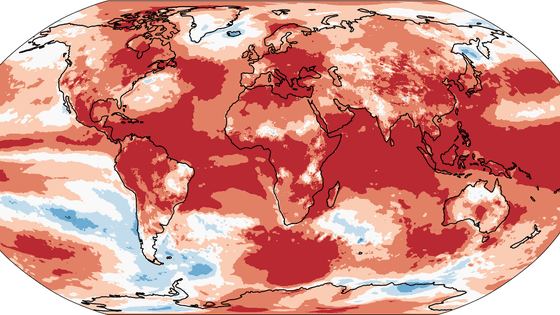
Global warming has accelerated sharply since 2015, according to an analysis that excludes the effects of El Niño, volcanic eruptions, and solar activity.
The rate of global warming has been thought to have remained roughly constant for several decades since the 1970s, but in recent years scientists have begun to debate whether global warming is accelerating. Researchers at
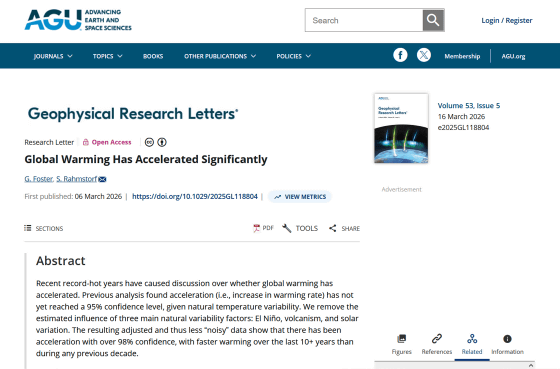
Global Warming Has Accelerated Significantly - Foster - 2026 - Geophysical Research Letters - Wiley Online Library
https://agupubs.onlinelibrary.wiley.com/doi/10.1029/2025GL118804
Significant acceleration of global warming since 2015 — Potsdam Institute for Climate Impact Research
https://www.pik-potsdam.de/en/news/latest-news/significant-acceleration-of-global-warming-since-2015
Humanity heating planet faster than ever before, study finds | Climate crisis | The Guardian
https://www.theguardian.com/environment/2026/mar/06/humanity-heating-planet-faster-than-ever-before-study-finds
Global warming is progressing year by year, making the Earth hotter and hotter, but there is ongoing debate about how quickly this is happening. The hottest months on record were recorded for 12 consecutive months between June 2023 and May 2024, but this is due in part to factors such as the El Niño phenomenon, which causes sea temperatures in the Pacific Ocean to rise. Some argue that excluding the effects of El Niño and other factors, the rate of global warming is not increasing.
So, a research team led by Stefan Rahmstorf of the Potsdam Institute for Climate Impact Research and Grant Foster, an American statistician, conducted an analysis that took into account factors that affect climate, such as the El Niño phenomenon, volcanic eruptions , and solar cycles .
The study used five large, established global temperature datasets: NASA (National Aeronautics and Space Administration) , NOAA (National Oceanic and Atmospheric Administration) , HadCRUT (UK Met Office and University of East Anglia), Berkeley Earth (a California non-profit organization) , and ERA5 (European Centre for Medium-Range Weather Forecasts) .
Using noise reduction techniques to remove the effects of El Niño, volcanic eruptions, and solar cycles, the researchers found that the rate of warming between 1970 and 2015 was less than 0.2 degrees Celsius per decade. However, they found that global warming has accelerated sharply since 2015, rising by about 0.35 degrees Celsius in the decade since.
The graph below shows the rate of warming per decade on the vertical axis and the year on the horizontal axis. The red line shows the rate of warming per decade excluding the effects of El Niño, volcanic eruptions, and solar cycles. Looking at the graph, we can see that global warming has progressed rapidly since 2015.
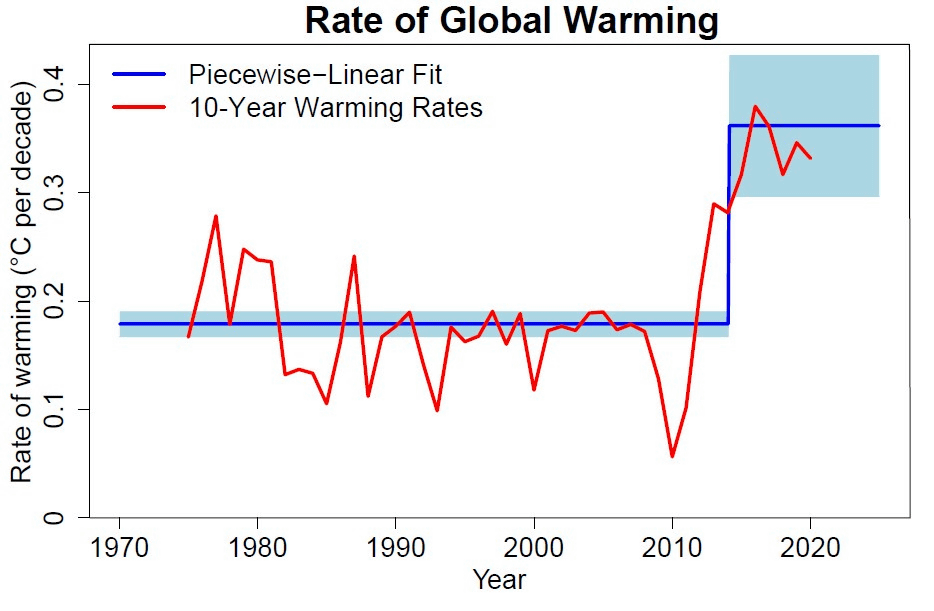
After correcting for the effects of El Niño and solar cycles, the rate of global warming in the unusually hot years of 2023 and 2024 slowed slightly, but they remained the warmest two years since observations began. The data also showed that global warming accelerated in 2013 or 2014 across all datasets.
'The adjusted data show with more than 98% statistical certainty that global warming has accelerated since 2015. This is consistent across all data sets examined and independent of the analytical method chosen,' Rahmstorf said.
The research team predicts that if global warming continues at its current rate, we will exceed the target set by the 2015
'How quickly the Earth continues to warm will ultimately depend on how quickly we can reduce global carbon dioxide emissions from fossil fuels to zero,' Rahmstorf said.
Related Posts:

in Science, Posted by log1h_ik