Genghis Khan's blood relatives may be fewer than previously thought

Genghis Khan (Khan), the first emperor of the Mongol Empire, has been claimed to have 16 million descendants worldwide. However, an international research team including researchers from the University of Wisconsin-Madison and the National Institute of Genetics in Japan conducted a genome analysis of human remains excavated from a mausoleum belonging to a medieval ruling class in the Ulytau region of Kazakhstan, suggesting that the number of Genghis Khan's descendants may be smaller than previously thought.
Genomes of the Golden Horde elites and their implications for the rulers of the Mongol Empire | PNAS
Far fewer people are related to Genghis Khan than previously assumed, new genomic study suggests | Live Science
https://www.livescience.com/archaeology/far-fewer-people-are-related-to-genghis-khan-than-previously-assumed-new-genomic-study-suggests
The Mongol Empire and its successor state, the Golden Horde , are said to have had a profound impact on Eurasian politics, economy, and culture. However, direct genetic information has not been available until now due to the practice of burying Genghis Khan and his family members in secret, as evidenced by records showing that their remains were 'hidden by leveling the ground with thousands of horses after burial.'

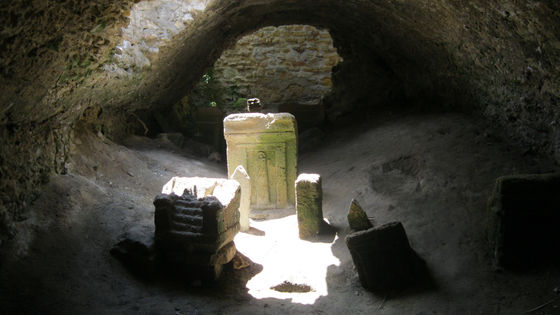
The Ulytau region of Kazakhstan, which was the subject of this research, is known as an important historical heritage of the Golden Horde period, and is home to a building believed to be the mausoleum of
The research team extracted DNA from the skeletons of three men and one woman excavated from the four mausoleums, performed radiocarbon dating, and then used the latest DNA analysis technology to examine more than one million genetic variants (SNPs) and analyze the data using advanced statistical methods.
As a result, it was determined that the man found in Jochi's Mausoleum and two others dated to the 14th century, while the remaining man dated to the 18th century. Further examination of the Y chromosomes of the three men revealed that they all belonged to a specific group called C3. This closely matches the lineage that had previously been predicted to be characteristic of Genghis Khan's family line. This scientifically demonstrated that there is a very high possibility that the man found in Jochi's Mausoleum was paternally related to Genghis Khan.
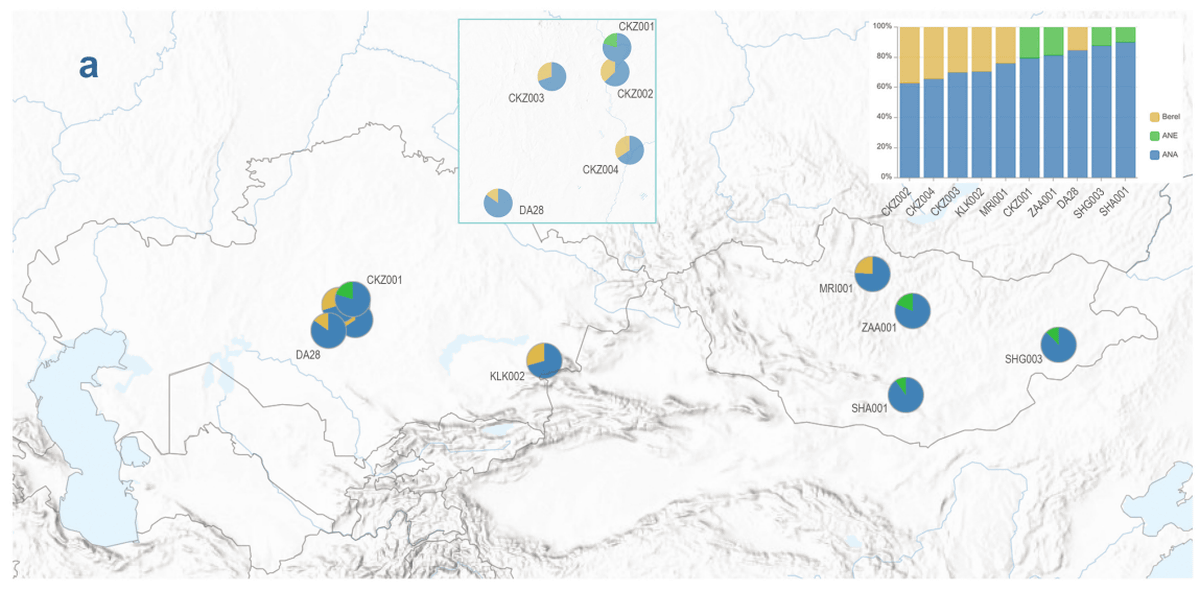
Furthermore, detailed analysis of the entire genome proved that the individual was not an indigenous person living around present-day Kazakhstan, but had a genetic background very similar to that of ancient Northeast Asians living on the Mongolian Plateau. It was discovered that the owner of the excavated human bones actually had genetic ties to several people who lived on the Mongolian Plateau in the Middle Ages, proving that they were a family that came to this area from the Mongolian Plateau as a ruling class.
In addition, the research team reported that the genetic lineage of the Mongolian ruling class was extremely rare even within the C3 lineage, overturning the commonly held belief that 'approximately 0.5% of the world's men are descendants of Genghis Khan.' This suggests that the number of blood-related descendants of Genghis Khan may actually be much smaller than previously thought.
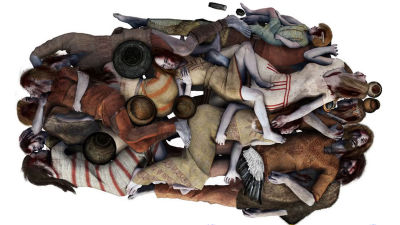
The researchers also found interesting cultural changes in the people buried there. The excavated bones were buried with their heads facing west, in a manner influenced by Islam, but they were also buried with luxurious grave goods, including animal bones, clothing, and gold cups. Although Islam does not normally allow for grave goods, the research team pointed out that this vividly shows that the people were in a transitional stage, when their culture was shifting from their original traditional beliefs to Islam.
Related Posts:





in Science, Posted by log1i_yk