DNA analysis of bones reveals father-daughter incest in Bronze Age Italy
Although incest is considered a serious taboo in modern times, archaeological sites
Archaeogenetics reconstructs demography and extreme parental consanguinity in a Bronze Age community from Southern Italy | Communications Biology
https://www.nature.com/articles/s42003-025-09194-2
Bronze Age DNA from Calabria reveals a distinct mountain community
https://www.mpg.de/25882013/bronze-age-dna-from-calabria-reveals-a-distinct-mountain-community
DNA analysis of 3,700-year-old skeleton from Italy reveals first evidence of father-daughter incest | Live Science
https://www.livescience.com/archaeology/oldest-known-evidence-of-father-daughter-incest-found-in-3-700-year-old-bones-in-italy
The Calabria region in southern Italy is located at the 'toe' of the boot, and has been a land where many different peoples have migrated since ancient times. A research team consisting of Italian and German researchers analyzed the DNA of human bones excavated at the Grotta della Monaca archaeological site in Calabria.
The Grotta della Monaca site is a Middle Bronze Age cave site located on a limestone ridge over 600 meters above sea level. It was used as a burial site between 1780 and 1380 BC, and numerous human bones have been discovered there.
The research team analyzed the DNA from the fragmented bones of 23 individuals and confirmed that 10 of them were female and 8 were male. The haplotypes of the mitochondrial DNA and paternal Y chromosome DNA in the bones were also diverse, indicating that the population was composed of people with diverse genetic backgrounds.
Furthermore, the Grotta della Monata people carried genes for adult lactose intolerance, but still engaged in livestock farming and consumed milk and dairy products, suggesting that cultural adaptations to thrive in harsh mountain environments can precede evolutionary adaptations.

When the researchers investigated the genetic relationships within the burial site, they found two pairs of 'parent and child.' One pair, consisting of adult women over 30 years old, was a simple 'mother and daughter' pair, while the other pair, consisting of an adult man and a prepubescent boy, was found to be a 'father and son born of incest.'
In this study, the research team analyzed
While most individuals buried at Grotta della Monata had ROH values suggesting their parents were distantly related, spanning the past 6-10 generations, the boy reportedly had the highest ROH values reported to date in an ancient genome dataset.
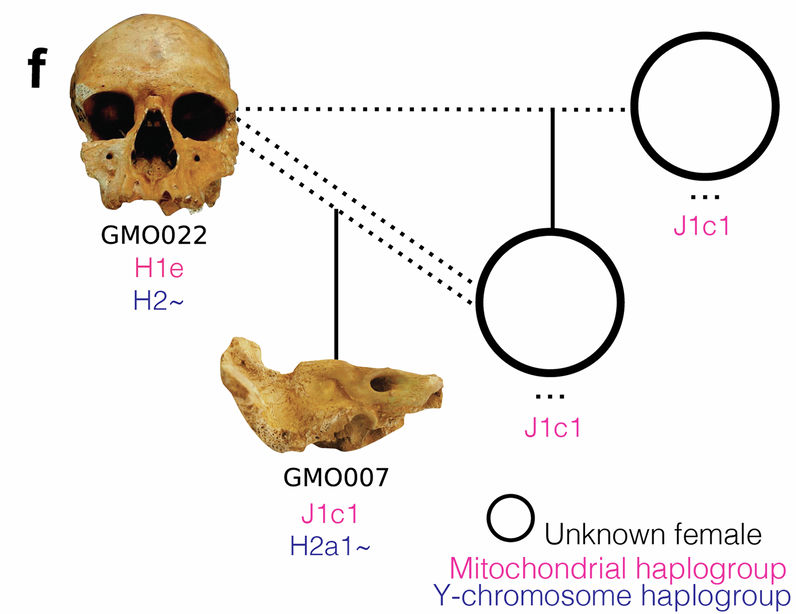
Further investigation confirmed that the boy was the result of incestuous relations between the father and his daughter. While incest increases the chances of genetic disorders in offspring, the boy's genes showed no evidence of rare genetic disorders. However, the remains of the boy's mother have not been found.
In the diagram below, 'GMO022' is the father in an incestuous relationship, 'GMO007' is his son, and the black circle is the unknown woman whose bones have not been found.
The research team pointed out that the discovery of a father-daughter pairing in Middle Bronze Age Italy is the oldest known archaeological record and is a remarkable and unusual one. 'This unique case may suggest culturally specific behavior in this small community, but its significance is ultimately uncertain,' said archaeogeneticist Alissa Mitnik , co-author of the paper. 'It is unclear whether inbreeding was common or not.'
Related Posts:




in Free Member, Science, Posted by log1h_ik