99% of adults over 40 have shoulder abnormalities on MRI
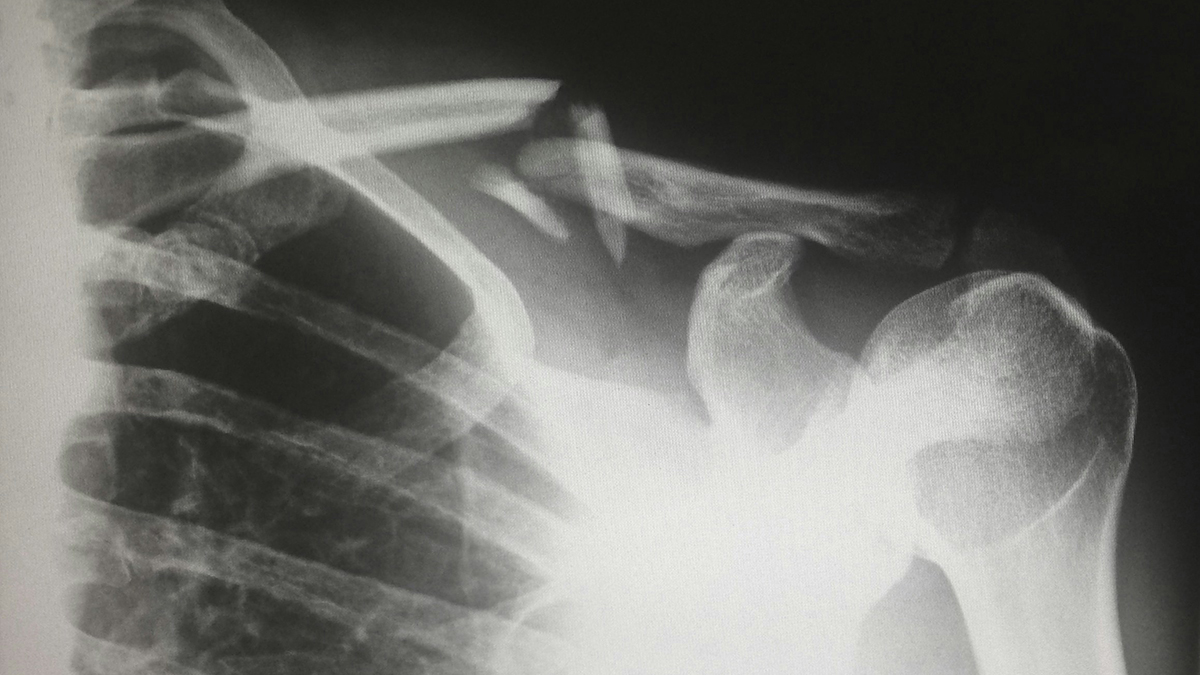
When people complain of symptoms such as shoulder pain or difficulty lifting their arms and undergo an MRI scan at a hospital, they are often told that there is something wrong with their shoulder. However, a study of the general population in Finland found that while approximately 99% of adults over the age of 40 had some kind of abnormal finding on their MRI, there was little correlation between this and symptoms such as pain or difficulty moving.
Incidental Rotator Cuff Abnormalities on Magnetic Resonance Imaging | Less is More | JAMA Internal Medicine | JAMA Network
A research team led by Thomas Ivunig and Teppo L. N. Järvinen of the University of Helsinki, Finland, focused on the rotator cuff , a bundle of muscles and tendons that stabilize the shoulder bones and move the arm. It has long been thought that wear or damage to the rotator cuff can cause shoulder pain. Therefore, doctors often use MRI to examine the rotator cuff and determine diagnoses and treatment plans based on changes seen on the MRI.
The research team conducted a survey of the general population to clarify whether changes in the rotator cuff tendon structure may be present even in the absence of symptoms after the age of 40. 602 adults aged 41 to 76 were randomly selected from the Finnish Health Survey Cohort. After completing a medical interview, questionnaires, and a shoulder exam by a physician, both shoulders were scanned using a 3 Tesla MRI. A 3 Tesla MRI machine uses a magnetic field strength of 3 Tesla, which is said to be more effective at detecting subtle changes in tendons and muscles than a standard 1.5 Tesla MRI.
The researchers analyzed the MRI scans and found that 595 of the 602 participants had changes in their rotator cuff muscles, accounting for 98.7% of the total. The findings were broadly categorized as tendon changes (tendinosis), partial tears, and complete tears, with tendonosis accounting for 25.3%, partial tears for 62.4%, and complete tears for 11.1%.
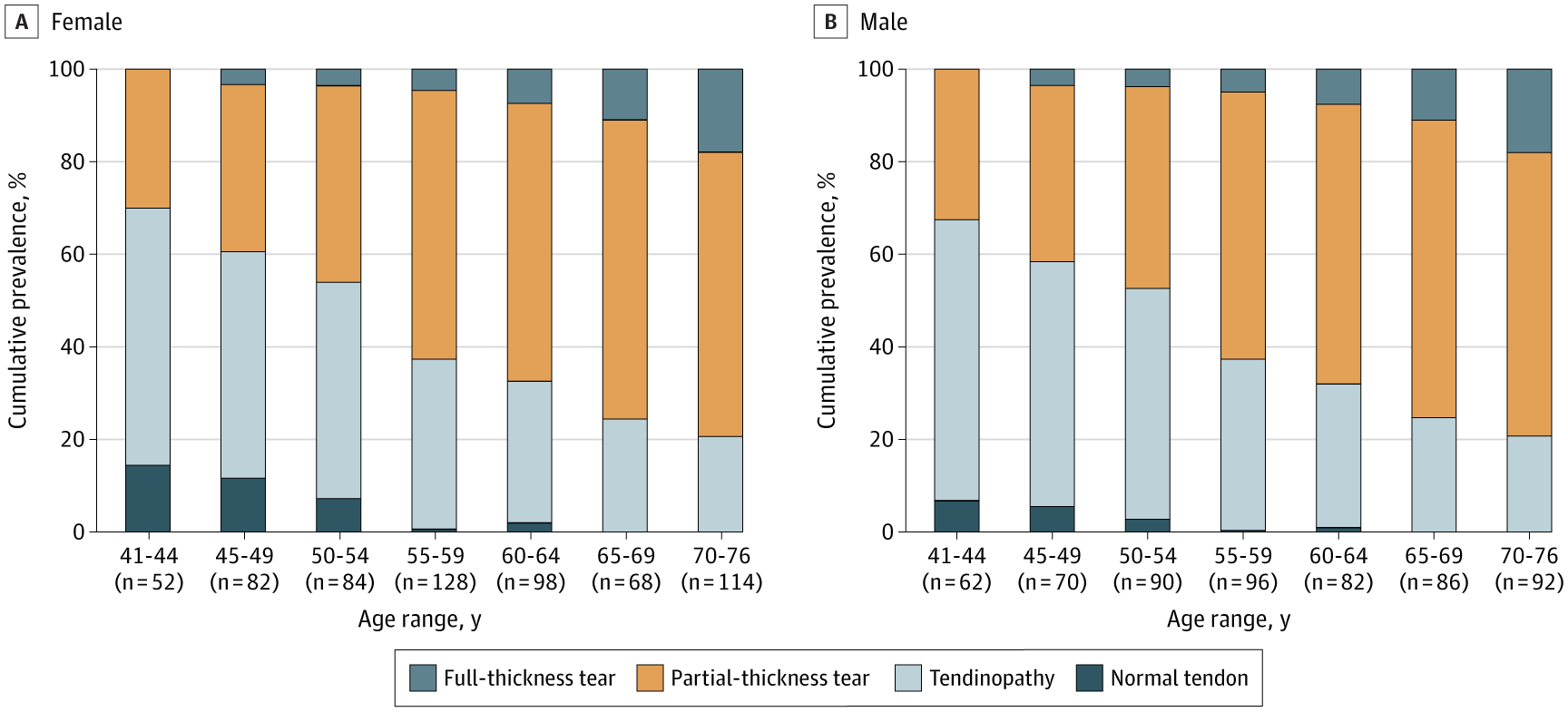
The graph below shows the classification of rotator cuff tissue by age group (normal, tendinosis, partial tear, or complete tear) for both men and women. As age increases, the percentage of 'normal' tissue decreases, while the percentage of 'tendinosis' and 'partial tear' increases. Furthermore, while 'complete tear' is rarely seen in younger people, it tends to increase with age, indicating that rotator cuff findings tend to progress with age.
One might think, 'If an abnormality is found on an MRI, surely that must be the cause of the pain?' However, to verify the relationship between symptoms and pain, the research team compared 1,204 shoulders (both shoulders of 602 subjects) based on whether they had experienced pain or shoulder dysfunction in the past week. They divided these into 'shoulders with symptoms' and 'shoulders without symptoms.'
As a result, the percentage of patients who found some kind of rotator cuff finding on MRI images was 98% in 'symptomatic shoulders' and 96% in 'asymptomatic shoulders,' with almost no difference between the two groups. The research team reported, 'We found that MRI can detect abnormalities even in shoulders that do not hurt.'
Furthermore, when looking only at the findings of 'complete rupture,' the proportion of 'symptomatic shoulders' was 14.6%, compared to 6.5% for 'asymptomatic shoulders,' indicating a higher proportion of 'symptomatic shoulders.' However, after adjusting for age, other imaging findings, and clinical test results, the difference became smaller.
Based on these analysis results, the research team argues that for shoulder pain not caused by trauma, 'we should be cautious about assuming that rotator cuff findings found on MRI are the cause of pain and then use them to determine diagnosis and treatment.' Because the rate of findings on MRI was almost the same in both pain- and pain-free patients, the research team concluded that 'it is difficult to distinguish between findings related to symptoms and those that are just randomly detected on MRI images.'
The research team also pointed out that although these findings were called 'abnormal,' many of them likely reflect normal aging changes rather than changes directly linked to diagnosis or treatment. The research team said that by using more accurate terms that convey less of a need for treatment, such as 'lesion,' 'defect,' 'fraying,' 'structural change,' and 'degeneration,' rather than strong words like 'rupture' that suggest trauma or the need for treatment, patients' anxiety and the sense that something needs to be done may be alleviated.
Related Posts:







in Science, Posted by log1b_ok