How does reading regulate the nervous system? What are some tips for restorative reading?

When you are immersed in reading, you are distracted by everything else but the content of the book, and you experience a sense of calm and relaxation that makes your mind relax. In today's busy and stressful society, the relaxing effects of reading are invaluable. Neuroscientist and entrepreneur
How reading books regulates your nervous system - Big Think
https://bigthink.com/mind-behavior/how-reading-books-regulates-your-nervous-system/
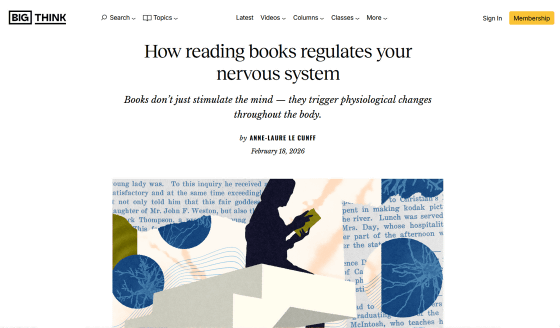
Le Cunff says he enjoys the feeling of the world around him fading away, his breathing slowing, his shoulders relaxing, and his mind quieting. 'What's happening in these moments has a much deeper meaning than entertainment or education, and we seem to instinctively sense this. Reading has a relaxing effect, and many people read as a way to counteract the overstimulation of modern society,' he says.
Reading isn't just about following words on a page with your eyes; it's a complex neurochemical process that affects everything from your heart rate to your hormones. Le Cunff explains that this is because reading uses some of the oldest circuits in the human brain.
Writing only emerged a few thousand years ago, so the brain didn't have time to develop the circuits necessary for reading. Therefore, humans reused neural networks that previously helped them read animal tracks, recognize patterns in cloud movement, and rustling leaves in the wind, and used them to build the circuits needed for reading. This hypothesis is called the ' neuron recycling hypothesis ,' and experimental results supporting it have been reported.
Research results show that humans can read because they 'recycle areas of the brain that originally had other functions' - GIGAZINE

When we read, our brain's visual system recognizes and converts letters into words, our language network associates those words with meaning stored in memory, our attention system stays focused on the storyline, and our memory system simultaneously integrates new information with existing knowledge. In other words, multiple brain regions work together while we read.
These processes require sustained focus on a single stream of information, rather than the fragmented attention demanded by digital media, which shifts the autonomic nervous system from a sympathetic-dominant fight-or-flight response to a parasympathetic-dominant state, resulting in visible physiological changes such as a slower heart rate, slower and more regular breathing, and reduced muscle tension.
Research has also shown that reading about an experience activates the same brain regions as experiencing it for real: reading about running through the woods activates the motor cortex as if you were actually moving, and reading about a character expressing sadness activates the brain regions responsible for empathy and emotional processing, as if they were actually sad.
'This simulation creates 'embodied reading,' in which the story becomes a practice for a real-world scenario. The brain processes the fictional experience as a low-stakes rehearsal for real life, building neural pathways that can be activated when a similar situation occurs beyond the page,' Le Cunff said.

While there are benefits to simply reading as you please, Le Cunff offers five tips to maximize the emotional recovery benefits of reading.
1: Read a variety of books
Non-fiction activates analytical brain networks, while fiction allows you to completely disconnect from active problem-solving. Reading fiction as well as non-fiction engages your imagination and relieves stress and anxiety.
2: Adjust your reading time
While reading can be beneficial any time of day, strategically timing your reading can be even more effective. For example, reading before bedtime can reduce stress hormones, activate the parasympathetic nervous system, and prepare your brain for sleep. Le Cunff recommends taking your time when reading, and staying focused and unhurried.
3: Establish a reading habit
By establishing a place, time, and pre-reading routine for reading, you can start to feel like you're rewarding yourself. Making reading a habit that you enjoy will make it easier to find time for reading and continue to enjoy the benefits.
4. Choose a book that suits your mental state
Forcing yourself to read complex literature when you're feeling anxious can be difficult, so start with a light, easy read when you're feeling agitated, and then tackle something more difficult once you've calmed down.
5. Follow your curiosity
The stress-reducing effect of reading comes from immersing yourself in the book, rather than forcing yourself to concentrate on it. If you can't relate to the content of the book and find it difficult to immerse yourself, you can switch to a book that interests you.

'Reading is one of the most sophisticated yet accessible tools for regulating the nervous system. In an age of constant stimulation and distractions, the 'stimulating brain, calming body' experience that reading provides is invaluable,' said Le Cunff. 'So the next time you unwind with a good book, remember that your brain has evolved to function so well, and that you're giving your nervous system what it needs to reset and recharge.'
Related Posts:







in Free Member, Note, Science, Posted by log1h_ik