Procrastination isn't laziness, so how can you avoid it?

We've all experienced procrastination, where you feel unmotivated and procrastinate even though the deadline for an assignment is approaching, or suddenly feel like cleaning the house even though you have other things to do. Annemieke Apergis-Schötte, a psychology lecturer specializing in obsessive-compulsive disorder, explains how to avoid this kind of procrastination by simply changing your way of thinking.
Why procrastination isn't laziness – it's rigid thinking that your brain can unlearn
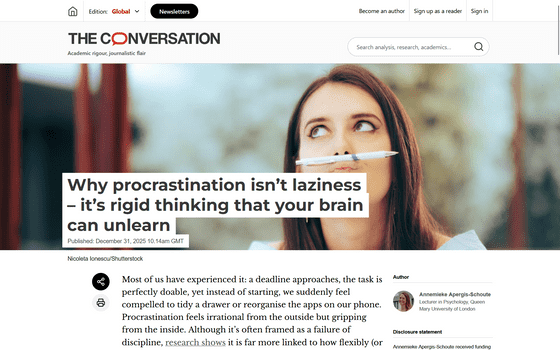
When Shote asked students why they procrastinate, most of them answered, 'I don't know where to start,' 'I feel lost,' 'I feel anxious,' or 'I feel overwhelmed.' Not a single person said, 'Because I don't care.' In other words, most people know they should do something, but they don't actually take action.
Schautte points out that procrastination isn't a lack of planning, it's simply an emotional issue.
The brain has a tendency to predict threats in the environment and attempt to avoid harm. When faced with a task that is uncertain, requires effort, or requires evaluation, the brain generates thoughts like, 'What if I do this badly?' or 'What if I fail?' In particular, people with inflexible thinking are unable to overturn their initial prediction that 'this task is threatening.' Then, an action that brings pleasure in the present moment becomes the only option, and the slight sense of relief it brings commands the brain to 'repeat the avoidance behavior.'
The important thing is that avoidance behavior prevents the important discovery that 'starting a task itself is rewarding,' Shote points out. Even if a task is difficult, taking the first step can release dopamine, which can give you the motivation to continue. Rather than engaging in avoidance behavior from the start, it's important to just give it a try.

Shote offers some advice for getting started on a task:
◆1: Reduce the task
Breaking tasks down into smaller, bullet-pointed lists will make the 'where to start' task feel less intimidating and give you the dopamine reward of completing each small task.
◆2: Utilize Microshift
Microshifts are small initiating actions, like opening a document or putting a notebook on your desk. While they don't advance the task itself, they can interrupt a 'stuck' state and gently stimulate your brain to get you moving.
◆3: Change your perspective
For example, reframing a task as if you were giving advice to someone. Asking yourself, 'What would I say to a friend in this situation?' helps to soften the fixed thinking that sees the task as a 'personal threat' and encourages flexible interpretation.
◆4: Develop emotional resilience
Being aware that discomfort peaks rapidly when you begin a task and then gradually decreases may help you avoid the misconception that peak discomfort will last forever, reducing the temptation to engage in avoidance behavior.
◆5: Give immediate rewards
Pair your task with something you enjoy, like listening to music, having a hot drink, or working with others, so that the first step feels rewarding rather than painful.

'Combining these strategies strengthens your ability to move beyond avoidance and take action on unpleasant tasks,' Shote said. 'Procrastination isn't a sign of laziness; it's a sign your brain is struggling to switch states. And the encouraging thing is that your flexibility in avoiding procrastination improves with practice. Over time, these small changes evolve into powerful forces.'
Related Posts:







in Note, Posted by log1p_kr