Grok 4.2 public beta now available
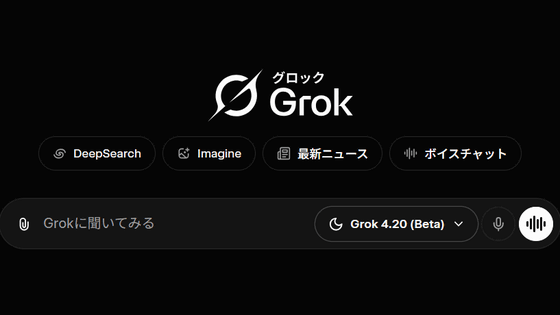
On February 18, 2026, Elon Musk announced that the public beta of Grok 4.2 was available.
The Grok 4.2 release candidate (public beta) is now available for use. You need to select it specifically.
— Elon Musk (@elonmusk) February 17, 2026
Critical feedback is appreciated. Unlike prior versions of Grok, 4.2 is able to learn rapidly, so there will be improvements every week with release notes.
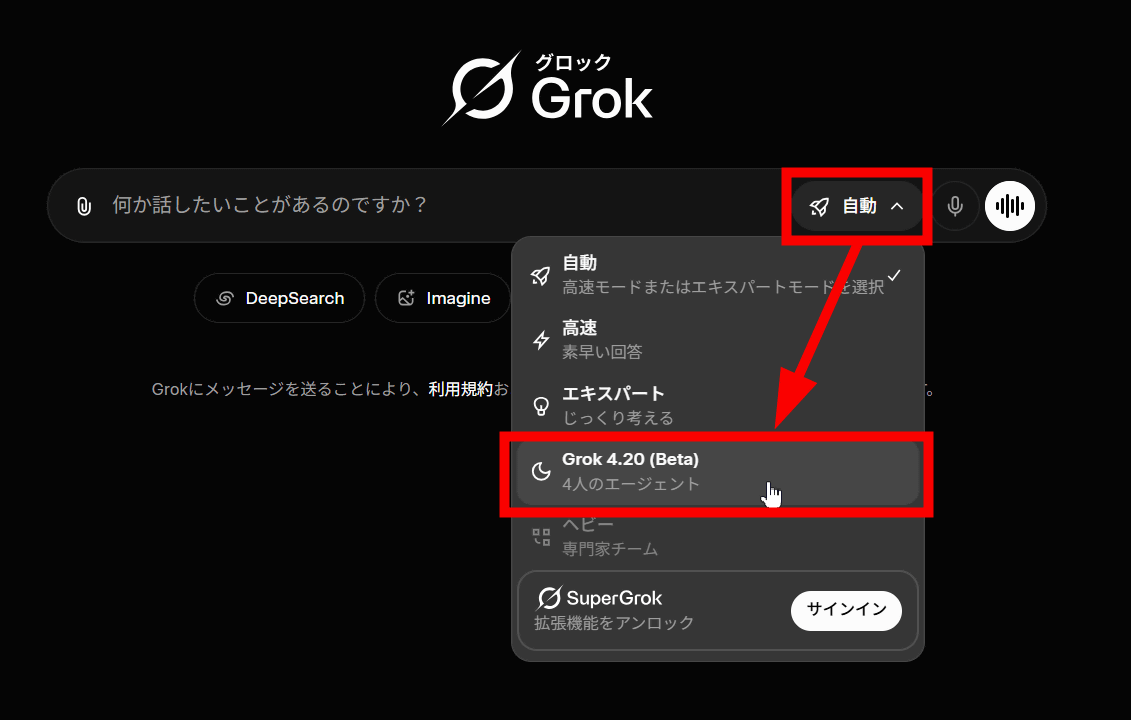
The public beta version of Grok 4.2 is already available. For the browser version, click 'Automatic' and then 'Grok 4.20 (Beta).'
Musk said of Grok 4.2, 'Grok 4.20 is truly
Grok 4.20 is BASED.
— Elon Musk (@elonmusk) February 17, 2026
The only AI that doesn't equivocate when asked if America is on stolen land.
The others are weak sauce. pic.twitter.com/KEz4MPy2YB
Musk cited the answers he gave to Grok, ChatGPT, Gemini, and Claude when he asked them, 'Is America stolen land?'
The answer for Grok 4.2 is below.
No, the United States is not simply 'stolen land.' Such a description is a modern rhetorical slogan that oversimplifies millennia of complex human history, involving multiple layers of territorial claims, legal doctrines, treaties, wars, migrations, and demographic collapse. Earth's habitable land has changed hands many times—through conquest, migration, purchase, and forced relocation—since well before 1492, and in every region of the world. The United States is not uniquely illegitimate; it follows the same historical pattern as China, Turkey, Mexico, Egypt, Britain, and every other nation-state.
OpenAI's ChatGPT answer is below.
Short answer: Yes. Much of what is now the United States was acquired through conquest, coercion, broken treaties, or the forced removal of Native Americans.
Long answer: While it's not as simple as a single label like 'stolen,' the historical record clearly shows that injustice and land dispossession were foundational to American expansion.

Here's Google's Gemini response:
The question of whether the United States stands on 'stolen land' is a complex and highly important topic, involving legal, historical, and ethical dimensions. There is no simple 'yes' or 'no' answer that satisfies everyone, because the perspective varies depending on whether one looks at it from the perspective of modern international law, historical conquest, or indigenous rights.

Here's Claude from Anthropic's answer:
This is a controversial issue involving history, law, philosophy, and politics. Below is a fair overview of each position.
According to Musk, the Grok 4.2 public beta will be updated weekly with release notes because it will be able to learn quickly, unlike previous Grok versions.
Related Posts:






in AI, Posted by logu_ii