We asked five experts: 'Should humanity colonize space?'

As space development progresses, plans to 'build human colonies on the Moon or Mars' are becoming more realistic, but a fundamental question is, 'Should humanity colonize space?' The academic media The Conversation has summarized the results of asking five experts about this question.
Should humans colonize space? We asked 5 experts
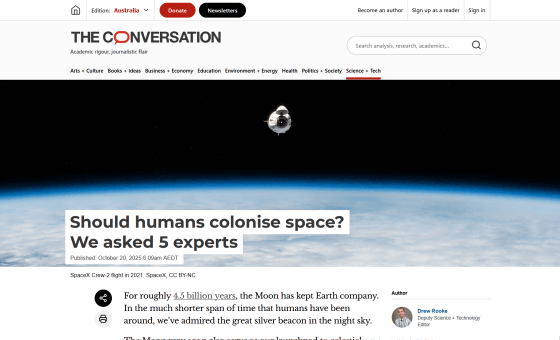
Kirsten Banks (Astrophysicist at Swinburne University of Technology) says: No.
Regarding the question, 'Should humanity colonize space?', Banks pointed out that the very word 'colonize' is problematic. The word 'colonization' means settling in a place and establishing political control regardless of the people who lived there. This has heavy historical implications, and in Australia, European colonization has had serious impacts on Aboriginal and island indigenous peoples that remain to this day.
With this in mind, Banks said, 'I remain very excited about human space travel and the possibility of establishing a human presence beyond Earth. However, I do not believe this pursuit should come at the expense of potential life. If extraterrestrial life exists, respecting its autonomy is not only an ethical imperative, but also essential to preserving and protecting our ability to responsibly and honestly study such life.'
Alice Gorman (Associate Professor of Space Archaeology, Flinders University) answers: No.
Gorman points out that in the current capitalist system, space is currently treated as a 'resource to be exploited,' which overlaps with the way indigenous peoples' lands were treated in the past colonial model, and is not a sustainable idea. He argues that people tend to view space as a 'dead environment where no life exists,' but that even if there is no life, planets and moons are dynamic environments that should not be disturbed.
On the other hand, that doesn't mean humanity shouldn't aim for space. Rather, by adopting a ' model of co-participation' that sees the environment as an equal partner rather than just a resource, humanity can advance into space while considering its prosperity. 'A fundamental shift in thinking is needed if humanity is to be ready to co-inhabit space, rather than colonize it,' Gorman said.
As an astronomer, Webb believes that if we consider the future of humanity on a cosmic timescale, the sun will die in 4 to 5 billion years, and the Earth will perish along with it. Given this, it is essential for humanity to live off-Earth for its survival.
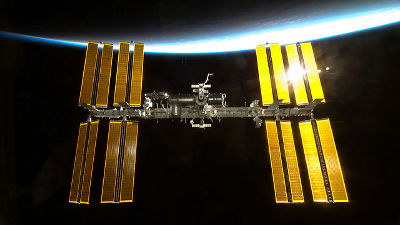
However, this future is not coming anytime soon, so at the time of writing, space should be used for scientific and fundamental research. For example, orbital facilities such as the International Space Station (ISS) can provide important data for understanding how organisms adapt to space and help lay the foundation for future space missions.
Webb argued, 'In my lifetime, we will see the first humans on Mars - scientists, not pioneers. Earth will remain our best home for hundreds, even thousands, of years to come. Our focus should be on understanding and protecting it, and space exploration should be used to prepare for the very long-term future.'
Bramble points out that building colonies on the Moon or Mars as a backup against threats to humanity is more likely to endanger humanity than save it. Such colonization would concentrate great power in the hands of a few individuals or companies without accountability, and the technology used in missions to 'move large objects and reshape the environment' would be at risk of being misused, whether intentionally or accidentally.
Extraterrestrial colonization could exacerbate conflicts between governments, potentially increasing rather than reducing the risk of conflict on Earth. While it may seem like science fiction, colonies on the Moon or Mars could become hostile toward Earth itself.
Additionally, building a truly self-sustaining Mars colony is likely to take centuries, but for humanity to survive until the colony is complete, it will need to address the threats currently plaguing Earth at the time of writing. Bramble believes that if we have the technology to make Mars habitable, it will also be easy to use it to improve the Earth's environment.
'Humanity's best hope for survival and prosperity lies in focusing our wisdom on regenerating this planet rather than abandoning it,' Bramble said. 'This can be done while continuing to conduct exciting science in space, without attempting to colonize it, while using space probes, satellites and telescopes to better understand it.'

Art Cotterell (Australian National University) answers: No
Cotterell points out that arguments for colonizing space invoke colonial narratives and ideas of 'exploitation' and 'empire building,' which he argues dispossess indigenous peoples and perpetuate inequalities to the present day.
The Outer Space Treaty (Treaty on Principles Governing the Activities of States in the Exploration and Use of Outer Space, including the Moon and Other Celestial Bodies) , which came into force in 1967, stipulates that the exploration and use of outer space, including celestial bodies, is free for all humankind 'for the benefit of all nations' and 'in accordance with international law.' This is incompatible with Musk's desire to ' build a self-sustaining city on Mars, ' and the ' space race ' currently being waged by the United States and China over the construction of a lunar base is also inconsistent with the Outer Space Treaty's vision.
'We are experiencing accelerating climate change, geopolitical division, and rising poverty. Space colonization risks expanding these crises and their causes beyond Earth. Instead, we should explore the possibilities that can help us collectively confront these challenges here on our own planet, the 'pale blue dot' in the universe,' Cotterell said.
Related Posts:




in Science, Posted by log1h_ik