Polis, an open-source platform that aggregates the opinions of tens of thousands of people, has proven its effectiveness in Taiwan and the UK and is now firmly established as a national democratic infrastructure.

Polis is an open-source platform that aggregates the opinions of tens of thousands of people and finds common ground beyond conflict. Since its launch in 2012, its effectiveness has been proven through massive discussions with over 10 million participants, and it is now established as democratic infrastructure supporting national-level decision-making in Taiwan, the UK, and Finland.
Polis
GitHub - compdemocracy/polis: :milky_way: Open Source AI for large scale open ended feedback
https://github.com/compdemocracy/polis
The Computational Democracy Project |
https://compdemocracy.org/
Polis's innovative feature is its interface, which intentionally eliminates the 'reply button' that often creates divisions in online discussions. Polis uses machine learning and statistical algorithms to analyze participants' voting behavior. Participants respond to short opinions with either 'agree,' 'disagree,' or 'pass.' Polis then processes the data into a 'voting matrix,' visualizes the distribution of opinions using principal component analysis (PCA) and k-means , and automatically generates groups. By intentionally eliminating the 'reply button' commonly used on social media, Polis' system design structurally prevents flame wars and slander, focusing instead on extracting 'bridging statements' that are commonly supported between different groups.
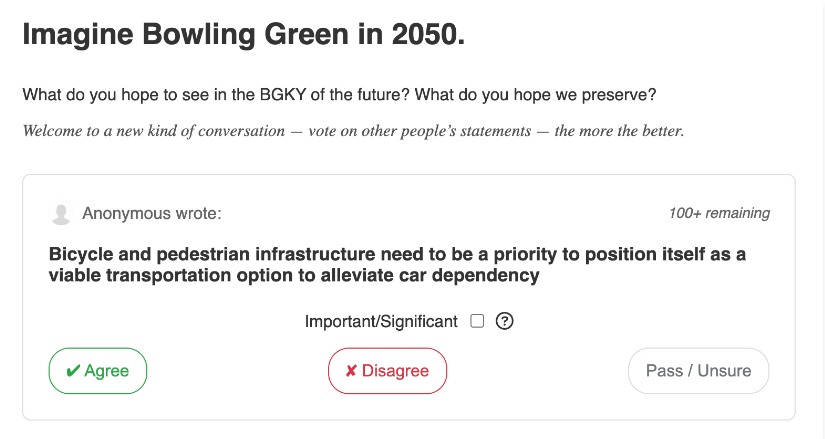
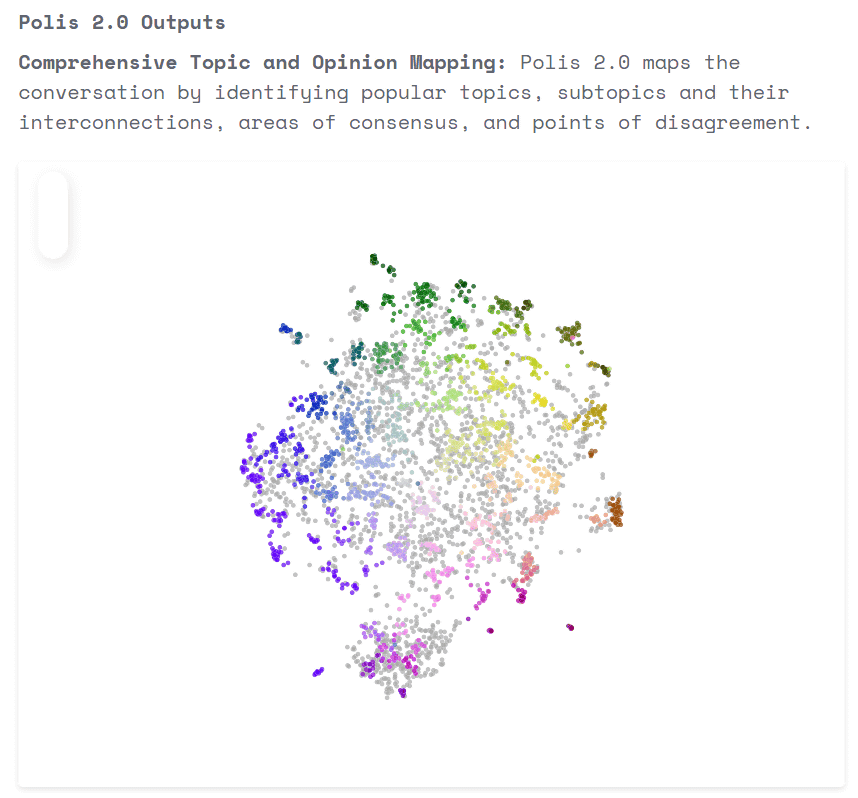
The latest version, Polis 2.0, supports millions of concurrent users through a distributed cloud infrastructure, and also features real-time summarization and automatic translation using LLMs (large-scale language models), as well as advanced topic analysis using
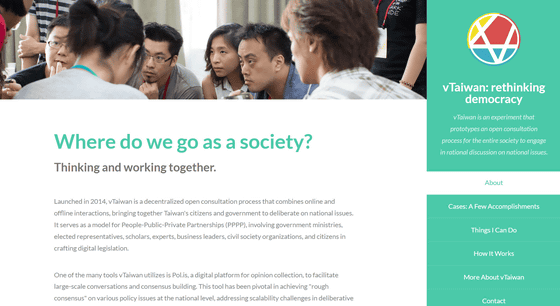
The use of Polis in Taiwan began with the

After the protests, the government asked itself how best to listen to the voices of its citizens, invited members of the civic hacker group 'g0v' into the government, and Audrey Tang was appointed Minister of Digital Affairs at the young age of 35. Tang led the design of 'vTaiwan,' a large-scale citizen participation and opinion gathering process, with Polis being introduced as its core tool.
One practical outcome of vTaiwan was that the initial fierce conflict in Uber's regulatory discussions was overcome, leading to a common concern of 'passenger safety' that 95% of participants agreed on, which led to the formulation of a concrete regulatory proposal. Polis has also played an important role in the formulation of more than a dozen other bills and regulations in Taiwan, including measures to combat revenge porn and fintech regulations, and is deeply rooted as part of Taiwan's national democratic infrastructure. Taiwan's case is an extremely advanced model that demonstrates that technology can be used to build true consensus from diverse opinions, rather than simply relying on majority votes.
Polis has also been used in Finland to design elderly safety and children's mental health services based on citizen feedback. It has also been used in the UK for national security consultations and local government parking policy development. The United Nations Development Programme (UNDP) used Polis for the largest online deliberative exercise in history, involving 30,000 young people from Bhutan, Timor-Leste, and Pakistan. Polis has also been used by governments in Singapore and the Philippines, the Austrian Climate Citizens Council, and the US city of Bowling Green to solve complex challenges.
Polis is released under the AGPL-3.0 license and is built in a variety of languages, including JavaScript, Python, TypeScript, and Clojure. The Computational Democracy Project, a non-profit American organization that develops and maintains Polis, aims to use advanced statistics and machine learning to not only streamline existing power structures, but also to design fairer, decentralized democracies.
Related Posts:







in Web Service, Posted by log1i_yk