Google apparently provided personal and financial information of international students to Immigration and Customs Enforcement (ICE), and there was no notice of the subpoena to prevent objections

The Intercept has reported that Google has been sending personal and financial information about student journalists to
Google Fulfilled ICE Subpoena Demanding Student Journalist Credit Card Number
https://theintercept.com/2026/02/10/google-ice-subpoena-student-journalist/
Google sent personal and financial information of student journalist to ICE | TechCrunch
https://techcrunch.com/2026/02/10/google-sent-personal-and-financial-information-of-student-journalist-to-ice/
In 2024, Amandla Thomas-Johnson, a British student journalist at Cornell University in New York, participated in a protest against companies supplying arms to Israel (the New Palestine Protest) at a Cornell-sponsored job fair. According to reports, Johnson only participated in the protest for five minutes, but Cornell University banned her from the campus for participating in the protest.

After Donald Trump took office and issued a series of executive orders targeting students involved in pro-Palestinian protests, ICE officers began detaining and deporting pro-Palestinian students who were legally in the U.S. Johnson reportedly left the U.S. with his friend, Momodou Tal.
In April 2025, Google sent Johnson an email informing him that it had shared his personal information with the Department of Homeland Security. This had already been reported, but it was revealed that the personal information Google provided to the Department of Homeland Security included Johnson's IP address, phone number, name, address, credit card number, bank account number, etc.
Johnson said, 'I had already seen the notice of the subpoena sent to Momodu by Google and Meta, and I knew that he had contacted his lawyers and that his lawyers had successfully challenged it. But I was very surprised that I didn't have that opportunity.' He also explained that he didn't have time to challenge the subpoena.
The subpoena sent to Google by ICE did not provide any basis for the request other than that the personal information was needed in connection with an investigation or inquiry into U.S. immigration enforcement. ICE also requested that Google refrain from disclosing the existence of the subpoena indefinitely. Because Google complied with this instruction, Johnson was unaware of the subpoena and was therefore unable to challenge it.
Johnson believes ICE asked him to provide his personal information to Google in order to track and detain him, but he had already fled to Geneva, Switzerland, and is currently in Dakar, Senegal.
The Electronic Frontier Foundation and the American Civil Liberties Union, representing Johnson, have sent letters to technology companies including Google, Amazon, Apple, Discord, Meta, Microsoft, and Reddit, urging them to resist similar subpoenas from the Department of Homeland Security without court intervention. They also urge them to notify users as soon as possible before complying with a subpoena and give them an opportunity to object, and to resist any orders that prevent them from notifying users that a subpoena has been issued.
Open Letter to Tech Companies: Protect Your Users From Lawless DHS Subpoenas | Electronic Frontier Foundation
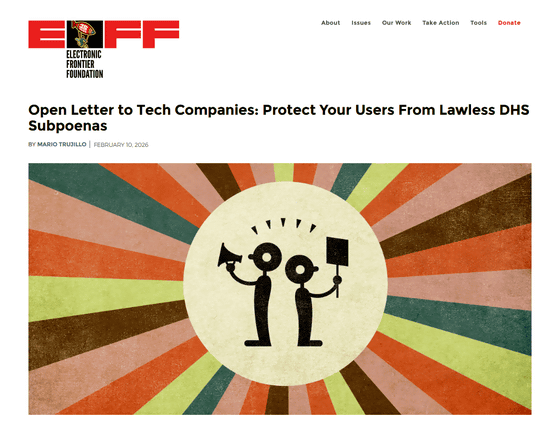
The open letter not only cites Johnson's case, but also other 'cases in which technology companies have provided users' personal information to the Department of Homeland Security.'
Lindsay Nash, a professor at Cardozo School of Law and a former attorney with the American Civil Liberties Union's Immigrant Rights Project, said Google's lack of notice to ICE subpoenas 'poses a problem for those whose personal information may be at risk and whose privacy may be violated, without being able to challenge the disclosure of that potentially private information.'
The Intercept noted that 'technology companies' data-sharing practices are primarily governed by the Stored Communications Act , which protects the privacy of digital communications, including email, and Title 5 of the Federal Trade Commission Act, which prohibits unfair or deceptive trade practices.'
Neil Richards, a law professor at Washington University in St. Louis, said, 'Under both federal and state law, you can't deceive consumers. If you make a material misrepresentation about how you handle data, that's a deceptive business practice.' He added that whether companies clearly communicate how they collect and share consumer information has been the subject of litigation for decades.
Google has reportedly received numerous requests from government agencies over the past decade for the personal information of specific users, similar to Johnson's case. The number of such requests has apparently increased sharply over the past five years, but it is unclear whether Google properly notified users of these requests.
'I'm calling on Congress to amend the Stored Communications Act to require higher standards before government agencies can access people's digital data,' Richards said. 'It's been 12 months since the leaders of big tech companies took to the stage at the presidential inauguration, and what we've seen is that big tech companies have become much friendlier to government and state power.'
'The strange thing about being a journalist is that we're so used to seeing things from the outside,' Johnson said. 'When governments and big tech know so much about us, and can track us, imprison us, and destroy us in so many ways, we have to think hard about what resistance looks like.'
Related Posts:





in Web Service, Posted by logu_ii