How to make your lithium-ion battery last longer
Lithium-ion batteries offer many advantages over other chemical batteries, such as lead-acid batteries, and are increasingly being used in a wide range of applications, including satellite power sources and electric vehicles (EVs). However, their performance deteriorates with repeated charging and discharging, temperature, and aging. Battery University, an information website about batteries run by Canadian electronics retailer Cadex Electronics, explains how to extend the life of lithium-ion batteries, using actual measurement data.
Battery University | BU-808: How to Prolong Lithium-based Batteries
Manufacturers generally conservatively estimate the lifespan of lithium-ion batteries for consumer products, often assuming around 300 to 500 discharge/charge cycles. Application requirements vary widely, with small wearable devices requiring around 300 cycles and smartphones requiring over 800 cycles, and there has also been discussion that a 'million-mile battery' for EVs would be equivalent to around 5,000 cycles.
However, since the amount of discharge is not always constant and there is no clear standard for what constitutes one cycle, evaluating battery life based solely on the number of cycles is not conclusive. Methods that recommend replacement based on the date without considering usage are also said to be difficult to reflect actual usage, as batteries may malfunction early or last longer depending on the load and temperature conditions.
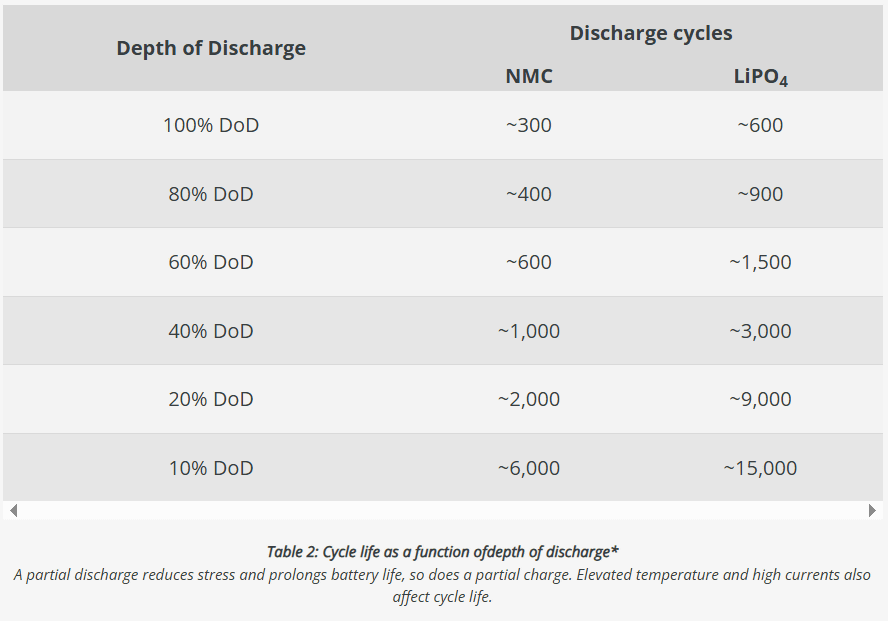
One of the major factors that affect battery life is the 'depth of discharge (DoD),' which indicates the percentage of capacity discharged during a single charge/discharge cycle. Because lithium-ion batteries have no memory effect , it's not necessary to fully discharge them regularly; in fact, it's recommended to avoid deep discharges. However, smart batteries and intelligent devices may require periodic calibration to maintain the accuracy of their battery life indicators.
For lithium-ion batteries using nickel-manganese-cobalt (NMC) cathodes, the lifespan is approximately 300 cycles at 100% DoD, but this increases to approximately 1,000 cycles at 40% DoD, approximately 2,000 cycles at 20%, and approximately 6,000 cycles at 10% DoD. This trend is even more pronounced for lithium iron phosphate (LiPO) batteries.
Temperature and charge state are also important. Battery University explains that temperatures above 30°C are considered high temperatures, and that maintaining a battery at a high charging voltage can also be stressful. In a one-year storage test, a 40% charge at 0°C resulted in a 98% capacity retention rate, and a 100% charge at 94%. At 25°C, a 40% charge resulted in a 96% capacity retention rate, and a 100% charge resulted in a 80% capacity retention rate. At 40°C, a 40% charge resulted in a 85% capacity retention rate, and a 100% charge resulted in a 65% capacity retention rate. Furthermore, at 60°C, a 40% charge resulted in a 75% capacity retention rate after one year, and a 100% charge resulted in a 60% capacity retention rate after three months. It has also been pointed out that maintaining a fully charged battery at high temperatures can be a greater burden than repeated charge-discharge cycles.
Setting the charging voltage also creates a trade-off with battery life. Many consumer devices charge to 4.20V/cell to maximize runtime, but for safety reasons, most lithium-ion batteries are not allowed to exceed 4.20V/cell. Increasing the voltage increases capacity, but excessive voltage can shorten battery life and potentially compromise safety. For example, 4.35V will halve the number of cycles a typical lithium-ion battery can get.
On the other hand, lowering the peak charging voltage extends battery life. 4.20V/cell provides approximately 300–500 cycles, 4.10V/cell provides 600–1000 cycles, 4.0V/cell provides 1200–2000 cycles, and 3.90V/cell provides 2400–4000 cycles. The optimal charging voltage for long life is 3.92V/cell, which virtually eliminates voltage-related stress. However, lower peak voltages reduce the battery's storage capacity. As a simple guideline, a 70mV reduction in charging voltage reduces overall capacity by approximately 10%, with full capacity restored by charging to peak voltage on the next charge. It's also important to note that repeated partial charging can negate the high specific energy benefits of lithium-ion batteries.
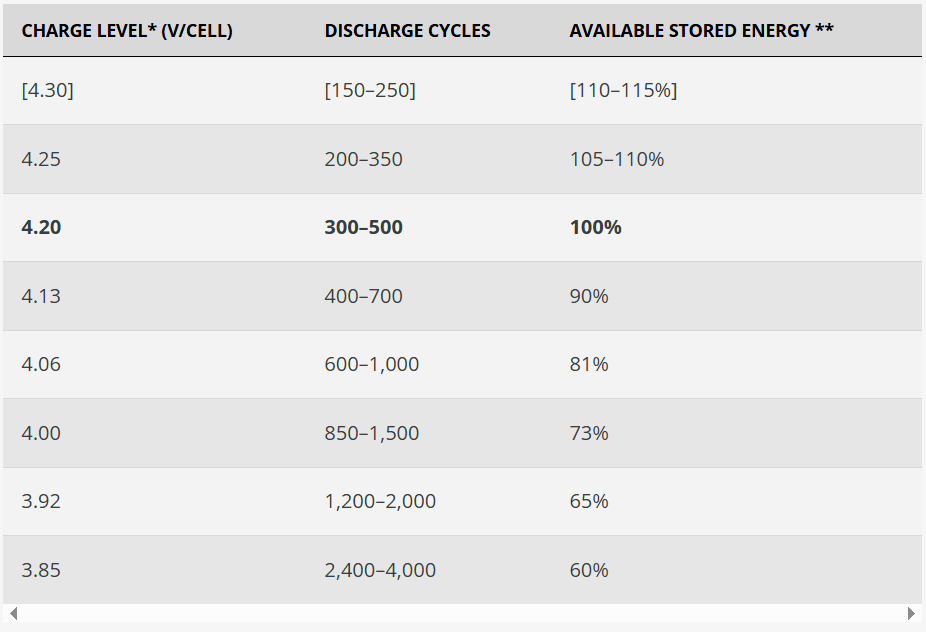
When it comes to voltage, it is also recommended not to leave the battery at the upper limit of full charge for a long period of time. For typical lithium-ion batteries, it is recommended not only to choose an appropriate voltage threshold for the application, but also not to leave the battery at the high voltage limit of 4.20V/cell for a long period of time.
In terms of operational bandwidth, industrial equipment and EVs are typically designed to limit charging to 85% and discharging to 25% to extend their lifespan, which means they use roughly 60% of the capacity, balancing available energy with lifespan.
In conclusion, Battery University showed that in order to extend battery life, it is important to avoid deep discharge, avoid the combination of high temperature and high state of charge, design peak voltage and bandwidth according to the application, and operate with an awareness of the trade-off between operating time and lifespan.
Related Posts:




in Hardware, Posted by log1i_yk