Friendship between shrimp and goby proves resistant to noise
by
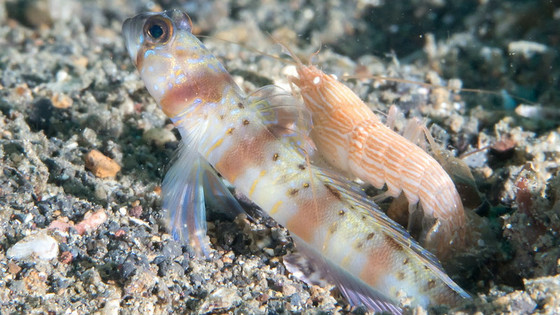
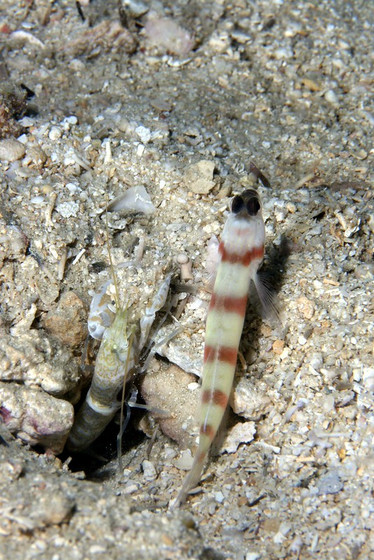
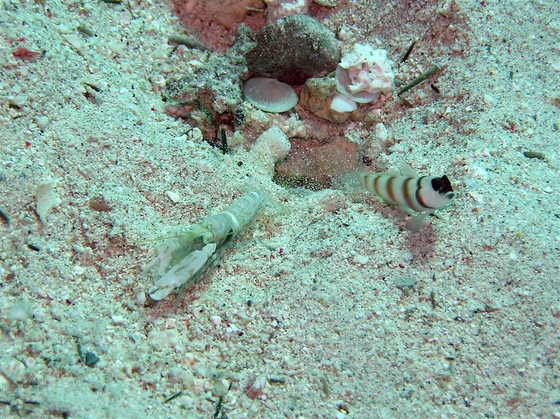
A symbiotic relationship exists between the Japanese goby (Amblyeleotris steinitzi) and the pistol shrimp (Alpheus spp.) that live in Australia's Great Barrier Reef, with the shrimp responsible for digging and maintaining their burrows, and the goby acting as a sentinel, keeping an eye out for predators. A study published by a research team including Monash University found that boat noise at sea alters the symbiotic behavior of the goby and shrimp.
Boat noise alters individual behaviors but not communication between partners in a fish-shrimp mutualism | Behavioral Ecology | Oxford Academic
https://academic.oup.com/beheco/article/36/5/araf110/8266905
When shrimp hear the engines roar: How boat noise rattles marine besties, but not their friendship
https://phys.org/news/2025-11-shrimp-roar-boat-noise-rattles.html
The researchers used underwater video cameras to study the effects of boat engine noise on 123 pairs of gobies and shrimps. The experiments involved two types of engines, a four-stroke and a two-stroke, both commonly used on shallow coral reefs.
The results showed that gobies and shrimp responded differently to the noise. Sentry gobies reduced the time they spent outside their burrows by 22% when they heard the more complex acoustics of a four-stroke engine. Digging shrimp, on the other hand, were more sensitive to the more intense sound of a two-stroke engine, reducing their time spent outside by 34%.

by Anker A, Grave S
This difference in reaction is thought to stem from differences in how each organism detects sound. Gobies are highly sensitive to frequencies between 100 and 300 Hz, while shrimp detect lower frequency sounds, around 80 to 100 Hz. Therefore, it is possible that the two-stroke engine, which emits a strong sound at a low frequency, is more likely to affect shrimp, while the complex acoustic characteristics of the four-stroke engine may have more strongly stimulated the goby's vigilance.
by
Furthermore, the research team claims that despite the changes in individual behavior, communication between the goby and shrimp was maintained. The goby communicated through tactile signals, such as small movements of its fins, and they maintained their coordination even in the midst of the noise. The goby remained vigilant at the entrance to the burrow, while the shrimp continued their work, touching the goby's body to confirm safety.
by prilfish
'While boat noise is certainly stressful for these creatures, their bonds are resilient,' said Jack Manella, lead researcher at the University of California, San Diego. 'This finding suggests that protecting marine environments requires considering not just the volume of noise, but also the differences in sound quality between engine types.'
Related Posts: