The Bermuda Triangle became a legend largely due to the Flight 19 incident.

Flight 19 Vanished in 1945, Fueling the Myth of the Bermuda Triangle
https://www.smithsonianmag.com/history/how-the-disappearance-of-flight-19-a-navy-squadron-lost-in-1945-fueled-the-legend-of-the-bermuda-triangle-180987759/
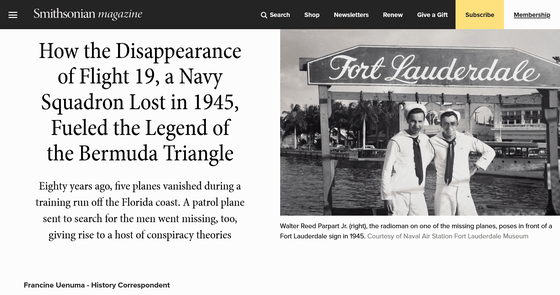
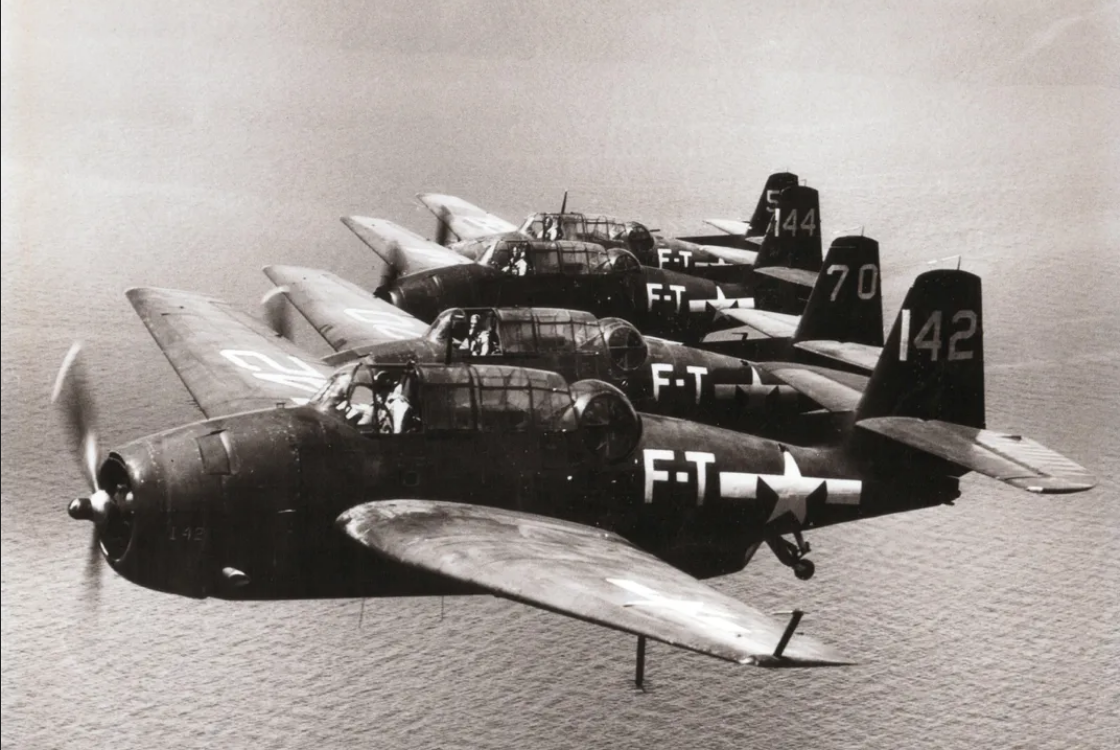
On December 5, 1945, Flight 19, a squadron of five General Motors TBM Avenger torpedo bombers, took off off the coast of Florida for routine training. However, a few hours after takeoff, the commanding plane reported that it had lost track, and then communication was lost, with the five planes disappearing somewhere over the Atlantic Ocean. Furthermore, the flying boats sent to search for the planes also lost contact, and ultimately, six planes and 27 crew members never returned... This is the story of the Flight 19 incident.
Below is the trajectory and time schedule of Flight 19. Flight 19 was scheduled to depart Naval Air Station Fort Lauderdale (1 in the image) at 2:10 PM, fly approximately 80 km east, and conduct bombing training near the Bimini Islands on the western tip of the Bahamas (2 in the image). It was scheduled to continue east (3 in the image), fly north over Grand Bahama Island (4 in the image), and then return to base. If nothing happened, the flight would take approximately 2 hours and 40 minutes.
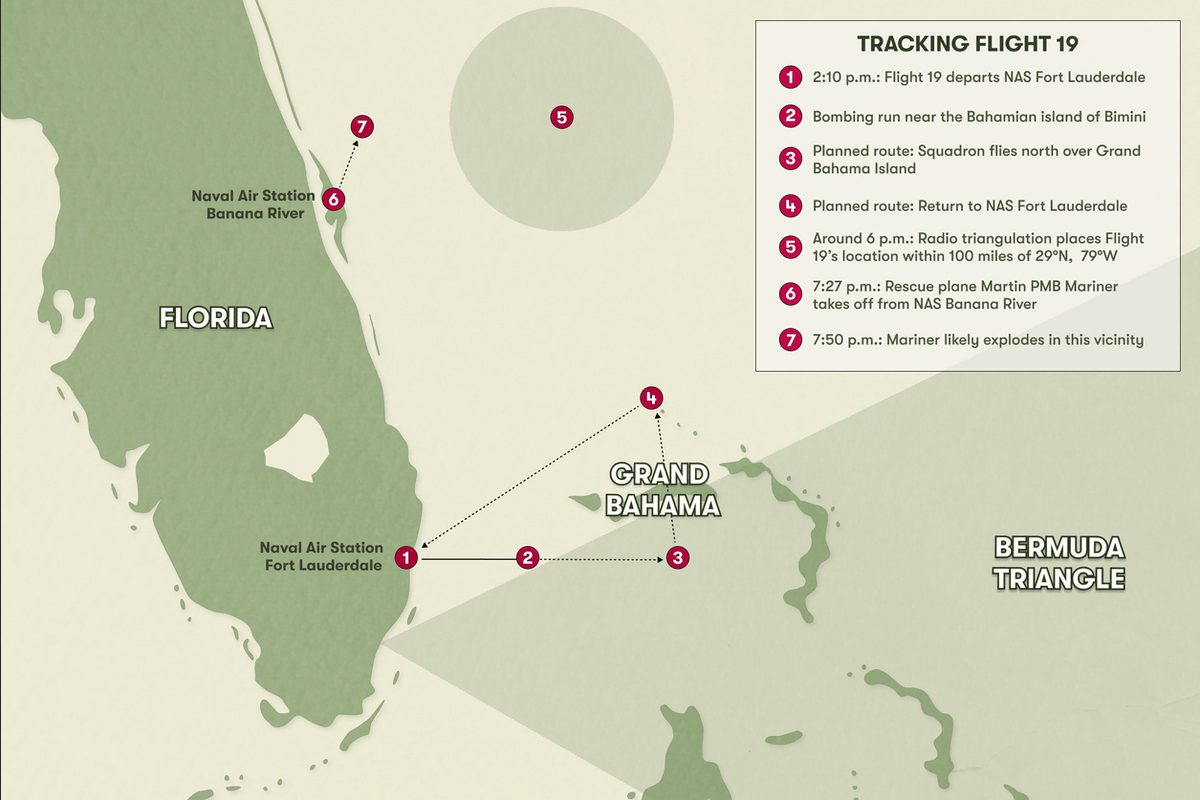
Flight 19 is confirmed to have conducted a bombing practice around 3:00 PM, but then appears to have lost track of its own position and become lost. Flight 19's commander, Lt. Charles Carroll Taylor, believes the aircraft is near the Florida Keys, an archipelago off the southwest coast of the Florida peninsula, according to communications. However, radio triangulation by the base indicates that the aircraft was within 100 miles (approximately 160 km) of 29 degrees north latitude and 79 degrees west longitude at 6:00 PM, off the east coast of central Florida (point '5' in the image).
Lieutenant Taylor's communications revealed that the five aircraft continued to fly together until the end, and the final message was at 7:04 PM when 2nd Lieutenant Joseph T. Bossi, one of Flight 19's pilots, attempted to contact Lieutenant Taylor. Taylor did not respond.
Furthermore, two Catalina flying boats were sent out to search for the missing Flight 19, but one of them was lost. A few hours later, an apparent explosion was spotted over the ocean at 28°59'N and 80°25'W, indicating the plane had crashed and burned. The Navy mobilized more than 200 aircraft over five days to investigate the double whammy, but was unable to find any trace of the 14 crew members of Flight 19 or the 13 crew members of the Catalina.
The Navy prepared a report stating that Lt. Taylor's disorientation caused him to lose track of the Florida peninsula and affected his subsequent decisions.
However, the report relied on the testimony of the rescue team, lacking any physical evidence or testimony from the pilot. The flight training officer, Major Donald J. Poole, wrote that Taylor 'was hopelessly confused and in a state of near-psychosis.' This was unacceptable to Taylor's mother, Katherine, so she set out to investigate the cause herself. She discovered that early on after Flight 19 went missing, there were aircraft available to search for the missing, and despite the pilot's request, Major Poole declined to do so.
Poole explained his decision at the time by saying he was 'waiting for a solution' and 'wanted to avoid disrupting communications with the ground by sending a new aircraft into the air,' but neither Katherine nor the pilot who requested the deployment, Lieutenant Cox, were convinced. However, it seems there were others who thought Flight 19 would reach the coast before it ran out of fuel, and Lieutenant Colonel Charles Kenyon, the base's operations officer, also testified, 'I believed Flight 19 was experiencing a temporary disruption and would return on time.'
Thanks to Katherine's tireless lobbying, the Navy revised its findings in 1947. Instead of focusing on Lt. Taylor's piloting error, the official position was that 'the reason and cause are unknown.'
As the Navy's official conclusion that the cause was unknown spread, Flight 19 became a classic example of mysterious disappearances. In 1964, a news article titled 'The Deadly Bermuda Triangle' became a hot topic, and the term 'Bermuda Triangle' became widely used.
According to the National Oceanic and Atmospheric Administration (NOAA), 'there is no evidence that mysterious disappearances occur more frequently in the Bermuda Triangle than in other large, heavily traveled areas of the ocean.' However, Flight 19 and similar unexplained disappearances have been confirmed, and have been the subject of various discussions and stories, including conspiracy theories and UFO theories.
Related Posts:


in Note, Posted by log1e_dh