Why has China's 'Singles Day' become an event that generates an economic effect of 20 trillion yen?

November 11th is known as 'Singles' Day' in China, and various promotional activities are held for singles. Peter McGraw, a psychology professor at the University of Colorado, Boulder, discussed how Singles' Day came about and whether these promotional activities could be implemented in the United States.
Singles' Day is a $150B holiday in China. Here's why I think '11/11' will catch on in the US
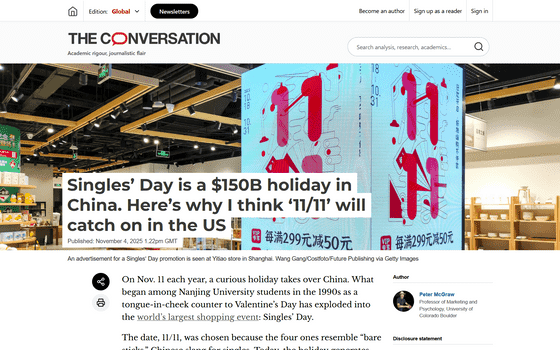
Singles' Day is said to have been started by students at Nanjing University in the 1990s as a response to Valentine's Day. At some point, major e-commerce sites began using the event to promote their products, and it has now grown into a major event that generates an annual economic impact of $150 billion (approximately 23 trillion yen).
McGraw, who is single himself, has studied how singlehood is transforming consumer behavior and market dynamics, and believes Singles' Day or something similar could resonate beyond Asia, globally, because the number of single people is increasing.
It's no coincidence that Singles' Day originated in China. The one-child policy, in place from 1980 to 2015, led many families to desire sons, creating a skewed gender balance and leaving millions of men without potential marriage partners. At the same time, expanding education and career opportunities gave many women the opportunity to abandon traditional marriage altogether and become independent, changing women's values about marriage.
These trends are being seen across East Asia. In Japan, single-person households will surpass the number of married couples with children, and in South Korea, single-person households will reach a record high of approximately 36% by 2023. These changes have combined to give rise to a culture known as 'hitorisama' in Japan and 'hongjok' (single-person tribe) in South Korea.

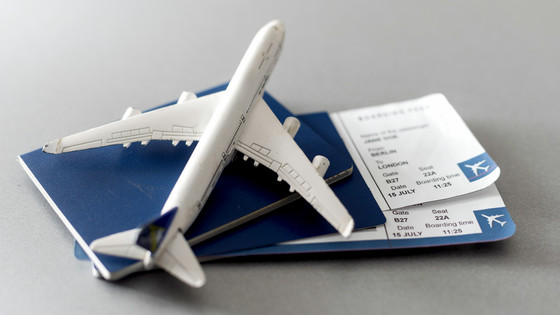
Asian companies have seized this opportunity, offering services that cater to the independent lifestyle, such as solo karaoke booths and movie theaters for solo travelers. Singles' Day is another business opportunity, with Asian retailers promoting the day each year with themed promotions and pre-sales. Xiaomi launches limited-edition smartphones, and Nike releases new sneakers every year. Airlines have also gotten involved, with Singapore's Jetstar Asia offering 111,111 discounted seats, positioning solo travel as an empowering experience. Singles' Day has spurred huge purchasing activity, redefining singlehood as something to celebrate rather than lament.
Meanwhile, in America and many parts of the world, companies have a 'marriage is everyone's destiny' philosophy, which McGraw sees as an 'outdated value system.'
This is because there are many single people in the United States, with half of adults unmarried and half of those not looking for a partner. In 1960, only 10% of American adults remained single for their entire lives, but by 2025, it is predicted that 25% of millennials aged 29-44 will never marry. The average age at first marriage was 21 in 1960, but by 2025, it will rise to 29.

McGraw pointed out that 'American companies can gain a competitive advantage by understanding the diverse goals and lifestyles of single people,' noting that values regarding marriage have changed over the decades but are still largely overlooked by most American companies.
However, there have been signs of improvement in recent years. For example, in 2021, MVNO Visible Wireless changed its 'family plan' to a 'friends and family plan.' In 2024, Norwegian Cruise Line introduced studio cabins for solo travelers, eliminating the long-standing 'single-guest surcharge.' Similarly, IKEA offered a couples-only Valentine's dinner in 2024, but in 2025, it shifted to a comprehensive promotion encouraging customers to 'bring your significant other, your best friend, and your whole family.'
However, these are exceptions, not the general trend, so McGraw said, 'To appeal to this growing market, learn from the value that not all singles are looking for romance and create singles events and non-romantic experiences that reflect the single lifestyle. Optimize your services for people who live and do things alone. Singles are everywhere, but they are still largely overlooked in a world built on two-person relationships. The rise of Singles' Day in Asia is a result of companies taking singles seriously, and the US will follow suit sooner or later.'
Related Posts:






in Note, Posted by log1p_kr