1,400-year-old 'cubic skull' discovered at Mexican ruins
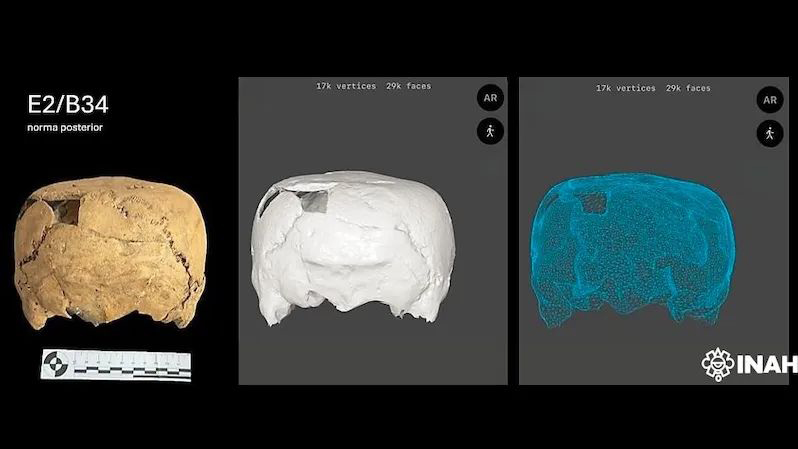
by INAH; Technical Archive of the Physical Anthropology Section of CINAH Tamaulipas
The artificial modification of the human skull is called
Especialistas del INAH revelan práctica de deformación craneal inédita en la Huasteca
https://www.inah.gob.mx/boletines/especialistas-del-inah-revelan-practica-de-deformacion-craneal-inedita-en-la-huasteca
Unusual, 1,400-year-old cube-shaped human skull unearthed in Mexico | Live Science
https://www.livescience.com/archaeology/unusual-1-400-year-old-cube-shaped-human-skull-unearthed-in-mexico
The area surrounding the Balcón de Montezuma ruins in the northeastern Mexican state of Tamaulipas was inhabited by various Mesoamerican peoples between 650 BC and 1200 AD. According to Mexico's National Institute of Anthropology and History (INAH) , a village was established around 400 AD, with approximately 90 houses built around two plazas.
Professor Jesús Ernesto Velasco González of the INAH and his colleagues reviewed the catalogue of materials and new archaeological discoveries at the Balcón de Montezuma site, and discovered that the skull of a middle-aged man over 40 years old unearthed at the site had a shape never seen before.

Cranial deformation typically results in an alien-like, conical shape, caused by binding the baby's head with a length of cloth or soft stuffing, which forces the skull to grow at an angle.
However, the skull discovered this time was shaped like a cube with a flattened top, which some experts call a 'parallelopid' because it resembles a three-dimensional parallelogram or rhombus.
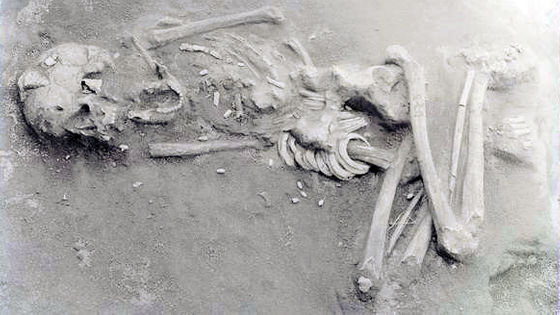
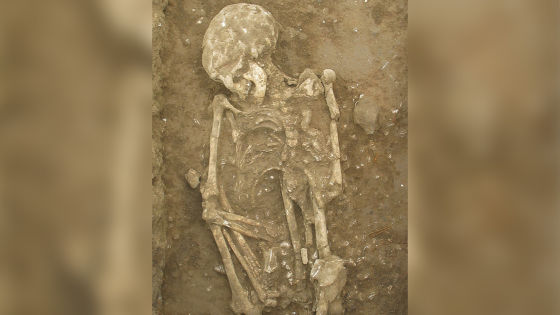
Below are photos and 3D scans of a cubic skull found at the Balcón de Montezuma ruins. It can be seen that the top is flattened and has a cube-like shape.
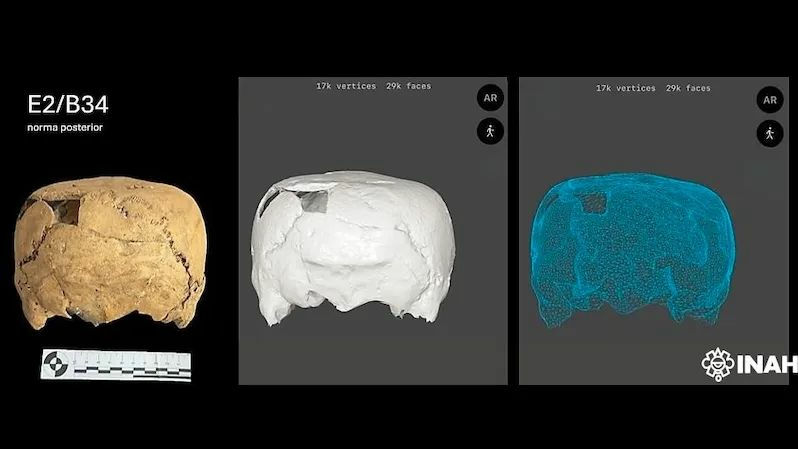
'The skull type identified at Balcón de Montezuma is an upright plate with a flattened top, a feature not previously seen in remains found in the Huasteca region ,' Velasco González said.
Examples of flat-topped skulls similar to the one found this time have been found at the El Zapotal ruins in the south-central part of Veracruz state , facing the Gulf of Mexico, and at ruins in the Maya region .
The research team then performed stable oxygen isotope analysis on samples taken from the bones and teeth to determine whether the middle-aged man found this time came from another area or was born and raised around the Balcón de Montezuma ruins.
They found that the man was born near the Balcón de Montezuma ruins and likely spent his entire life in the area, but it's possible that the people who reshaped his skull were members of a different cultural group.
Related Posts:



in Free Member, Science, Posted by log1h_ik