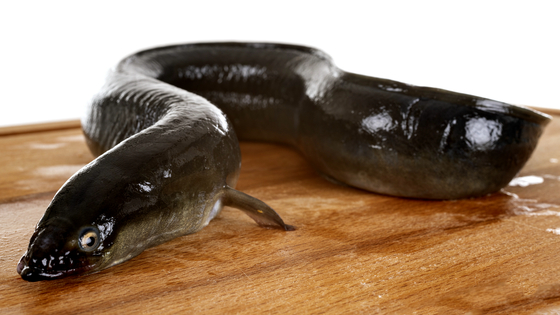
Components in eel mucus prevent infection with bacteria that cause diarrhea, such as Salmonella.
A Massachusetts Institute of Technology (MIT) research team has uncovered the mechanism by which
Mucus-derived glycans are inhibitory signals for Salmonella Typhimurium SPI-1-mediated invasion: Cell Reports
https://www.cell.com/cell-reports/fulltext/S2211-1247(25)01075-7
Study shows mucus contains molecules that block Salmonella infection | MIT News | Massachusetts Institute of Technology
https://news.mit.edu/2025/study-shows-mucus-contains-molecules-that-block-salmonella-infection-0925
Mucin is a high molecular weight glycoprotein derived from animals, and is found in the mucous membranes that cover the surface of eels and loaches, as well as in the mucus secreted by the digestive tract, such as the esophagus and intestines. It was known that mucin has the function of actively suppressing microorganisms such as bacteria, but the mechanism by which this serves as an effective defense against microorganisms was not clear.
This research revealed that MUC2, a type of mucin present in the intestine, inactivates a group of genes that Salmonella uses to invade and infect host cells.
When Salmonella infects cells, it forms a needle-like structure called a type III secretion system (T3SS). The genes that form the blueprint for this T3SS are contained in a DNA region called SPI-1 on the Salmonella chromosome.

by Schraidt O, Lefebre MD, Brunner MJ, Schmied WH, Schmidt A, Radics J, Mechtler K, Galán JE, Marlovits TC
The research team found that MUC2 inactivates
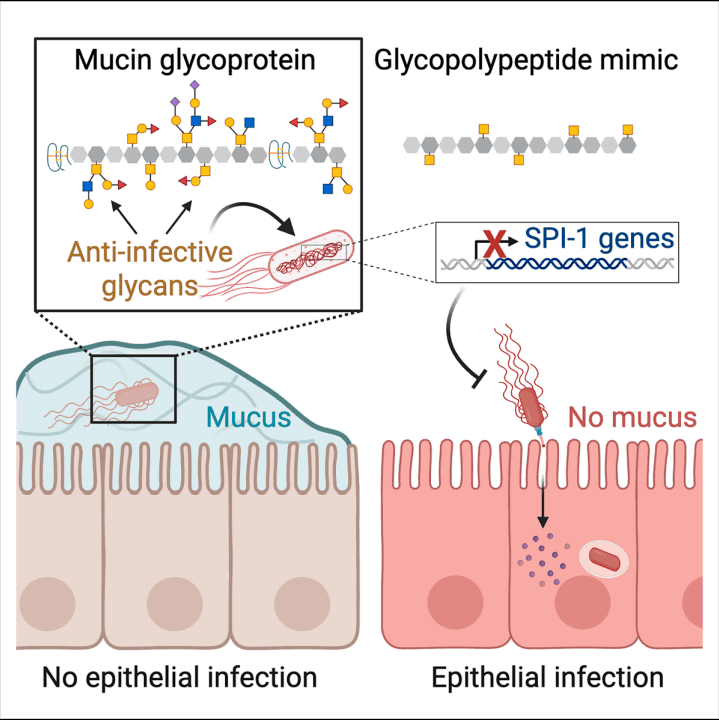
Furthermore, it was identified that the main role in this infection-suppressing effect is played by complex sugar molecules called glycans (sugar chains) attached to the peptide backbone of mucin. In particular, it has been suggested that two monosaccharides that make up the glycans, N-acetylgalactosamine (GalNAc) and N-acetylglucosamine (GlcNAc), may bind to specific sites on HilD and inhibit its function.
In addition, experiments showed that the SPI-1 gene suppression effect was significantly enhanced when these monosaccharides were presented in a peptide backbone (glycopeptide) like mucin, rather than when they were presented alone. However, it was also found that this suppression effect was completely lost when the terminal glycans were capped with sialic acid .
The research team is now applying this discovery to develop synthetic mucins to enhance the body's natural defenses. Salmonella is known to target areas where the mucus barrier is weak or non-existent, so synthetic mucins could complement these weak spots.
'The research team is considering adding synthetic mucin to oral rehydration salts to treat dehydration caused by diarrhea, or taking it before traveling to areas with a high risk of food poisoning. Furthermore, because synthetic mucin functions as part of the innate immune system, the research team believes it could be particularly effective as a preventative medicine before infection.'
Related Posts:



in Science, Posted by log1i_yk