DRAM prices are expected to double in just one month from May 2025 and remain high, leading to speculation that China's CXMT may stop producing DDR4 and focus on DDR5 and HBM.
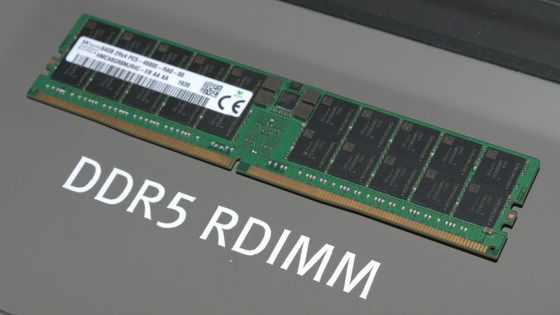
While Chinese semiconductor manufacturers have been successful in producing high-end DRAMs and other components, there is speculation that they are gradually reducing some DRAM production to meet domestic demand for AI. This has reportedly caused DRAM prices to double in just one month.
China makes inroads in DRAM chips in challenge to Samsung and Micron - Nikkei Asia
https://asia.nikkei.com/business/technology/tech-asia/china-makes-inroads-in-dram-chips-in-challenge-to-samsung-and-micron
According to a Bloomberg report from the end of January 2025, despite US export restrictions on China, Chinese semiconductor manufacturer ChangXin Memory Technologies (CXMT) has succeeded in further advancing semiconductor manufacturing technology.
China's CXMT Memory Chip Breakthrough Beats US Export Controls - Bloomberg
https://www.bloomberg.com/news/articles/2025-01-28/china-s-cxmt-memory-chip-breakthrough-beats-us-export-controls
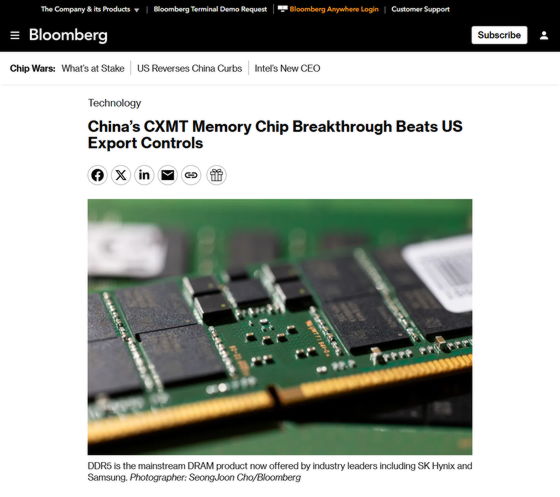
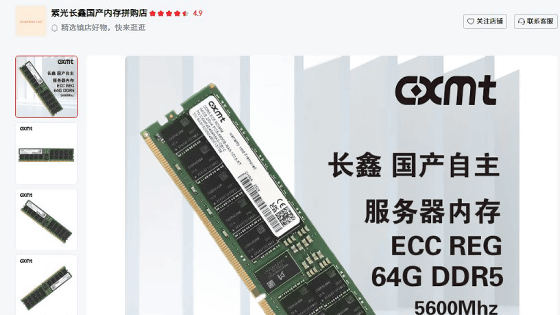
According to information obtained by Bloomberg from Canada-based research firm TechInsights , CXMT's DDR5 DRAM is used in memory modules sold by Gloway and uses advanced manufacturing techniques not previously seen in the Chinese domestic market.
TechInsights, which provided information to Bloomberg, said, 'CXMT has found a unique approach to designing and manufacturing DDR5 DRAM on a commercial scale. TechInsights predicted that CXMT's DDR5 DRAM would appear in late 2025 or early 2026, so this discovery is surprising.'
The US DRAM export restrictions state that 'technology and equipment for manufacturing DRAM chips with a minimum transistor wiring pitch of 18nm or less (half pitch) cannot be supplied to Chinese companies without US government approval.' However, CXMT's latest DDR5 DRAM appears to achieve a half pitch of 16nm. In semiconductors, the smaller the nanometer dimension, the better the semiconductor's performance and power efficiency.
Since its commercialization in 2020, DDR5 DRAM has become the flagship DRAM product offered by industry giants such as SK Hynix and Samsung, and is also used in high-bandwidth memory chips for AI accelerators developed by companies such as NVIDIA. However, TechInsights pointed out that CXMT's latest technology is about three years behind that of industry giants such as South Korea's and the US's Micron Technology.
In December 2024, the U.S. Department of Commerce's Bureau of Industry and Security announced a ban on exports to China of 24 types of semiconductor manufacturing equipment and three categories of software essential for semiconductor development, and added 140 Chinese companies to the Entity List (subject to export restrictions).
The US tightens export controls on high-bandwidth memory (HBM) due to concerns about China's military use of AI, adding 140 Chinese companies to the Entity List - GIGAZINE

The South China Morning Post reported that the Entity List did not include CXMT, a major Chinese semiconductor company, due to Japan's influence. CXMT receives a major supply from Tokyo Electron , a major Japanese manufacturer of semiconductor manufacturing equipment, and multiple sources testified that Japan's opposition led the US to not include CXMT on the Entity List.
Reports that China's largest DRAM manufacturer 'CXMT' has been removed from the US blacklist due to opposition from Japanese companies - GIGAZINE
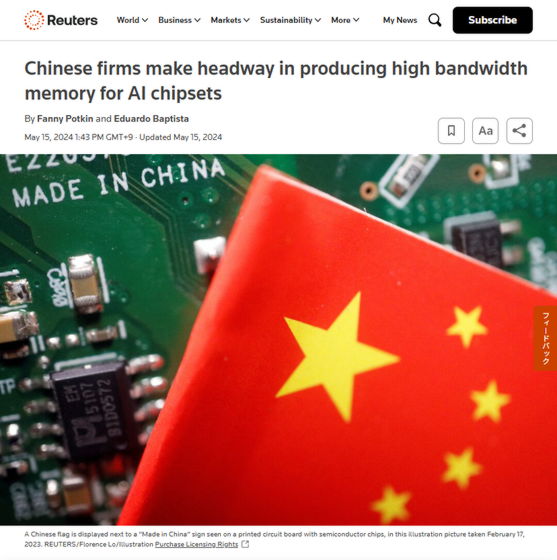
Additionally, it was reported in May 2024 that CXMT had partnered with Tongfu Microelectronics , a semiconductor company that handles chip packaging and testing, to develop HBM chip samples. According to sources, the HBM chips developed by CXMT have already been provided to some customers, and CXMT is in regular meetings with semiconductor manufacturing equipment manufacturers in South Korea and Japan to purchase the equipment necessary for HBM development.
Chinese firms make headway in producing high bandwidth memory for AI chipsets | Reuters
https://www.reuters.com/technology/chinese-firms-make-headway-producing-high-bandwidth-memory-ai-chipsets-2024-05-14/
Most of the DRAM on the market is either standard DDR4 or its next-generation model, DDR5, which offers faster data transfer speeds. According to Tokyo-based research firm BCN, DDR4 accounts for approximately 60% of the DRAM market for desktop PCs, while DDR5 accounts for approximately 40%.
According to a report by Nikkei Asia, the price of 8Gbit DDR4 DRAM was approximately $4.12 (approximately 610 yen) per unit as of June 2025, and the price of 4Gbit DDR4 DRAM was approximately $3.14 (approximately 460 yen) per unit. The price of 4Gbit DDR4 DRAM has reached its highest price since July 2021.
According to a semiconductor trading company, the selling price of DDR4 DRAM has doubled in one month, an unprecedented phenomenon. Nikkei Asia reported that the reason for the price increase is 'widespread speculation that China's CXMT has stopped DDR4 production, raising concerns about a shortage.'
CXMT is supported by the Chinese government's semiconductor sector, and its parent company is backed by the China State Semiconductor Fund. Chinese media reports predict that CXMT will shift to DDR5 DRAM production in line with the government's policy of focusing on semiconductors for AI and cloud computing.
According to CITIC Securities, a major Chinese securities firm, CXMT plans to begin small-scale production of DDR5 DRAM in 2024, with mass production planned at the time of writing. However, due to the current low production yield of DDR5 DRAM, full-scale mass production is expected to begin in the second half of 2025.
CXMT appears to be converting its DDR4 DRAM production plants to DDR5 DRAM production, which is likely contributing to the decline in DDR4 DRAM production. CXMT's DDR4 DRAM production is expected to end in the first half of 2026.
According to market research firm Omdia, the top three DRAM manufacturers by sales are Samsung, SK Hynix, and Micron Technology. These three companies will account for 90% of the market in the second quarter of 2025. The price war between these three companies is putting pressure on the profitability of DDR4 DRAM, and it is predicted that Samsung and SK Hynix will reduce their DDR4 DRAM production volume as they transition to DDR5 DRAM. These factors are also contributing to the rise in DDR4 DRAM prices, Nikkei Asia reported.
Related Posts:
in Hardware, Posted by logu_ii