Pandemic is turning Nigerian university students into cybercriminals

The novel coronavirus disease (COVID-19), which became a global pandemic in 2020, is once again experiencing a global pandemic due to the emergence of mutant strains such as the Delta and Omicron strains, with the global death toll exceeding 5 million in November 2021. As one of the aftermaths of this pandemic, it has been reported that in Nigeria, one of Africa's leading economic powers, 'university students are being forced to become cybercriminals.'
How the pandemic pulled Nigerian university students into cybercrime - The Record by Recorded Future
https://therecord.media/how-the-pandemic-pulled-nigerian-university-students-into-cybercrime/
The COVID-19 pandemic that began in 2020 has had a devastating impact on the economy, industry, and daily life, and even in Japan, terms like 'pre-corona' and 'post-corona' have become common terms. Nigeria, located in West Africa, was not spared from the pandemic, and in 2020 it made the decision to close its universities indefinitely.
Kayode, who attended the University of Ilorin in Nigeria, says he attended a party attended by many cybercriminals around November 2020. Of course, he was aware of the risks of attending this type of party, but as he continued to stay at home with no prospects for the future since the university closed due to the pandemic, he turned to cybercrime.
Kayode attended the party with the ulterior motive of 'making connections with some bigwigs,' but around 11 p.m., a fight broke out between two bigwigs. Guests were surrounded by men wielding knives and broken bottles. Kayode fought back to defend himself, but was beaten until he vomited and passed out.
One might think that this story is just one of the fate of a down-and-out young person living in one of the poorest countries. However, Nigeria is Africa's leading economic power, ranking 26th in the International Monetary Fund's (IMF) 2020 GDP rankings , just below the G20 and far ahead of second-place Egypt. Kayode's University of Ilorin is also known as one of the country's leading academic institutions, and he himself served as a prefect in high school, earning straight A's. He was an excellent student, even being selected as a representative in an inter-school academic competition.
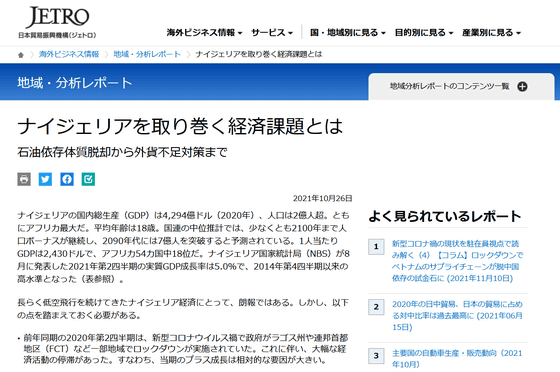
While the direct cause of Kayode's downfall was the COVID-19 pandemic, the underlying cause lies in Nigeria's economic foundation. Nigeria is one of the world's leading oil producers, ranking 15th in the world in terms of oil production, and was once an oil-heavy economy, with crude oil sales accounting for approximately 70% of total exports. In recent years, the country had been developing various industries in an effort to move away from oil dependence, but since the COVID-19 pandemic, both oil production and exports have fallen sharply following the OPEC + production cut agreement, leading to a 17% inflation rate and a major blow.
Economic Issues Surrounding Nigeria | Regional Analysis Report - International Business Information - JETRO
https://www.jetro.go.jp/biz/areareports/2021/e09d30525d710718.html
According to a recent World Bank report , despite being one of Africa's leading economic powers, the number of households falling below the poverty line is increasing, and some people are beginning to be unable to even afford food.
Kayode, who comes from a single-parent family, said his mother's income was reduced and the money he sent home was cut, so he studied graphic design and online marketing and looked for work, but these efforts did not lead to any income. This is how Kayode turned to cybercrime.
Kayode's first crime was 'romance fraud.' Romance fraud involves creating attractive profiles using photos of 'good-looking people' collected online, tricking the victim into sending money or stealing personal information needed to apply for benefits or loans. Kayode is said to have belonged to a criminal organization that commits romance fraud.
The number of victims of 'romance scams' that deceive others using the power of love has increased by 50%, and the new coronavirus may be the cause - GIGAZINE

In this criminal organization, in addition to the deceivers who directly handled interactions with targets like Kayode, there were also thieves who used stolen personal information to covertly apply for benefits and other benefits, and laundered money. One day, Kayode, who had asked one of the thieves to launder the funds for him, had his money stolen, and he began to commit 'matching app scams' by offering prostitution or 'sell nude photos' on dating sites, getting those who fell for it to transfer money before disappearing.
Cases like Kayode's are not uncommon, and cybercrime is rapidly increasing in Nigeria. The Nigerian Economic and Financial Crimes Commission, which specializes in economic and financial crimes, announced that it arrested 117 people for cyber fraud in 2019 and 62 in 2020. However, it has announced that in the first half of 2021 alone, the number exceeded 300. The FBI also announced that Nigerian cybercriminals received more than $110 million (approximately 12.6 billion yen) in fraudulent grant and loan applications in 2020, a threefold increase from 2019. According to a study published (PDF file) by Agari, a security company specializing in business email, an analysis of fraudulent emails that did not use proxies or other methods to conceal their identities revealed that approximately 50% were sent from Nigeria.
While being beaten up at the party, Kayode unconsciously called his mother, and when he woke up, his mother was on the bus heading to her boarding house. Having reunited with his mother and quitting his criminal activities, Kayode is now living with her. While he says he has regained his mother's trust, he continues to blame himself, saying, 'There are others who have been in much worse circumstances who have not resorted to this.' Cases like this are becoming commonplace in Nigeria, and many young people are struggling with the moral guilt of being lured into cybercrime by the potential financial gains, leading some to go astray.
Related Posts: