I created a custom AI driver for a film scanner to read old photos left behind by my deceased mother.
Christian F.K. Schaller, Engineering Director at Red Hat, reports that he 'created his own AI-powered driver' to scan old photographic
Using Artificial Intelligence to reverse engineer hardware | Christian FK Schaller
https://blogs.gnome.org/uraeus/2026/10/15/aiandreverseengineerhardware/
Mr. Schaller, who lost his mother, found a box containing old negative films of family trips from his childhood. He then purchased a film scanner to scan the negatives. He bought the ' Plustek OpticFilm 8200I-SE ' because it was supposed to be Linux compatible, but when it arrived, he found that the chip installed had been changed to one that was not Linux compatible.
Schaller reportedly tried to create his own driver for SANE, a software platform for film scanners, using the AI coding tool Claude Code, but initially ran into problems, which remained unresolved for months.
Around that time, he came across a post on X by Tom Crider, who had used an AI tool to fix his mouse driver. Crider also explained how he had a system in place to allow the AI agent to completely control the Windows environment so that it could collect the data needed to fix the driver.
-install codex on windows machine
— GloriousEggroll (@GloriousEggroll) September 26, 2026
-install and enable ssh server on windows machine
- open codex on linux, make it create a client that asks you once to authenticate for windows rdp and windows ssh
- it uses xfreerdp and pipewire window capture to render the rdp session…
Schaller pasted this post into Claude Code and built a Windows virtual machine so he could do the same thing with his own scanner. This created 'hw-harness,' which can analyze the operation of the hardware. With hw-harness, he was able to check the USB communication when scanning film on Windows, bringing him one step closer to completing the Linux driver.
GitHub - cschalle/hw-harness: Small set of tools for helping with reverse engineering Linux drivers · GitHub
https://github.com/cschalle/hw-harness
Schaller says that this, combined with improvements to Claude Code itself, allowed them to build the SANE driver within a few hours. Although there were issues with image quality, they succeeded in capturing photos of a quality that clearly indicated they were images from negative film. A few days later, they completed a nearly perfect driver that also supported infrared scanning.
It was later discovered that while Mr. Schaller was creating the driver, SANE had also developed a driver for the same scanner, and that support had been added in September 2026. The following is a page reporting the differences between the driver created by Mr. Schaller and SANE's official driver.
GitHub - cschalle/OpticFilm8200i-sane: This is a driver for the Opticfilm8200i scanner using the GL128 chipset and USB id 07b3:1825 · GitHub
https://github.com/cschalle/OpticFilm8200i-sane
Alternative SANE driver for Genesys GL128 (Opticfilm 8200i) (#886) · Issue · sane-project/backends
https://gitlab.com/sane-project/backends/-/work_items/886
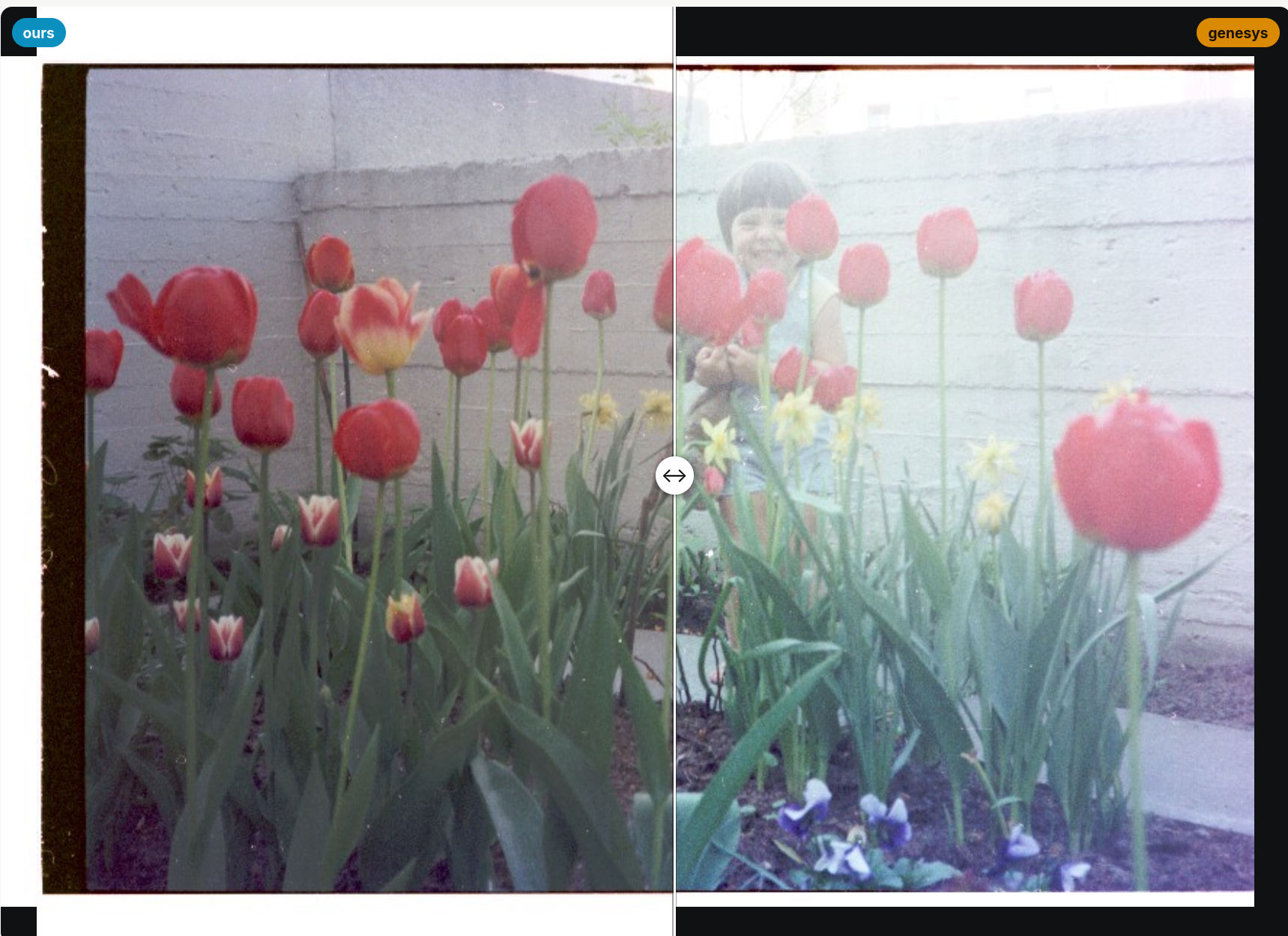
The image below compares the results of scanning negative film using a driver created by Mr. Schaller (left) and the official SANE driver. Although there are differences in brightness and other aspects, both drivers successfully captured the original photographs.
Schaller said, 'This kind of work is perfect for AI models. They can read thousands of lines of USB capture data, notice repeating sequences where only one byte changes, and suggest the meaning of those bytes. AI models can also create test code to verify it, so the work never gets boring. Of course, it's the human's job to decide what to build and make sure it works on actual hardware, but the tedious work can be greatly reduced by using AI.'
Related Posts:
in AI, Posted by logu_ii