Mistral unveils 'Mistral Large 4 Le Chonk,' an open-weight AI model with over 1 trillion parameters, aiming to compete with Chinese competitors.

French AI company Mistral announced a new AI model, ' Mistral Large 4, ' with over 1 trillion total parameters, on October 6, 2026. Mistral Large 4 is a multimodal model nicknamed ' Le Chonk ,' and according to Mistral, its performance 'is comparable to promising open-weight models developed by Chinese companies.'
Introducing Mistral Large 4 | Mistral
Mistral Large 4 - Mistral AI | Mistral Docs
https://docs.mistral.ai/models/mistral-large-4-0
Meet Mistral Large 4, aka Le Chonk.
— Mistral AI (@MistralAI) October 6, 2026
• 1T parameters, natively multimodal. 49B active.
It is the best open weights model from US or Europe on aggregated benchmarks.
• State-of-the-art on critical workloads, including cyber defense, manufacturing and finance and it surpasses closed frontier models on visual grounding.
• Forged in Europe end-to-end and is deployable from Europe via our own Mistral Cloud infrastructure.
• Available to all via API today. Working with cybersecurity partners privately.
Open weights release end of October.
Mistral Large 4 employs a Mixture-of-Experts (MoE) architecture that selects and runs only the necessary parts of multiple expert models. While the total number of parameters is 1.05 trillion, only 49 billion are active parameters used during inference, and it features a 1.6 billion-parameter image encoder. This mechanism eliminates the need to run all of the parameters at once, even with over 1 trillion parameters.
This native multimodal model handles text and images and supports a context window of 1 million tokens. It's designed to handle coding, reasoning, AI agents using tools, cybersecurity, science, mathematics, finance, law, image understanding, and more—all within a single model. A significant portion of its training data consists of multilingual data, supporting over 160 languages, including all official EU languages.
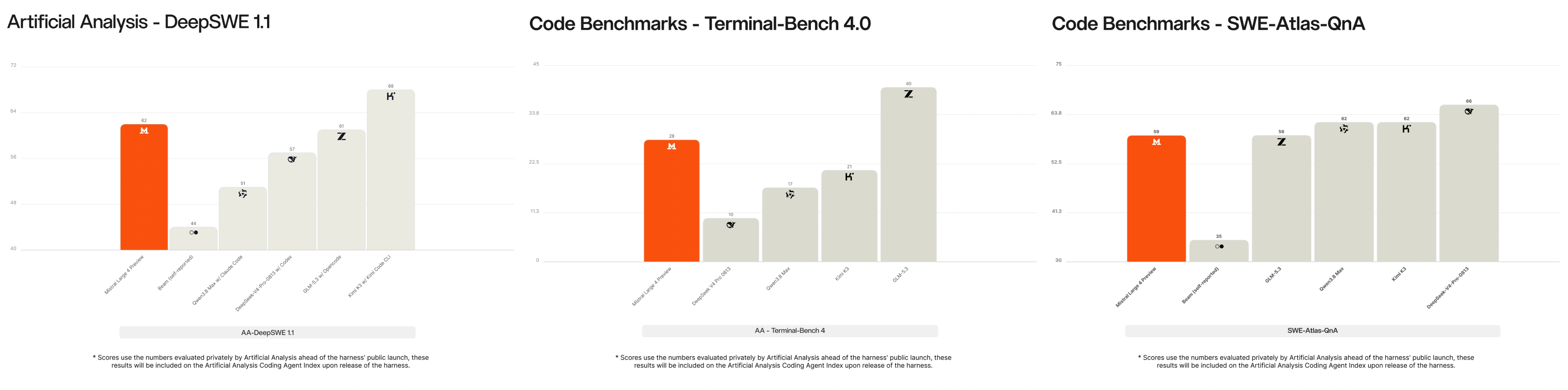
Mistral particularly emphasizes its competitiveness against open-weight models developed by Chinese companies. Le Chonk scored 61.7% in DeepSWE v1.1, which assesses software development capabilities, and 59.4% in SWE-Atlas-QnA, which assesses understanding the contents of a software repository and answering questions. It also scored 28.3% in Terminal-Bench 4, which assesses performing complex tasks by manipulating a terminal. Combining these, the Coding Agent Index was 49.8%, which Mistral explains surpasses DeepSeek V4 Pro 0813 and Qwen3.8 Max.
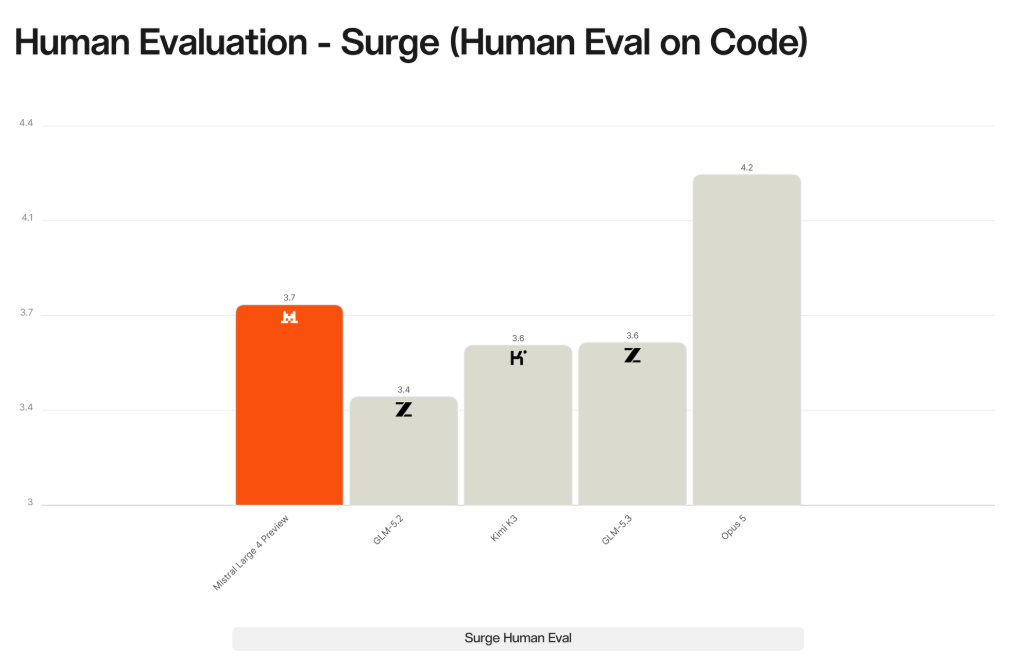
In collaboration with Surge AI, Mistral also conducted a test in which professional evaluators scored the generated code on a 5-point scale without revealing the model names. The Mistral Large 4 scored 3.74 points, falling short of the Claude Opus 5's 4.22 points, but surpassing the GLM-5.3's 3.60 points, the Kimi K3's 3.59 points, and the GLM-5.2's 3.40 points, placing it second among the five models compared.
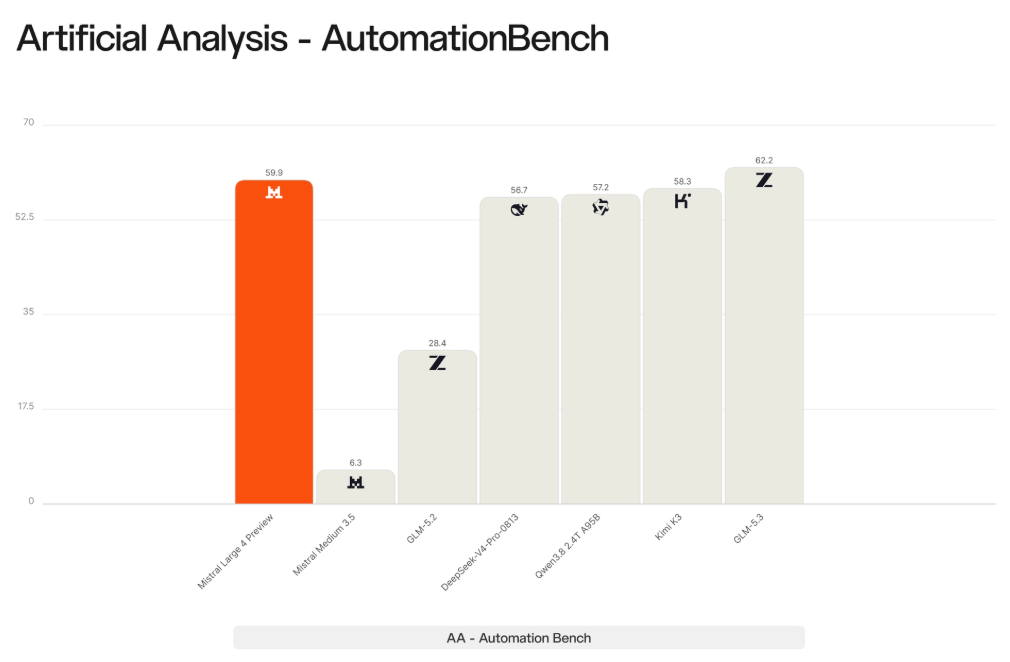
Its performance as an 'AI agent' that works for extended periods using tools has also been enhanced. In AutomationBench, which evaluates 657 types of business workflows using Gmail, Google Sheets, Slack, Salesforce, etc., it scored 59.9%, surpassing Kimi K3, MiMo-V2.6-Pro, and DeepSeek V4 Pro. In AA-Briefcase, which evaluates long-term knowledge work such as creating spreadsheets, slides, and PDFs, it scored 1393 Elo, also surpassing DeepSeek V4 Pro.
Cybersecurity is also one of our focus areas. In the Artificial Analysis Cyber Index, which examines whether AI can detect and fix vulnerabilities in real-world software, our model ranked among the top 5 in the world. This is said to have significantly outperformed openweight models developed outside of China.
In the evaluation, which included tests that reproduced and fixed real-world vulnerabilities in open-source software, the model achieved an 82% success rate. According to Mistral, this was the best performance among the models evaluated. In addition, in Cybench, which solves 40 problems based on security competitions, the model solved 93% of the problems. Mistral explains that some closed models refuse to reproduce vulnerabilities due to their safety features, resulting in scores of nearly 0% in the same tests.
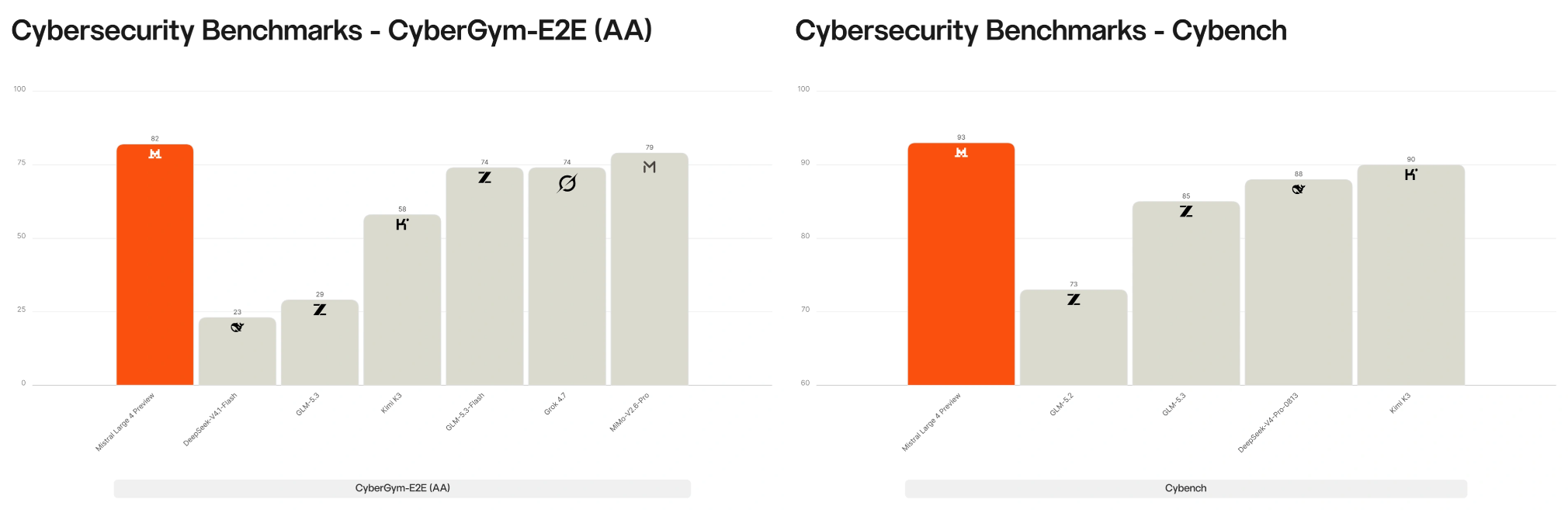
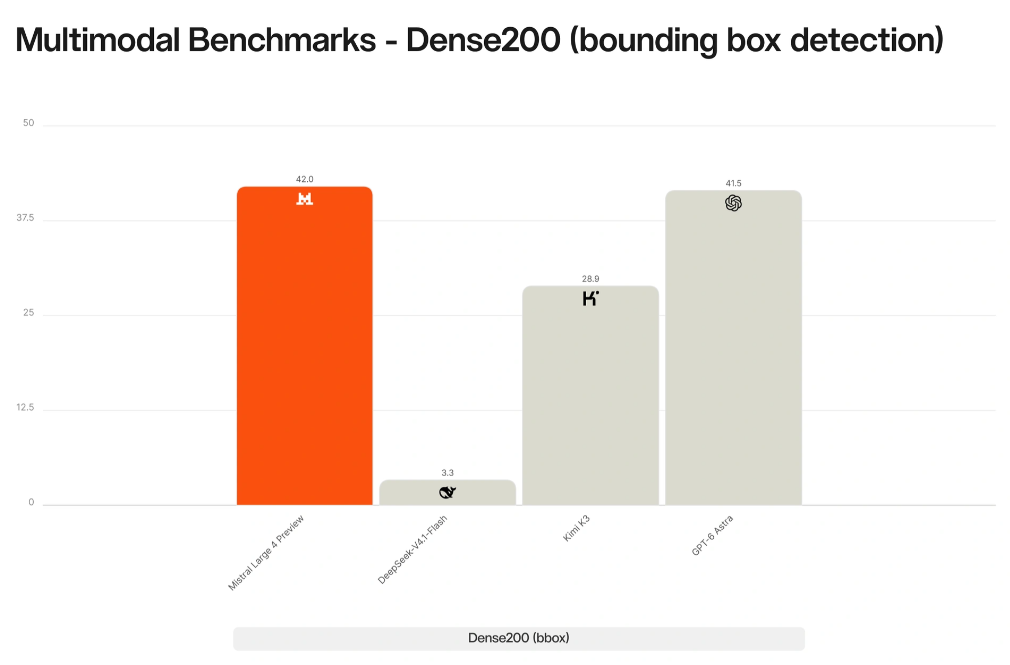
Image understanding performance has also been significantly improved compared to previous Mistral models. In addition to general photographs, it can analyze documents, graphs, engineering drawings, and large satellite imagery. It also supports 'visual grounding,' which finds specific objects or regions within an image. In Dense 200, which identifies objects in high-density images, it achieved a 42% accuracy rate, slightly surpassing the 41.5% achieved by GPT-6 Astra in the Mistral evaluation.
In the scientific field, Mistral has achieved top-level performance as an open-weight model in SciCode-Verified, which measures the ability to implement complex scientific calculations in fields such as physics, mathematics, materials science, and biology as code. It also supports physical simulations and data analysis. An example has been shown in which it generates a Hartree-Fock simulation in quantum chemistry, which requires multiple advanced computational steps, with a single instruction.
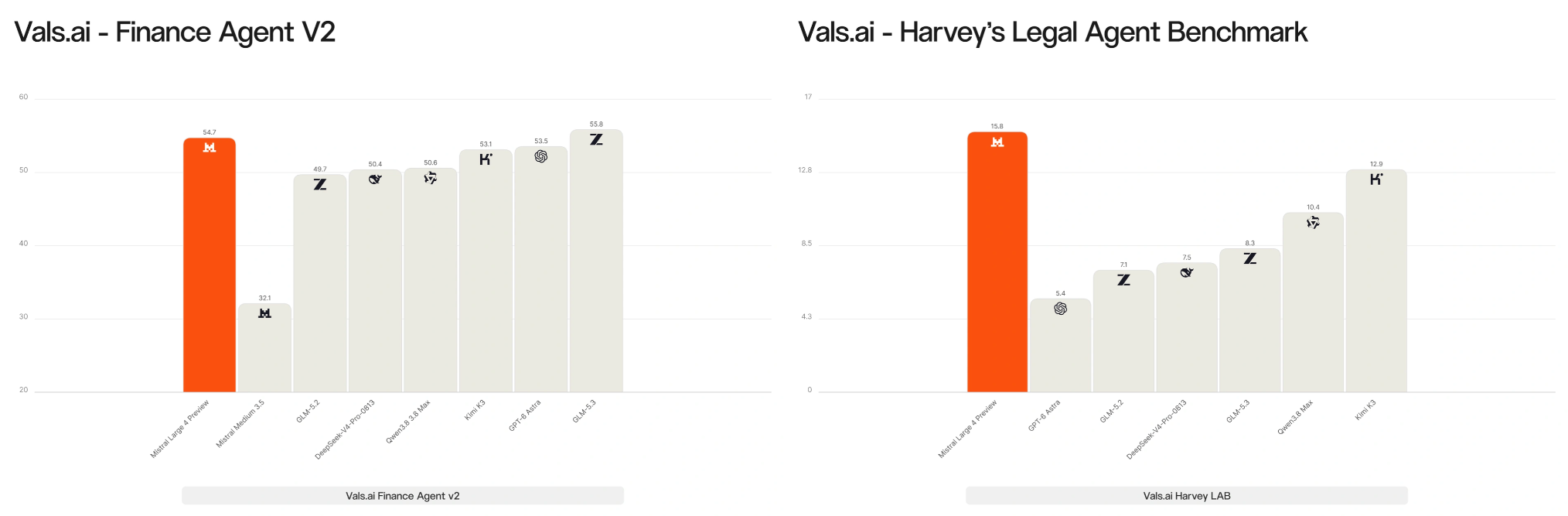
High performance has also been reported in financial and legal benchmarks. According to Mistral, it outperformed GPT-6 Astra in financial and legal evaluations by third-party evaluation firm vals.ai. It also outperformed the open model used as a comparison in Harvey AI's Legal Agent Benchmark. It also showed high performance in FinWorkBench, which tests spreadsheet creation and editing capabilities simulating actual financial and accounting operations.
The model's security has also been evaluated. In Lakera's B3 AI Security Benchmark, which tests resistance to 'indirect prompt injection,' a malicious command embedded in external documents that hijacks the AI's operation, it withstood 93.3% of attacks. In the KORA Benchmark, which evaluates security and responsible responses, it scored 1.691 out of a maximum of 2 points.
Mistral Large 4 was trained from scratch using 3,800 NVIDIA Grace Blackwell GPUs at Mistral's own data center in Europe. The Public Preview available at the time of writing also runs on the same infrastructure. Mistral emphasizes 'AI sovereignty,' which means that companies and governments do not rely on specific external AI providers. A key feature of Mistral is that it handles everything from training to delivery on its own infrastructure, and that it can be operated in private clouds or on-premises in the future.
As of the time of writing, Mistral Large 4 is available as a Public Preview via API. However, the model weights are not yet publicly available. Mistral plans to release the weights by the end of October 2026. Until then, they will be conducting red teaming in real-world environments with cybersecurity companies, vetted partners, and government agencies to verify its security.
According to Mistral, reinforcement learning of the models provided in Public Preview is still ongoing as of the time of writing, and performance has not yet saturated. When the weights are released, they plan to also release architectural details, additional benchmarks, and post-training tuning methods, and will use them as a foundation for specialized and optimized models to be developed in the future.
Related Posts: