A technology has been developed that uses smartphones, lights, and AI to detect hidden cameras.
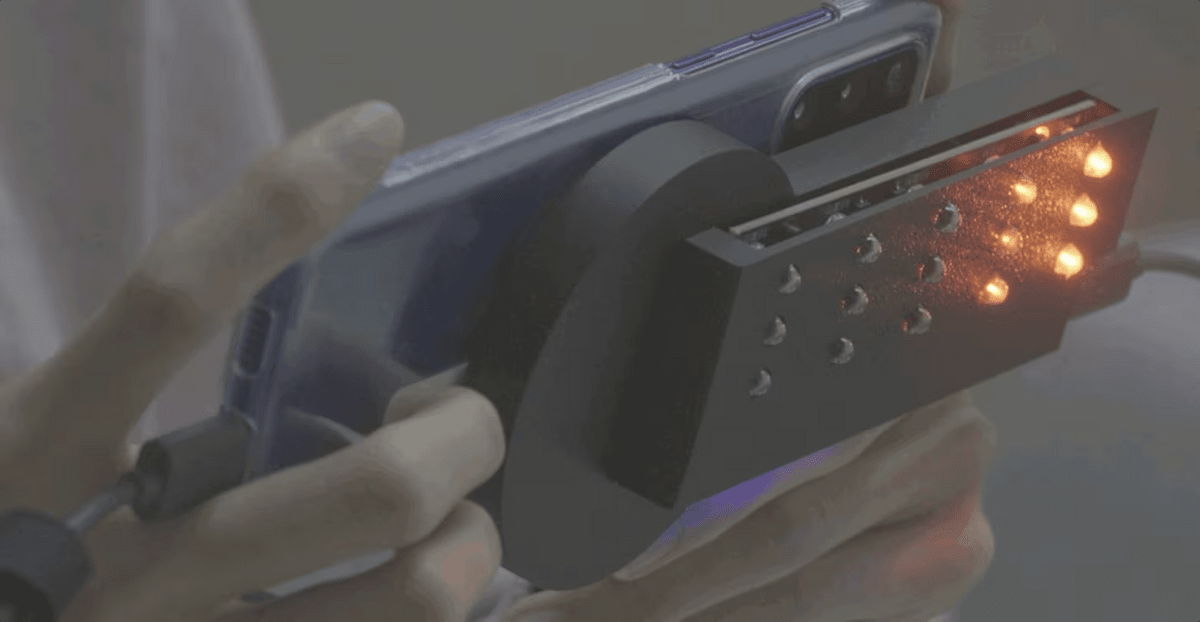
Researchers in South Korea have developed a hidden camera detection technology using smartphones and LED lights. By attaching an inexpensive LED light to a smartphone, the system uses light reflection to locate the camera.
Poster: Detecting Hidden Cameras using LED Illumination Sweeps | Proceedings of the 24th Annual International Conference on Mobile Systems, Applications and Services Companion
I'm in love with you
Smartphone LED and AI Detect Hidden Cameras
https://www.chosun.com/english/industry-en/2026/08/30/SBFXUIJQYZEARKP5T4FBAY25HQ/
'SweepLED,' a camera detection technology developed by researchers at the Korea Advanced Institute of Science and Technology (KAIST), can detect illegal hidden cameras installed in hotels, restrooms, and other locations simply by attaching an LED light costing around 10,000 won (approximately 1,200 yen) to a smartphone. The technology works by illuminating the surrounding area with the light, capturing the light reflected from the hidden camera's lens with the smartphone's camera, and then analyzing it with AI to detect the camera.
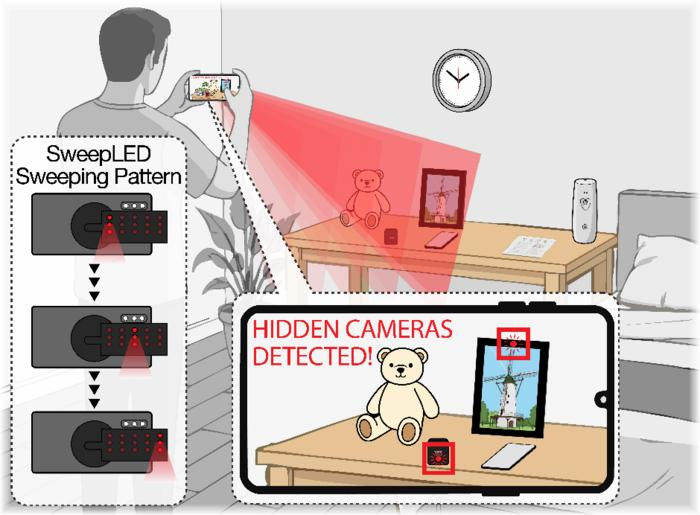
Conventional detection systems also use lights, but they require humans to visually confirm the reflected light, and this method often leads to misidentification of reflections from metal or glass as camera footage, resulting in accuracy problems.
According to researchers at KAIST, cameras are composed of multiple lenses, diaphragms, and image sensors, so they exhibit unique reflection patterns when illuminated from different angles. On the other hand, light moves or disappears depending on the direction of illumination on metals and glass, so cameras can be detected by distinguishing between these differences in patterns.
KAIST has entrusted this decision-making to AI. In experiments targeting 30 types of objects commonly found in living spaces, such as chargers, alarm clocks, remote controls, and decorative items, it achieved a detection accuracy of 94%. It started by analyzing the position and shape of reflections that change over time using deep learning to determine whether they originate from a camera lens, and eventually refined the system to be able to inspect one object in less than 5 seconds.

Professor Han Jun of KAIST stated, 'Illegal hidden cameras threaten individual safety and privacy. By combining low-cost hardware and AI, we have demonstrated the potential of detection technology that can be easily used even by non-experts.'
Related Posts: