Research shows that people who work entirely remotely are happier than those who commute to the office.

The COVID-19 pandemic led to the widespread adoption of remote work, but some companies are returning to office work due to concerns about employee isolation and decreased connection with the workplace. A research team led by Stephanie Johnson of the University of Colorado Boulder analyzed responses from 7,704 employees of a large American healthcare institution and found that employees working entirely remotely reported the highest levels of happiness.
Frontiers | Rethinking return-to-office: the positive impact of remote work on well-being, connection, and employee retention
Remote workers report the highest well-being in study of 7,700 employees | CU Boulder Today | University of Colorado Boulder
https://www.colorado.edu/today/2026/08/12/remote-workers-report-highest-well-being-study-7700-employees
The research team analyzed responses to an employee survey conducted in 2023 by a large healthcare institution in the southwestern United States. The team focused their analysis on 7,704 employees who also provided free-response comments about their workplace atmosphere. Of these 7,704, 1,869 worked entirely remotely with no days in the office; 2,099 worked a hybrid work model, typically coming into the office 2-3 days a week; and 3,736 worked in the office every day. The classification of work styles used was based on the categories registered in the healthcare institution's human resources system, derived from each employee's work schedule.
In a survey of healthcare workers, participants were asked to rate on a scale of 1 to 5 how much they agreed with four statements: 'My workplace cares about my health and well-being,' 'I feel energized by my work,' 'I receive support from my supervisor regarding my health and well-being,' and 'I am able to balance work and life.' The research team used the average of these four items as the happiness score and compared it across different employment types.
When the happiness score, calculated on a 5-point scale for each employee, was averaged across different work arrangements, the highest score was 4.22 for fully remote work, followed by 4.12 for hybrid work and 3.89 for fully office-based work. Fully remote work scored 0.10 points higher than hybrid work and 0.33 points higher than fully office-based work, while hybrid work also scored 0.23 points higher than fully office-based work. When the research team examined the variability in individual employee scores and the number of employees in each work arrangement, they found differences in all three comparisons that could not be explained solely by random variation.
The questionnaire also included a free-response section where employees were asked to describe the workplace atmosphere in 3 to 5 words. The research team reviewed the words employees provided and created a list of words that indicate a sense of unity and mutual support in the workplace, such as 'teamwork,' 'sense of unity,' and 'support.' They then checked whether each response included one or more of these words. The results showed that the percentage of responses that included one or more words indicating a sense of unity and mutual support was 61% for fully remote work, 58% for hybrid work, and 55% for fully in-office work. However, when considering the differences in the number of people in each work style, there was no statistically significant difference. In other words, while the numbers alone might suggest that fully remote work indicates a stronger connection with the workplace, this difference of only a few percent does not mean that the connection with the workplace differs depending on the work style.

Furthermore, the research team compared the questionnaire responses with the employment and resignation records of healthcare institutions held one year prior. The results showed that the percentage of employees who resigned within one year was 7.8% for those working fully remotely, 8.3% for those working hybridly, and 8.8% for those working fully in the office. However, the differences were not significant enough to suggest that resignation rates differed significantly based on work style. On the other hand, regardless of work style, employees with higher levels of happiness tended to be less likely to resign within one year.
Johnson initially predicted that hybrid work would lead to the highest level of happiness because it allows for flexible work from home while also enabling face-to-face interaction. Therefore, he was surprised to find that fully remote work resulted in the highest level of happiness. While this study did not investigate the reasons for this, Johnson suggests that 'it may be because people can more easily decide their own work environment and daily schedule, and they no longer need to commute, making it easier to care for children and pets.'
However, this study only targeted one large medical institution, and there is a bias in that fully remote work was more common in administrative and analytical positions, while full-time on-site work was more common in clinical and field positions. Also, the connection to the workplace was judged based on whether words such as 'teamwork' were included in the free-response answers, so it does not reveal the depth or quality of interpersonal relationships.
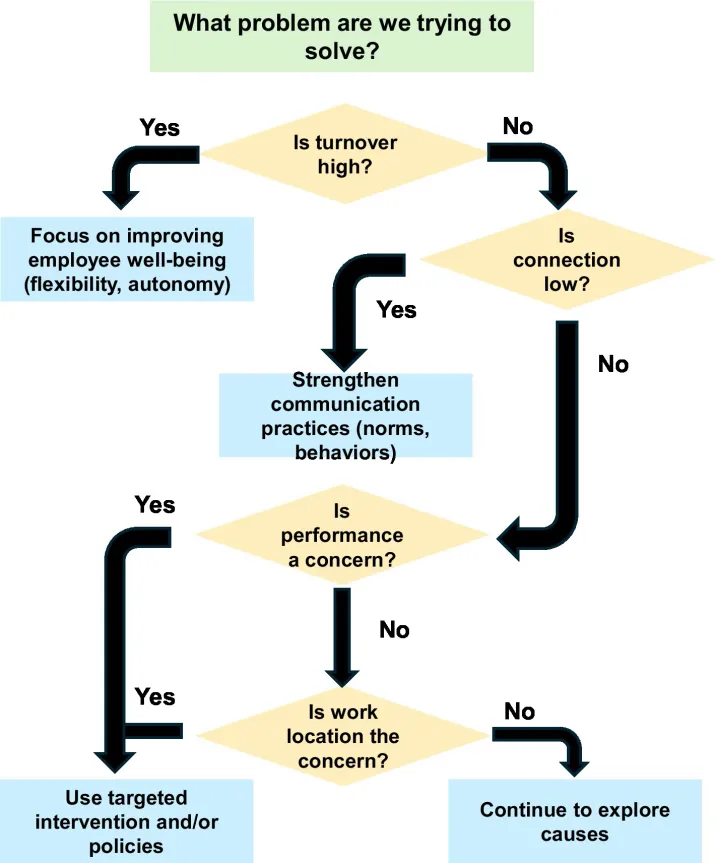
The research team also outlines decision-making procedures for companies to clarify the problems they want to solve before deciding on work policies. If employee turnover is high, they suggest increasing flexibility and autonomy to improve employee well-being; if employees have weak connections with the workplace, they suggest reviewing communication rules and behaviors. If the problem lies with performance or the workplace itself, they suggest using targeted measures and policies; and if none of the above apply, they suggest looking for other causes.
Johnson stated that companies should focus on initiatives that increase employee well-being rather than solely on where employees work, and concluded by saying, 'I believe flexible working arrangements will become established.'
Related Posts:








in Science, Posted by log1b_ok